
A lantern-lighting festival celebrating Buddha’s Birthday, where thousands of paper lanterns—glowing symbols of light, hope, and unity—illuminate Korean streets and temples across the lunar calendar’s fourth month.
In UNESCO’s words
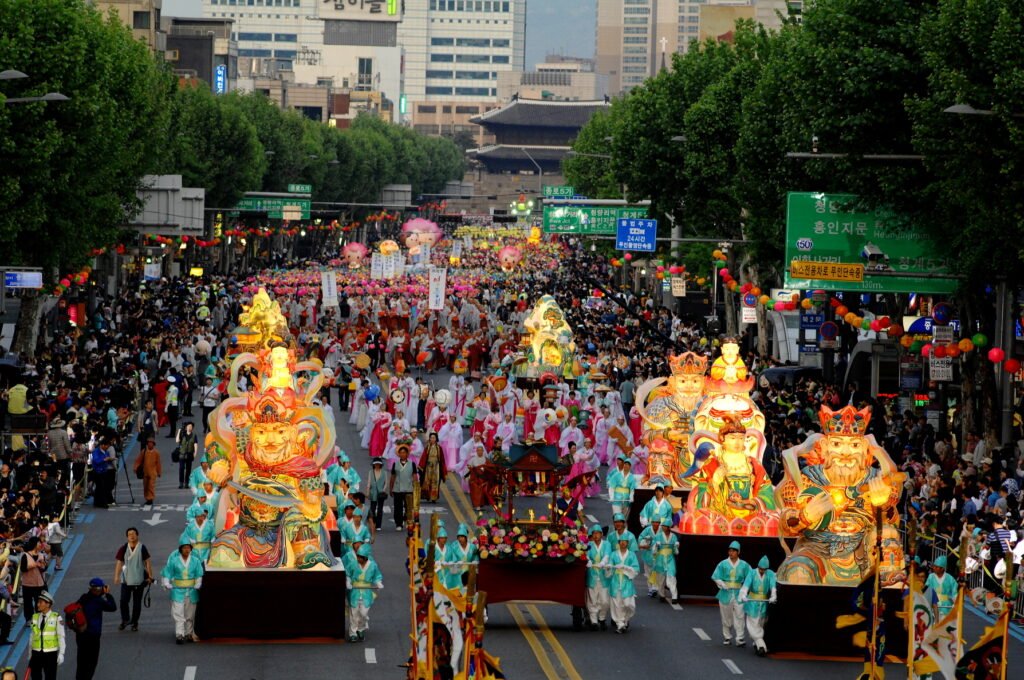
Yeondeunghoe, lantern lighting festival, takes place throughout the Republic of Korea. As the eighth day of the fourth lunar month (Buddha’s birthday) approaches, the entire country lights up with colourful lanterns. Originally a religious ritual to celebrate Shakyamuni’s birth, Yeondeunghoe has now become a national spring festival open to all. Streets are hung with colourful lotus lanterns and crowds holding handmade lanterns gather for a celebratory parade. The annual festival starts with bathing an image of the baby Buddha as a ritual celebrating Shakyamuni’s birth. This is followed by a public procession of lantern-bearing participants, after which participants gather for recreational events culminating in collective games. Members of the public can participate by carrying lanterns they have made to express good wishes for themselves, their families and neighbourhoods and the entire country. Lighting the lanterns also symbolises enlightening the minds of individuals, communities and all of society through Buddha’s wisdom. The related knowledge and skills are mainly transmitted through Buddhist temples and communities, and the Yeondeunghoe Safeguarding Association plays a notable role through the organisation of educational programmes. The festival is a time of joy during which social boundaries are temporarily erased. In times of social difficulties, it plays a particularly important role in integrating society and helping people overcome the troubles of the day.
Official description, UNESCO Intangible Cultural Heritage List — Yeondeunghoe, lantern lighting festival in the Republic of Korea
At a glance
Yeondeunghoe is a national spring festival that takes place throughout the Republic of Korea on the eighth day of the fourth lunar month, Buddha's birthday. The entire country lights up with colourful lanterns as crowds gather to celebrate. Originally a religious ritual honouring Shakyamuni's birth, it has become a festival open to all people, whether or not they follow Buddhism.
Origins & history
Yeondeunghoe began as a religious ritual to celebrate Shakyamuni's birth. Over time, it evolved from a practice rooted in Buddhist tradition into a national spring festival that welcomes participation from across society, while retaining its connection to Buddha's birthday and Buddhist spiritual meaning.
The practice
The festival opens with a ritual bathing of an image of the baby Buddha. Participants create handmade lanterns, often lotus-shaped, and carry them in a public procession through streets. After the parade, people gather for recreational events and collective games. The practice is transmitted mainly through Buddhist temples and communities, with educational programmes organised by the Yeondeunghoe Safeguarding Association.
Cultural significance
Participants light lanterns to express good wishes for themselves, their families, neighbourhoods and country. The lit lanterns symbolise enlightening minds through Buddha's wisdom. The festival temporarily erases social boundaries and brings people together in joy. During times of social difficulty, it plays a crucial role in integrating society and helping communities overcome hardship.
Key facts
- Country: Republic of Korea
- Inscribed: 2020
- UNESCO list: Representative List of the Intangible Cultural Heritage of Humanity
- UNESCO reference: 00882
- UNESCO vocabulary: Buddhism; Festivals; Lantern
- Map: not shown — UNESCO’s official description of this element names no locality, and a living tradition is practised across a community, not at one address.
- Related World Heritage site: Haeinsa Temple Janggyeong Panjeon, the Depositories for the <I>Tripitaka Koreana</I> Woodblocks, Sansa, Buddhist Mountain Monasteries in Korea (a different UNESCO designation, not the place of the tradition)
Where to experience it
Yeondeunghoe illuminates the entire Republic of Korea as the eighth day of the fourth lunar month approaches. Throughout the country, Buddhist temples and communities organize the festival's central rituals, including the bathing of the baby Buddha image and public lantern processions. Streets fill with colourful lotus lanterns and crowds carrying handmade lanterns in celebratory parades. Visitors can participate by joining processions, making their own lanterns to express wishes for themselves and their communities, and taking part in recreational games and collective celebrations that follow the main events.
Sources & resources
- UNESCO — official element page: Yeondeunghoe, lantern lighting festival in the Republic of Korea
- UNESCO — open data record: Intangible Heritage List, reference 00882
- UNESCO — official video: UNESCO film on this element — embedded on this page
- UNESCO — official photograph: Post parade celebration with all participants in Yeongeunghoe — Cultural Heritage Administration and Yeondeunghoe Safeguarding Association, Republic of Korea, 2018
- Reference — Wikipedia (secondary): Yeondeunghoe — consulted as a secondary reference, not as confirmation
- Cultural Heritage Online: Our archive and city guides

Sources
- S1 — Buswell, Robert E. The Zen Monastic Experience. Princeton University Press, 1992. ISBN 978-0-691-03477-5.
- S2 — Lancaster, Lewis R., and Chai-Shin Yu, eds. Buddhism in the Inception of Chosen. Asian Humanities Press, 1996. ISBN 978-0-89581-890-4.
Spotted an error? Write to editorial@culturalheritageonline.com and we correct it the same day.