
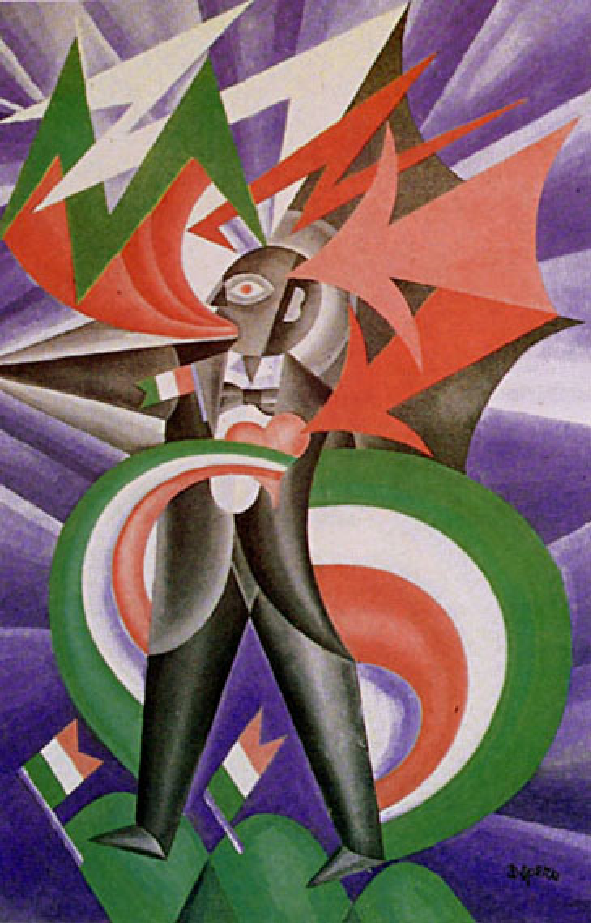
Marinetti temporale patriottico is a 1924 work by Fortunato Depero, an Italian Futurist painter, sculptor, writer, and graphic designer. The piece depicts Filippo Tommaso Marinetti, founder of the Futurism movement, and represents Depero’s engagement with the avant-garde circle that shaped early twentieth-century Italian art.
Depero’s career crystallized around his commitment to Futurist principles. In 1915, working alongside fellow Futurist Giacomo Balla, he co-authored the manifesto Ricostruzione futurista dell’universo (Futurist Reconstruction of the Universe), which sought to find abstract equivalents for all forms and elements of the universe with the goal of making it “more joyful” through integral recreation. By the 1920s, when this work was created, Depero had become a multidisciplinary practitioner, extending Futurist concepts across painting, design, and theatre.
About Fortunato Depero
Born in 1892 in the Trentino region (then part of the Austro-Hungarian Empire), Depero discovered Futurism through an article by Marinetti published in the journal Lacerba in 1913. He moved to Rome in 1914 to pursue the movement’s radical vision, and remained a central figure in Futurist circles throughout the interwar period until his death in 1960.
Details
- Creator: Fortunato Depero
- Year: 1924
- Movement: Futurism
- Subject: Filippo Tommaso Marinetti
On video
Frequently asked questions
Who created this work?
Fortunato Depero, an Italian Futurist painter, sculptor, writer, and graphic designer born in 1892, created this 1924 work.
What is the connection between Depero and Marinetti?
Depero discovered Futurism through an article by Marinetti in 1913 and moved to Rome the following year to engage with the Futurist circle. In 1915, Depero co-authored the manifesto Ricostruzione futurista dell’universo with fellow Futurist Giacomo Balla, expanding upon ideas introduced by Marinetti and other Futurists.
What was Depero’s role in the Futurist movement?
Beyond painting, Depero applied Futurist principles across multiple disciplines including sculpture, graphic design, and theatre. He was instrumental in translating Futurism’s abstract concepts into visual and spatial forms throughout his career.


