
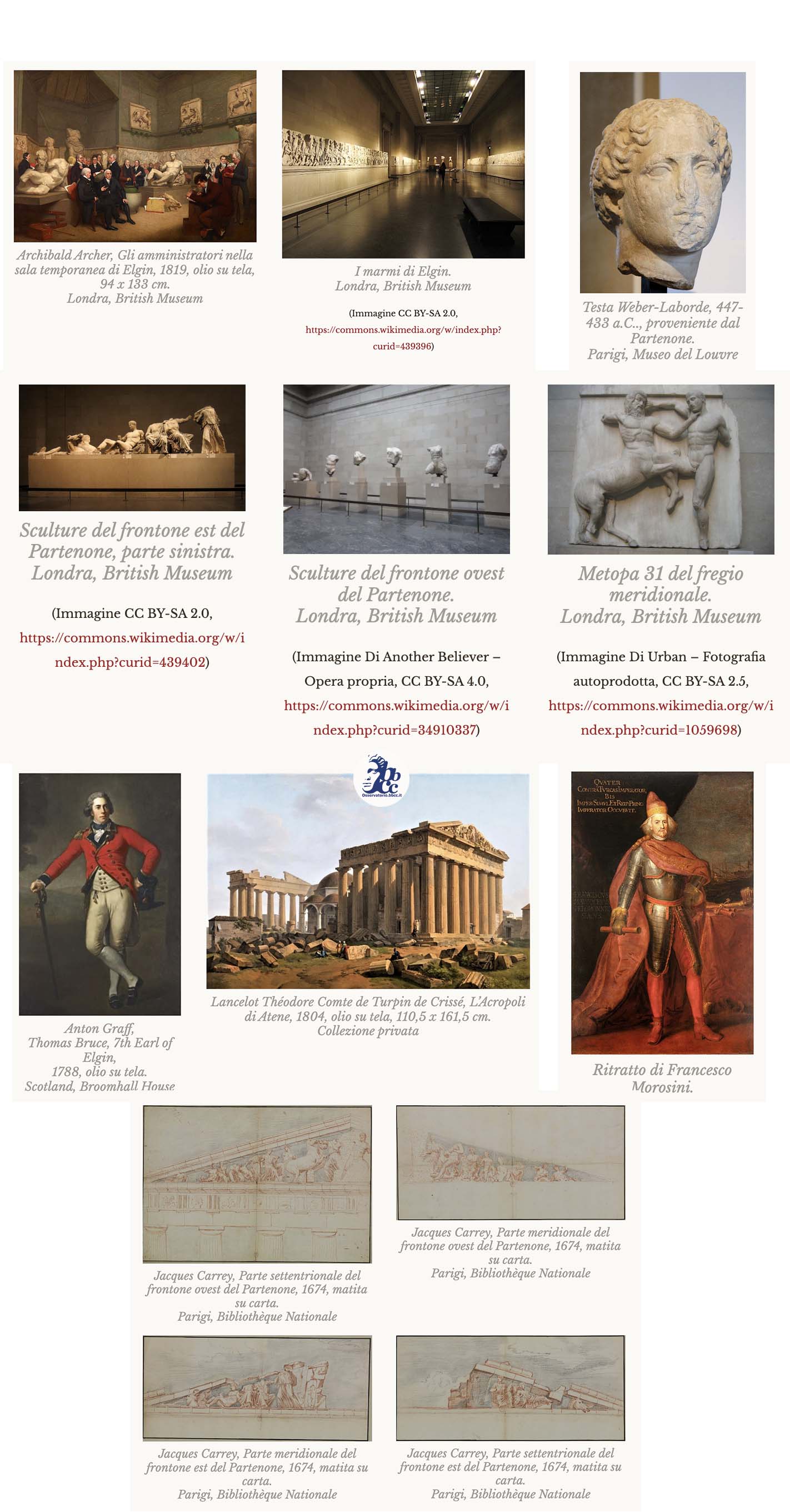
Presented in February 2024, this article examines the removal of the Parthenon marbles from Athens by Thomas Bruce, VII Earl of Elgin, and the historical events that preceded and followed this contested acquisition.
Centuries of damage and transformation
The Parthenon underwent numerous transformations across the centuries before Elgin’s arrival. Damaged by the Heruli in 276, the structure was closed to worship in 435 following an edict by Theodosios II. During the sixth century, it was converted into a Christian church. After the Ottoman conquest of Greece in 1456, it became a mosque. The most significant damage before Elgin came during the Venetian War of Morea (1684–1699) between the Venetian Republic and the Ottomans. In 1687, Venetian forces bombarded the Parthenon, causing severe structural damage when Turkish ammunition stores inside the building exploded. Francesco Morosini, head of the Venetian expedition, attempted to remove important sculptures, but transportation caused irreparable harm to works such as the Weber-Laborde Head, now in the Louvre. Drawings made by painter Jacques Carrey in 1674 provide the only visual record of the west pediment’s appearance before the Venetian bombardment.
Elgin’s acquisition and removal
Between 1798 and 1803, Thomas Bruce served as British ambassador to the Ottoman Empire. He obtained a firmman (decree) from the Sultan permitting him to reproduce and remove sculptures from the Acropolis. Starting in 1801, Elgin began systematic removal of marbles from the Parthenon and the Erechtheion, causing structural damage in the process. He engaged Antonio Canova, an Italian artist renowned for restoration work, to repair sculptures that had been decapitated and damaged during transport. Canova refused the commission. In 1816, Elgin sold his collection to the British Museum, where the marbles went on display in 1832 and became known as the Elgin Marbles.
The dispute over return
Over the past thirty years, a movement has emerged calling for the marbles to be returned to Greece. The British Museum has maintained that the acquisition was legal and that the sculptures now serve a complementary educational role within the British museum context. Greece has consistently argued for the legitimacy of repatriation, emphasizing the importance of preserving and returning cultural heritage to its place of origin.
On video
On the heritage map: Parthenon
Frequently asked questions
Why was the Parthenon damaged before Lord Elgin arrived?
During the Venetian War of Morea in 1687, Venetian forces bombarded the Parthenon under Francesco Morosini’s command. Turkish ammunition stored inside the building exploded, causing severe structural damage to the central portion of the edifice.
What is the significance of Jacques Carrey’s 1674 drawings?
Carrey’s drawings of the west pediment provide the only visual documentation of the Parthenon’s sculptures before the 1687 Venetian bombardment, making them invaluable for understanding the original appearance of the marbles.
How did the marbles enter the British Museum?
Lord Elgin removed the sculptures beginning in 1801 and sold his entire collection to the British Museum in 1816, where the marbles were first displayed in 1832.
Sources
- S1 — Hitchens, Christopher. The Parthenon Marbles: The Case for Reunification. Verso, 2008. ISBN 978-1-84467-252-3.
- S2 — Miles, Margaret M. Art as Plunder: The Ancient Origins of Debate about Cultural Property. Cambridge University Press, 2008. ISBN 978-0-521-88459-4.
Spotted an error? Write to editorial@culturalheritageonline.com and we correct it the same day.


