
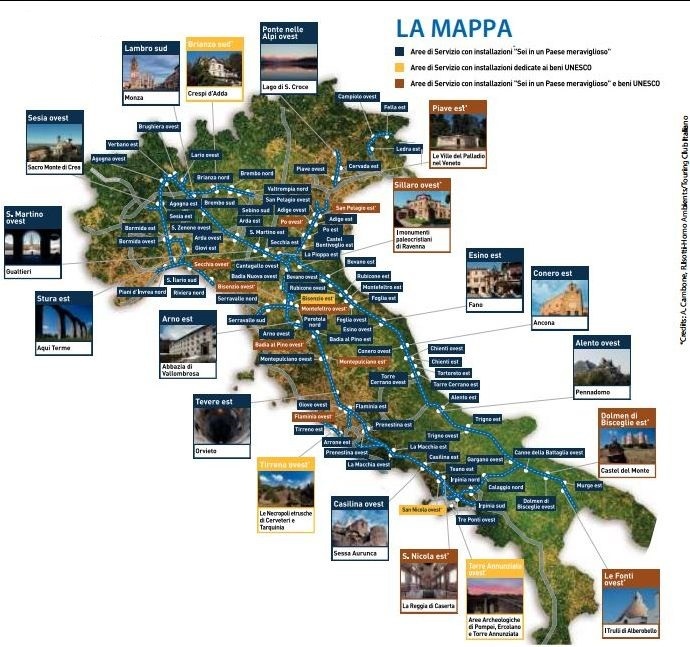
In December 2018, Autostrade per l’Italia launched a major initiative to promote Italy’s extraordinary cultural patrimony through a nationwide highway-based campaign. The project, called Sei in un Paese meraviglioso (You Are in a Wonderful Country), was designed to connect motorway travellers with the country’s unparalleled artistic and cultural treasures. Italy holds 53 UNESCO World Heritage Sites, along with over 3,400 museums and 2,000 archaeological parks and areas—the most significant cultural heritage collection in the world.
The initiative addressed a paradox: while foreign visitors frequently seek out these Italian landmarks, domestic travellers often overlook them. The project aimed to reveal the dispersed cultural riches across the country that remain underexplored by Italians themselves.
The Highway Service Area Network
At the heart of the campaign were 100 motorway service areas equipped with specially framed displays describing nearby cultural and natural attractions. The itineraries were developed with scientific contributions from Touring Club Italiano and Slow Food, offering visitors flexible exploration options: three-hour, half-day, one-day, and two-day experiences tailored to available time and interests.
The project identified 18 UNESCO destinations accessible from the Italian motorway network, with plans to expand to 40 sites. These included the Padua Botanical Garden, the archaeological areas of Herculaneum and Pompeii, Crespi d’Adda, and the Etruscan Necropolises of Tarquinia and Cerveteri. The motorway system was positioned as the nation’s vital connective infrastructure for cultural promotion.
Integrated Promotion Strategy
The campaign operated across multiple channels: 300 original travel experiences, 1,000 promoted locations, and a reach of seven million motorists. The system integrated motorway signage with a mobile application, television programming, and the Autostrade website. Franco Bernabé, president of UNESCO Italia, emphasized the approach of systemic promotion: transforming cultural sites into anchors for integrated territorial development, generating positive economic impact on local communities through sustainable and responsible tourism practices.
Francesco Delzio, External Relations and Marketing Director at Autostrade per l’Italia, explained that the initiative presented UNESCO sites not in isolation but as part of broader territorial experiences spanning art, gastronomy, nature, and environment. Motorways, he noted, served as powerful promotional platforms for medium and small territories otherwise marginalised by conventional tourism flows.
International Recognition
The project’s appeal extended beyond Italy’s borders. The Italian Embassy in New Delhi expressed interest in showcasing Italian UNESCO sites to Indian audiences and authorities, reflecting Italy’s status as one of the world’s most sought-after tourist destinations. A photography project documenting these sites was planned for permanent display at the diplomatic compound in Delhi and throughout the Indian capital’s streets, promoting lesser-known territories and pathways alongside Italy’s most celebrated heritage.
Frequently asked questions
How many UNESCO sites does Italy have?
Italy has 53 UNESCO World Heritage Sites, making it home to the world’s most significant cultural heritage collection, along with over 3,400 museums and 2,000 archaeological parks and areas.
What was the initial scope of the motorway service area campaign?
The project initially identified 18 UNESCO destinations accessible from Italian motorways, with plans to expand to 40 sites across 100 service areas.
Which UNESCO sites were highlighted in the project?
Featured sites included the Padua Botanical Garden, Herculaneum and Pompeii, Crespi d’Adda, and the Etruscan Necropolises of Tarquinia and Cerveteri.
Sources
- S1 — Settis, Salvatore. Italia S.p.A.. L'assalto al patrimonio culturale. Einaudi, 2002. ISBN 978-88-06-16973-2.
- S2 — Casarin, Francesco. Il marketing dei musei e delle istituzioni culturali. Il Mulino, 2019. ISBN 978-88-15-28514-0.
Spotted an error? Write to editorial@culturalheritageonline.com and we correct it the same day.


