
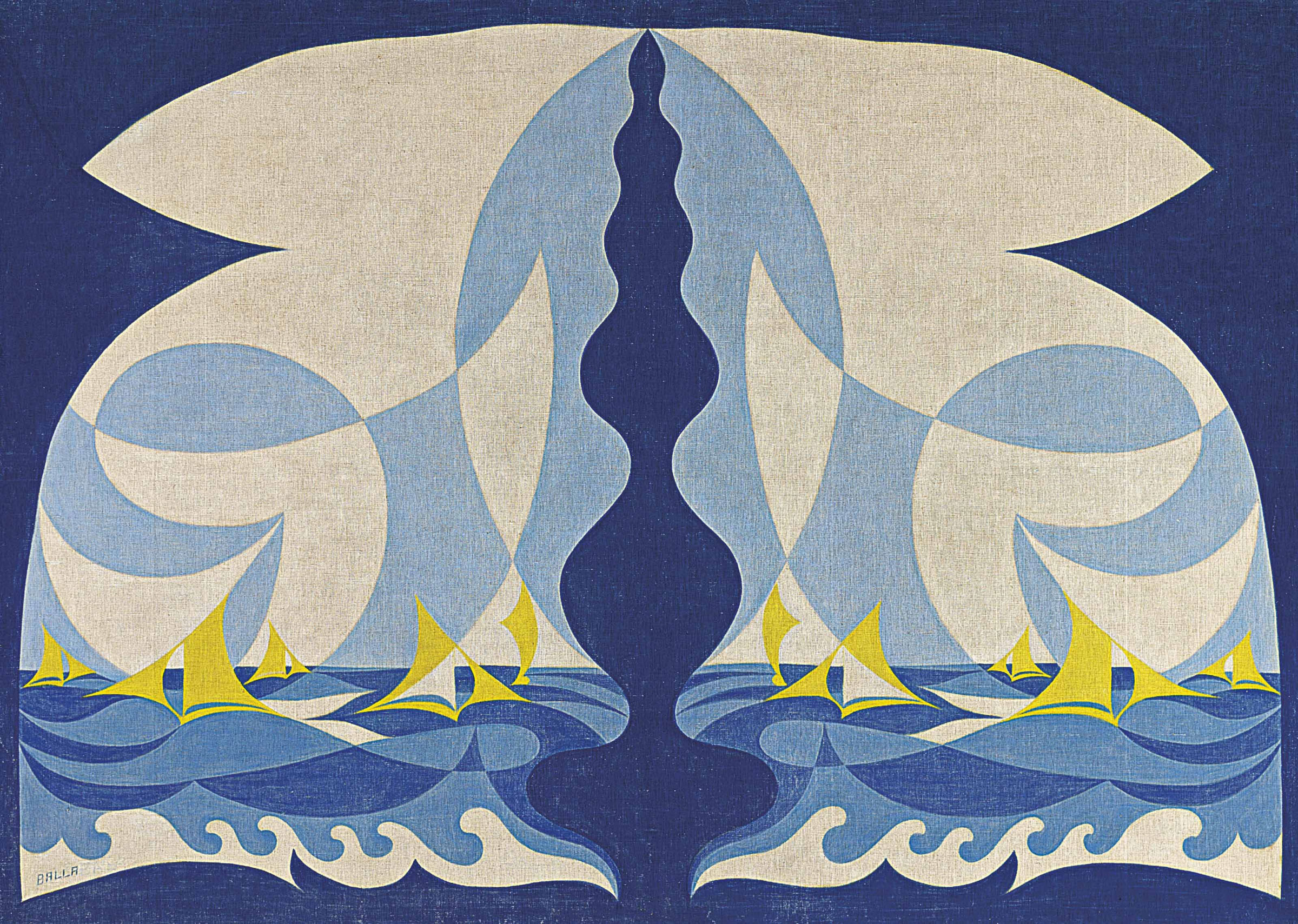
Giacomo Balla’s Linee forza di mare (Lines of Force of the Sea), completed in 1926, is a painting that expresses movement and energy through dynamic linear composition. Balla, a key proponent of Futurism, devoted his practice to depicting light, movement and speed in visual form.
Unlike many of his Futurist contemporaries, Balla did not centre his work on machines or violence. Instead, his paintings tended towards the witty and whimsical, emphasizing the expressive potential of abstracted natural phenomena. Linee forza di mare demonstrates this approach: the title itself—Lines of Force of the Sea—announces the artist’s intention to render invisible forces of nature as visible formal rhythms. The composition translates maritime energy into a system of intersecting lines and planar forms, making the immaterial sensation of movement the work’s primary subject.
About Giacomo Balla
Giacomo Balla was an Italian painter, art teacher and poet whose career centred on Futurist principles. His distinctive contribution to the movement lay in his focus on light, motion and sensation rather than the industrial or violent themes favoured by other Futurist leaders. This orientation allowed his work to remain playful and inventive, translating natural and perceptual experience into abstracted visual language.
Details
- Artist: Giacomo Balla
- Year: 1926
- Movement: Futurism
- Medium: Painting
On video
Frequently asked questions
Who was Giacomo Balla?
Giacomo Balla was an Italian painter, art teacher and poet known as a key proponent of Futurism. He specialised in depicting light, movement and speed, and distinguished himself from other Futurists by avoiding machines and violence in favour of witty, whimsical expression.
What does the title mean?
Linee forza di mare translates as Lines of Force of the Sea. The title indicates Balla’s interest in visualizing the invisible forces and energy of natural phenomena through abstract linear forms.
What artistic movement does this work belong to?
The painting is a work of Futurism, an early twentieth-century movement concerned with expressing speed, movement and modernity. Balla’s interpretation emphasised light and sensation over the mechanical themes central to other Futurist artists.
Sources
- S1 — Pontiggia, Elena. Il Novecento Italiano. Abscondita, 2003. ISBN 978-88-8416-048-5.
- S2 — Bossaglia, Rossana. Il Novecento italiano. Electa, 1995. ISBN 978-88-435-6178-0.
Spotted an error? Write to editorial@culturalheritageonline.com and we correct it the same day.


