

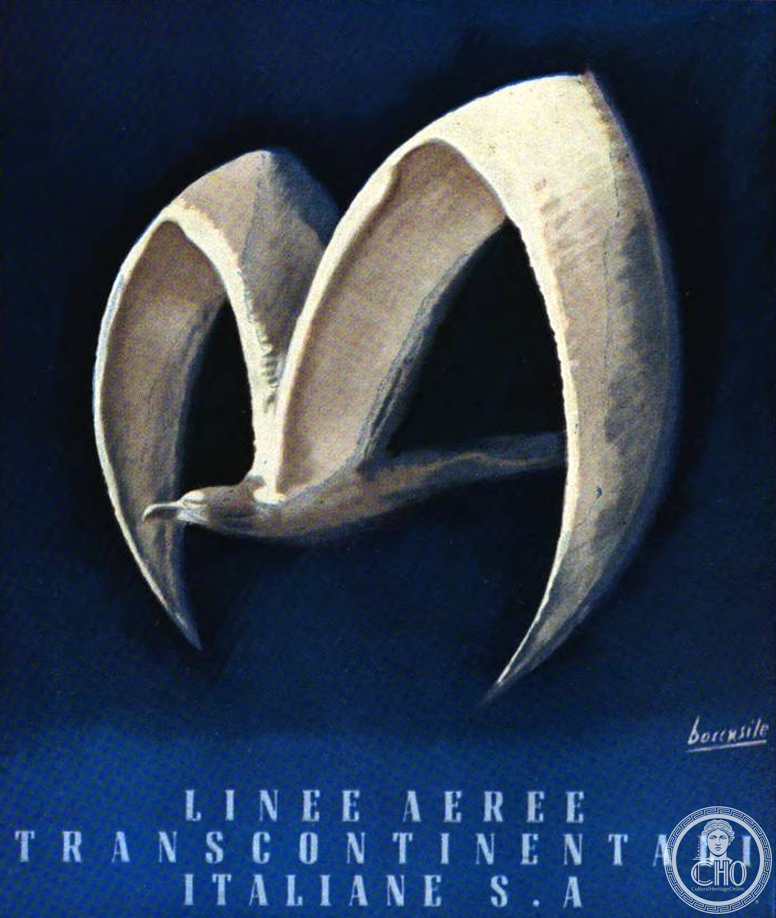
One bird, one colour, one name. After ten sheets of eagles, globes, factory photographs and product lists, this design clears the table: a white seabird against midnight blue, wings thrown up so that bird and lettering become a single emblem, and beneath it three words — Linee Aeree Transcontinentali Italiane.
The bird is painted, not drawn: soft-edged, lit from below, its long wings curling at the tips like the strokes of a signature. It reads at once as an albatross — the ocean-crossing bird — and as a monogram. In the lower right, in white script, an actual signature: Boccasile. Of the thirteen sheets in this group of the collection, it is the only one that names its author, and the name is one of the biggest in Italian advertising art.
The Atlantic airline
L.A.T.I. was the last and most ambitious of the fascist state’s airlines, born from Ala Littoria as an autonomous direction and officially founded on 11 September 1939 — days after the European war began — to fly the South Atlantic mail. Its inaugural flight left on 21 December 1939 on the route Rome–Seville–Lisbon–Villa Cisneros–Ilha do Sal and on across the ocean toward Brazil: a regular air link between Europe and South America begun in the first months of the war. An airline whose whole identity was an ocean crossing could hardly have chosen a better emblem than a seabird that crosses oceans on its own wings.
Boccasile
Gino Boccasile (Bari, 14 July 1901 – Milan, 10 May 1952) was among the most recognisable Italian illustrators of his generation — creator of the «Signorina Grandi Firme» cover girl of the 1930s, a prolific poster artist for products of every kind, and later the author of some of the most notorious propaganda images of the Italian Social Republic, a chapter that made him a controversial figure after the war. This design shows the other, purer side of his craft: an emblem reduced to one gesture. Since Boccasile died in 1952, the seventy-year Italian copyright term on his work ran out at the end of 2022, and the design is now in the public domain; the date of the design itself is not marked on the sheet, which the company’s founding places no earlier than 1939.
About this image. The author of this design, Gino Boccasile, died on 10 May 1952; under Italian law (L. 633/1941) copyright runs for 70 years from the author’s death, so protection of his work expired at the end of 2022 and the design is now in the public domain. The scan was made by the collector from his own copy of the sheet, part of the period material he keeps in a private archive. Cultural Heritage Online publishes this material to document it, with no celebratory intent; see our terms.
Sources
- S1 — Vannucchi, Vanna, and Giuliano Ercoli. Gino Boccasile: La pubblicità e la grafica italiana. Edizioni Polistampa, 1999. ISBN 978-88-8304-122-8.
- S2 — Gentilli, Roberto. Ali d'Italia: Linee Aeree Transcontinentali Italiane LATI. La Bancarella Aeronautica, 2004. ISBN 978-88-88402-18-5.
Spotted an error? Write to the editors and we correct it the same day.
At auction this weekOriginal posters still come up at auction every weekAdvertising, travel and exhibition posters are open for bidding today on Catawiki, where an expert checks each lot before it goes live.See what is open on Catawiki →


Advertisement. Pictured, from the Cleveland Museum of Art (CC0) and not for sale: posters by Toulouse-Lautrec, Grasset and Chéret. How we handle this