
An ancient Korean circle dance performed exclusively by women, combining song, movement, and folk games under the full moon to celebrate harvest and seasonal turning points.
In UNESCO’s words
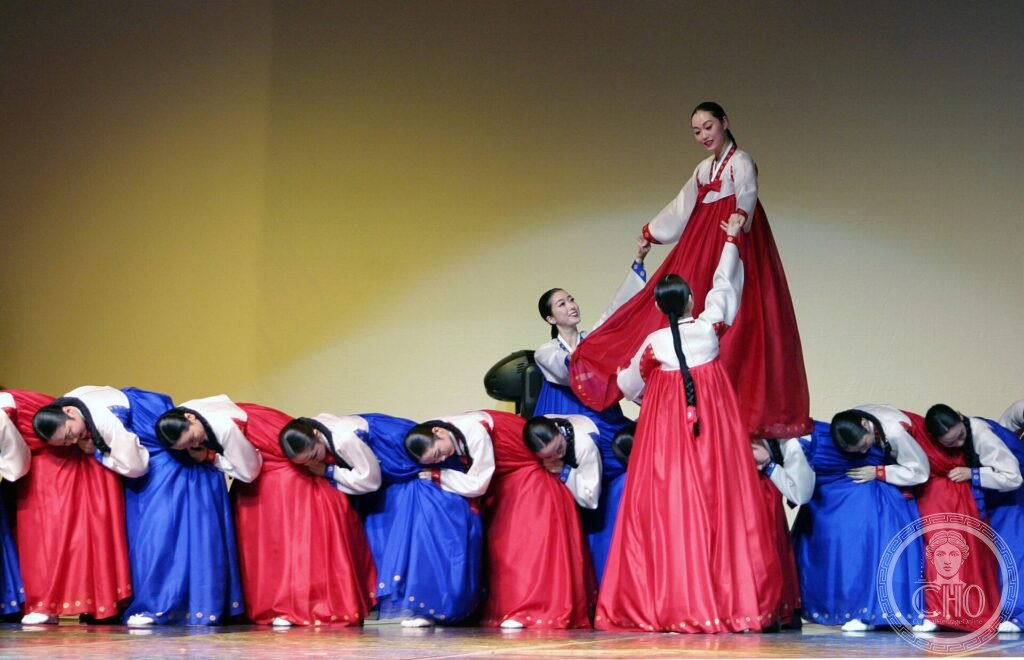
Ganggangsullae is a seasonal harvest and fertility ritual popular in the south-western part of the Republic of Korea, performed primarily on Korea’s Thanksgiving in the eighth lunar month. Under a bright full moon, dozens of young, unmarried village women gather in a circle, join hands and sing and dance all night under the direction of a lead singer. During interludes, the women playfully mime vignettes reflecting life in a farm or fishing village, including treading on roof tiles, unrolling a mat, catching a mouse or tying herrings. The dance takes its name from the refrain repeated after each verse, although the exact meaning of the word is unknown. Once a rare break from restrictive rules governing the behaviour of rural young women who were not allowed to sing aloud or go out at night, except during the ''Chuseok'' Thanksgiving celebration, the ritual is mostly preserved today by middle-aged women in cities and taught as part of the music curriculum of elementary schools. Now practised as a performing art throughout Korea, it can be seen as a representative Korean folk art. It is an important hereditary custom drawn from the rice culture that pervaded daily life in the countryside. The easy tunes and movements can be learned quickly for this communal practice that contributes to harmony, equality and friendship among the women dancers.
Official description, UNESCO Intangible Cultural Heritage List — Ganggangsullae
At a glance
Ganggangsullae is a seasonal harvest and fertility ritual performed by young, unmarried women in circles under the full moon. Participants join hands, sing, and dance through the night while a lead singer directs the group. Between verses, the women act out playful scenes from village life—treading on roof tiles, catching mice, tying herrings—creating a blend of song, dance, and mime that takes its name from a repeated refrain whose exact meaning remains unknown.
Origins & history
The ritual emerged from rice culture in the countryside, where it provided a rare exception to strict rules that prevented young rural women from singing aloud or leaving home at night. Its practice was permitted only during the Chuseok Thanksgiving celebration in the eighth lunar month. Over time, the tradition has shifted from a working community practice to a performed art form, now taught in elementary school music curricula and practiced by middle-aged women in cities throughout Korea.
The practice
The practice gathers dozens of unmarried village women in a circle under a bright full moon. A lead singer directs the group as participants join hands, sing, and dance all night. The easy tunes and simple movements can be learned quickly, making it accessible for communal participation. Between verses, women mime scenes reflecting farm and fishing village life, breaking the continuous dance with brief theatrical interludes before returning to the circle.
Cultural significance
Ganggangsullae represents an important hereditary custom rooted in rice culture and continues to foster harmony, equality, and friendship among women dancers. Once a rare space where young rural women could freely sing and gather, the ritual preserves a women-centered tradition and is now recognized as a representative Korean folk art practiced throughout the nation. It remains a vital expression of collective identity and cultural continuity.
Key facts
- Country: Republic of Korea
- Inscribed: 2009
- UNESCO list: Representative List of the Intangible Cultural Heritage of Humanity
- UNESCO reference: 00188
- UNESCO vocabulary: Fertility ritual; Ritual dance; Seasonal ritual
- Map: not shown — UNESCO’s official description of this element names no locality, and a living tradition is practised across a community, not at one address.
Where to experience it
Ganggangsullae is practised throughout Korea today, performed most prominently during Chuseok, the autumn Thanksgiving celebration in the eighth lunar month. While historically rooted in south-western rural communities, the tradition is now preserved by middle-aged women in cities and taught in elementary school music curricula across the country. Visitors can encounter the dance as a performing art at cultural festivals and community celebrations during Chuseok, when villages and cities gather under the full moon. Local cultural offices and festival programs offer information on current performance schedules and opportunities to witness this representative Korean folk art.
Sources & resources
- UNESCO — official element page: Ganggangsullae
- UNESCO — open data record: Intangible Heritage List, reference 00188
- UNESCO — official video: UNESCO film on this element — embedded on this page
- UNESCO — official photograph: Photograph of this element — Ju Beung-soo — National Research Institute of Cultural Heritage, 2004
- Reference — Wikipedia (secondary): Ganggangsullae — consulted as a secondary reference, not as confirmation
- Cultural Heritage Online: Our archive and city guides

Sources
- S1 — van Zile, Judy. Perspectives on Korean Dance. Wesleyan University Press, 2001. ISBN 978-0-8195-6494-8.
- S2 — Howard, Keith. Preserving Korean Music: Intangible Cultural Properties as Finished Products. Ashgate, 2006. ISBN 978-0-7546-5792-7.
Spotted an error? Write to editorial@culturalheritageonline.com and we correct it the same day.