
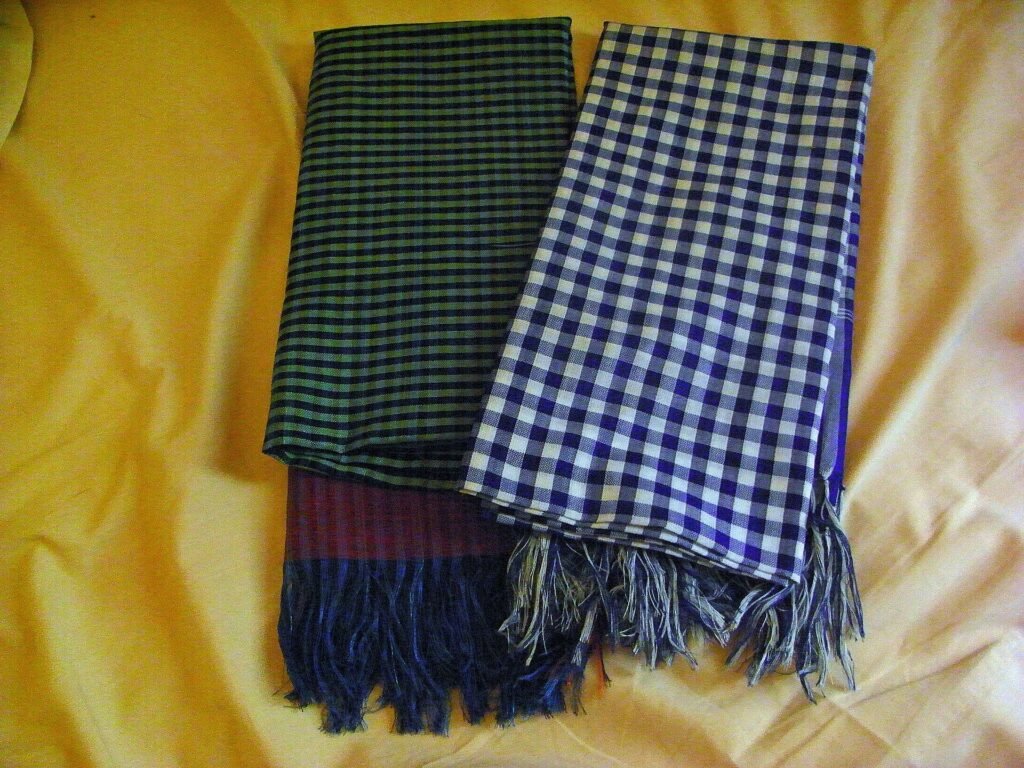
The krama is a sturdy, multipurpose textile woven in traditional patterns that serves as scarf, headwrap, child’s hammock, and symbol of Cambodian identity. Worn by all ages and genders, it embodies centuries of practical craftsmanship and cultural belonging.
In UNESCO’s words
Krama is a woven textile associated with traditional practices and cultural expressions of the daily life in Cambodia. A rectangular cloth made of either cotton or silk, krama features a variety of grid-pattern motifs. The white, yellow, red and blue dyes used are extracted from natural vegetation and insects, and the cloth is woven manually using a traditional handloom. A socio-cultural staple, krama is used daily through all walks of life, as a scarf, belt, blanket, bandana, lower garment, decorative cloth, and hammock for children. It is also used during rituals, ceremonies and festive events, as well as to prepare food and in health care. Although krama is predominantly produced by women, men also participate in the process by planting and harvesting cotton, collecting the materials for the dyes, and maintaining the handlooms. In the past, most women knew how to weave krama and passed the knowledge and skills on to their daughters. Today, professional krama groups and producers are taking over the production role. Educational organizations play an important role in transmitting the related skills and knowledge through training courses and workshops. The krama chain of production is based on a collaborative approach that promotes social cohesion and peacebuilding while contributing to Cambodian social and cultural identity.
Official description, UNESCO Intangible Cultural Heritage List — Cultural practices and expressions linked to Krama, a traditional woven textile in Cambodia
At a glance
Krama is a rectangular cloth woven from cotton or silk that forms a cornerstone of Cambodian daily life. Featuring grid-pattern motifs and dyed in white, yellow, red, and blue using natural plant and insect dyes, the textile serves multiple purposes: worn as a scarf, belt, bandana, or lower garment; used as a blanket, decorative cloth, or child's hammock; and employed in rituals, ceremonies, food preparation, and health care.
Origins & history
Historically, krama weaving was widely practiced knowledge passed from mothers to daughters across Cambodian communities. The tradition connected women through shared skill and cultural practice. In recent times, this pattern has shifted as professional krama groups and producers have begun taking the primary production role, while educational organizations now transmit the weaving skills and knowledge through formal training courses and workshops.
The practice
Weavers create krama manually on traditional handlooms. Although women predominantly produce the cloth, men contribute by planting and harvesting cotton, gathering dye materials, and maintaining the looms. The production process follows a collaborative approach, with natural dyes extracted from vegetation and insects applied to create the finished textile.
Cultural significance
Krama production and use reinforce social cohesion and peacebuilding within Cambodian communities. The cloth's presence across all walks of life—worn and used by people of every social status and age—anchors it to cultural and social identity. The transmission of weaving knowledge and the continuation of this textile tradition help preserve Cambodian heritage for future generations.
Key facts
- Country: Cambodia
- Inscribed: 2024
- UNESCO list: Representative List of the Intangible Cultural Heritage of Humanity
- UNESCO reference: 02115
- UNESCO vocabulary: Traditional tools; Weaving; Women workers
- Map: not shown — UNESCO’s official description of this element names no locality, and a living tradition is practised across a community, not at one address.
Where to experience it
Throughout Cambodia, the krama remains ubiquitous in daily life, worn by people of all ages as a practical garment, ceremonial cloth, and emblem of cultural identity. Visitors can observe the textile in markets where finished kramas are sold, and in workshops where artisans continue traditional weaving practices using handlooms. Educational organizations offer training courses and workshops where the skills of krama production—from cotton harvesting to natural dyeing and weaving—can be witnessed and learned, revealing how this socio-cultural staple connects Cambodian communities through collaborative craftsmanship.
Sources & resources
- UNESCO — official element page: Cultural practices and expressions linked to Krama, a traditional woven textile in Cambodia
- UNESCO — open data record: Intangible Heritage List, reference 02115
- UNESCO — official video: UNESCO film on this element — embedded on this page
- UNESCO — official photograph: The bas-relief of Bayon temple, end of 12th beginning of 13th century, displays a man wearing a Krama on his shoulder — Ministry of Culture and Fine Arts, Cambodia, 2023
- Reference — Wikipedia (secondary): Krama — consulted as a secondary reference, not as confirmation
- Cultural Heritage Online: Our archive and city guides

Sources
- S1 — Green, Gillian. Traditional Textiles of Cambodia: Cultural Threads and Material Heritage. River Books, 2003. ISBN 978-974-8225-39-5.
- S2 — Chandler, David. A History of Cambodia. Westview Press, 2008. ISBN 978-0-8133-4363-1.
Spotted an error? Write to editorial@culturalheritageonline.com and we correct it the same day.