
A hand-woven textile tradition where silk or cotton is interlaced with gold or silver threads to create shimmering brocade cloth, worn across maritime Southeast Asia for centuries as formal dress and ceremonial fabric.
In UNESCO’s words
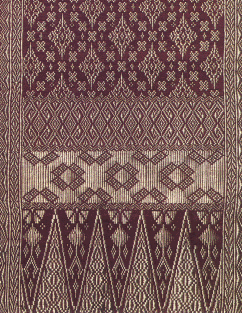
Songket is a traditional Malaysian handwoven fabric created by women in the Malay Peninsula and Sarawak. The term songket refers to the decorative weaving technique used to make the fabric, which entails inserting gold or silver thread in between the base threads. As a result, the extra threads seem to float over a colourful woven background to create an ornamental effect. Songket is woven using a kek, a traditional, two-pedal floor loom. The final product is a delicate fabric resulting from months of skilled handloom weaving by expert artisans. The weaving technique, which dates back to the sixteenth century, is passed on from generation to generation, and the songket style can be identified by the design patterns that use geometric shapes and organic elements, such as flowers, birds and insects. The songket material was traditionally worn only by royalty and their families. However, today it is used by Malay people all over the country in traditional ceremonial clothing, for royal installations, weddings, births, festive occasions and formal state functions. Although the weaving of songket has always been firmly in the hands of women, men also partake in the practice by making the weaving equipment.
Official description, UNESCO Intangible Cultural Heritage List — Songket
At a glance
Songket is a traditional handwoven fabric created by women in the Malay Peninsula and Sarawak through a decorative weaving technique. Gold or silver threads are inserted between base threads on a traditional two-pedal floor loom called a kek, making the metallic threads appear to float over a colourful woven background. The result is a delicate fabric with ornamental patterns featuring geometric shapes and organic elements such as flowers, birds and insects.
Origins & history
The songket weaving technique dates back to the sixteenth century and has been passed down from generation to generation. The practice and its distinctive style patterns have remained central to Malay cultural tradition across this long history.
The practice
Expert artisans weave songket using a kek, a traditional two-pedal floor loom, with the process taking months of skilled handloom work to complete. Although women have always been the primary weavers, men participate by making the weaving equipment. The finished fabric is used in traditional ceremonial clothing worn by Malay people throughout the country.
Cultural significance
Songket was traditionally worn only by royalty and their families, reflecting its importance as a marker of status. Today it remains central to Malay cultural life, worn for royal installations, weddings, births, festive occasions and formal state functions. The practice sustains knowledge passed between generations and connects wearers to their cultural heritage.
Key facts
- Country: Malaysia
- Inscribed: 2021
- UNESCO list: Representative List of the Intangible Cultural Heritage of Humanity
- UNESCO reference: 01505
- UNESCO vocabulary: Textile arts; Weaving
- Map: not shown — UNESCO’s official description of this element names no locality, and a living tradition is practised across a community, not at one address.
Where to experience it
Songket weaving remains a living tradition across the Malay Peninsula and Sarawak, where women continue to work at traditional floor looms creating this intricate gold- and silver-threaded fabric. Visitors can encounter songket weavers in their communities, observe the months-long handweaving process, and purchase finished cloth at local markets and workshops. The fabric appears prominently at Malaysian ceremonial occasions—royal installations, weddings, and formal state functions—where it is worn as traditional dress by Malay people throughout the country. Museums and cultural centres preserve historical examples alongside contemporary pieces, offering insight into the geometric and organic design patterns that have distinguished songket since the sixteenth century.
Sources & resources
- UNESCO — official element page: Songket
- UNESCO — open data record: Intangible Heritage List, reference 01505
- UNESCO — official video: UNESCO film on this element — embedded on this page
- UNESCO — official photograph: Unwinding the hanks and winding the threads on to the bobbins or spools — The Department of National Heritage, Malaysia, 2018
- Reference — Wikipedia (secondary): Songket — consulted as a secondary reference, not as confirmation
- Cultural Heritage Online: Our archive and city guides

Sources
- S1 — Selvanayagam, Grace Inpam. Songket: Malaysia's Woven Treasure. Oxford University Press, 1990. ISBN 978-0-19-588928-4.
- S2 — Maxwell, Robyn. Textiles of Southeast Asia: Tradition, Trade and Transformation. Periplus Editions, 2003. ISBN 978-0-7946-0104-1.
Spotted an error? Write to editorial@culturalheritageonline.com and we correct it the same day.