Partner ContentContent published in partnership with CHO Editorial.
Winter travellers know these three names from piste maps: Kitzbühel in Tyrol, St. Anton am Arlberg on the Tyrolean side of the pass, Lech on the Vorarlberg side. The skis came early and the lifts came late: three men put them on for sport at Langen on the Arlberg in 1885, Franz Reisch climbed the Kitzbüheler Horn on them in 1893, and Lech — where the parish priest brought the first pair in 1894 simply to get between villages in winter — waited until 1940 for a lift. Recent, in the life of an Alpine village.
What the skis found when they got there was a chartered market town of 1271 with a mining past, a farming colony cleared out of high forest by migrants from the Valais around 1300, and a hamlet on a trade pass whose hospice had been sheltering travellers for centuries. All of that is still legible on the ground, usually two streets away from the lift station. This is a guide to what you can see, and to the practical business of arriving.
Kitzbühel: a chartered town that happens to have a mountain
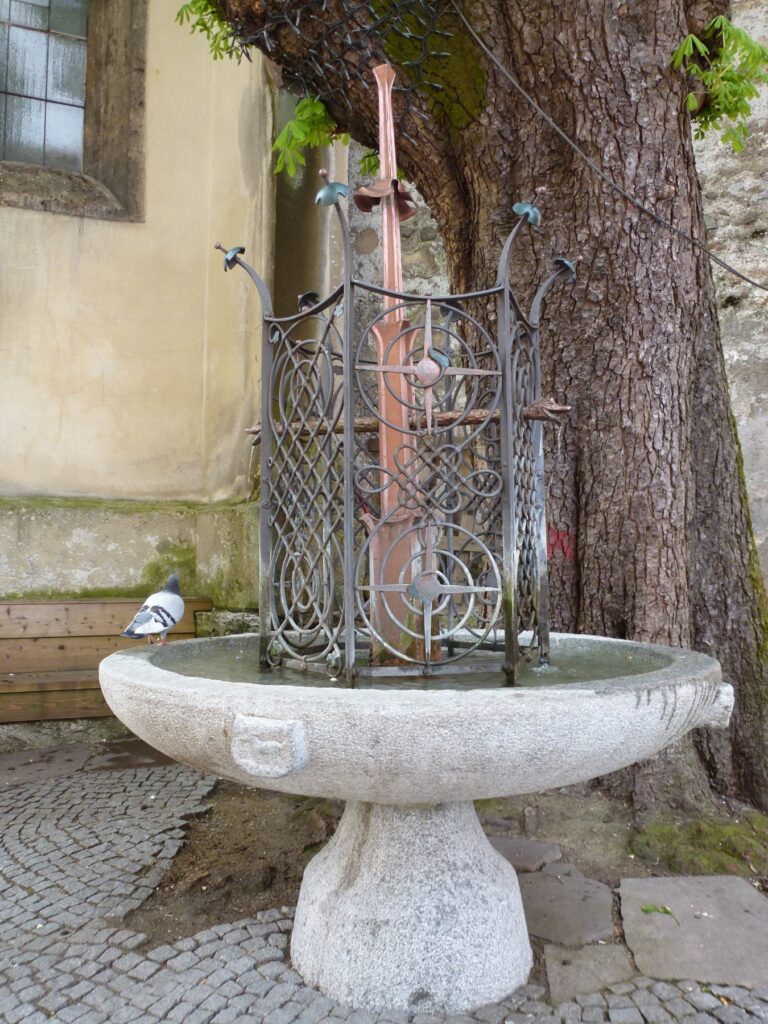
Kitzbühel enters the written record between about 1178 and 1182, in a Chiemsee document that names one Marchwardus de Chizbuhel. It became a town by charter: on 6 June 1271 Duke Ludwig II granted town rights, and the charter of elevation survives as the town’s founding document. For the next two and a half centuries it belonged to whoever held the surrounding politics — Upper Bavaria from 1255, briefly united with Tyrol in 1342 through the marriage of Margarete of Tyrol, ceded back to Bavaria in 1369 after the Peace of Schärding, passed to the Landshut line of the Wittelsbachs in 1450, and finally and permanently Tyrolean on 30 June 1504.
Underneath the town is the reason it was worth chartering. Copper ore was worked in these mountains in the Bronze Age, between roughly 1100 and 800 BC, and mining was pushed systematically again under the Landshut dukes. A visitor sees the consequence rather than the cause: a compact, well-built town at 762 metres with painted house fronts along the Vorderstadt, which is wide because it was a market, and a civic fabric — the old district court building, the Pfleghof by the Jochberger gate — out of proportion to the 8,281 people who live there now.
Skiing came as an import, and it has a date and a name. In 1892 the Kitzbühel hotelier Franz Reisch bought a pair of skis about 2.30 metres long in Norway, having read Fridtjof Nansen’s account of crossing Greenland on them. He practised alone on the slopes below the Hahnenkamm, and on 15 March 1893 he climbed the Kitzbüheler Horn on skis and came down it — the descent that local histories treat as the beginning of skiing in Tyrol. He wrote it up for the Munich magazine Der Schneeschuh on 1 November 1893, which is why the date is certain rather than remembered. Reisch then did what mattered more: he founded the Kitzbühel winter sports association, whose founding meeting was held on 21 December 1902 and which became a formal club on 15 October 1905, and he served as the town’s mayor from 1903 to 1913. He died on 6 January 1920, aged 56, at the end of a ski tour with his sons.
Lech: the Walser village on the Tannberg
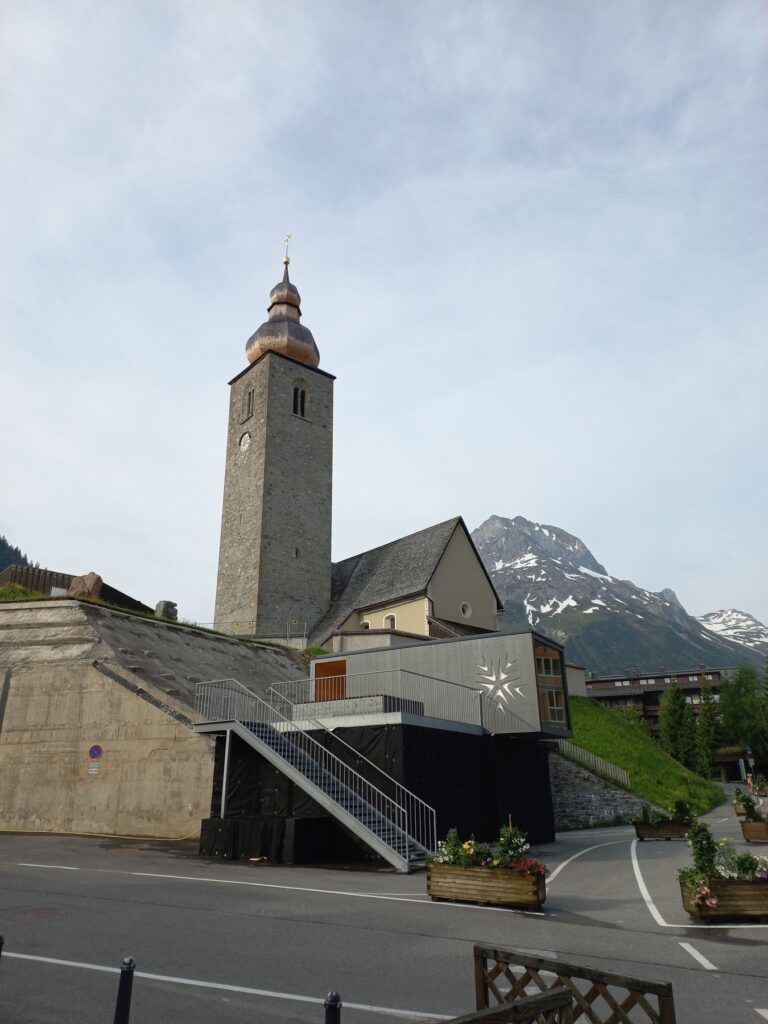
Lech is a different kind of place, and the difference is older than tourism. Around 1300, Walser colonists from the Valais in what is now western Switzerland moved into the densely wooded Tannberg and began clearing the steep forest for pasture. The settlement was called Tannberg into the nineteenth century; the full form Tannberg am Lech gave the village its present name, and the river name itself is Rhaeto-Romance, older than the settlers.
The Walser did not arrive as tenants. Their special legal status let them exercise lower jurisdiction and govern themselves, and by 1412 there is documentary evidence of an Ammann — a magistrate — for the Walser Court of Tannberg. The court sat in what everyone called the Great House, first mentioned in 1477; the building that followed it, Lech’s former town hall of 1520, still holds a Baroque courtroom, and for centuries it was the only secular stone building in the village. By 1780 it was known simply as the White House.
Two other buildings carry the same story. The parish church of St. Nicholas is dated by archaeological evidence to the early fourteenth century, which makes it the oldest church on the Tannberg and, until 1610, the only parish church there; it was newly consecrated in 1433, and its tower received the decorative double onion dome in 1694. The Huber-Hus, a log farmhouse of 1590, is now a museum and the community archive, which is the most useful single building in Lech for a visitor who wants to understand the valley rather than photograph it.
There was mining here too, on a smaller scale: in 1515 the Emperor Maximilian I granted Ludwig von Nordholz a fief for a mine on the Tennenberg, and the place name Schlössle, at 1,720 metres above Oberlech, is thought to mark the house of a mining overseer. Skiing, by contrast, is recent even by Arlberg standards. Neighbouring Zürs received Austria’s first drag lift in 1937; Pastor Müller brought the first pair of skis to Lech in 1894 and used them to cross between Warth and Lech in winter, but the village installed its first ski lift only in 1940 — nearly four decades after the Ski Club Arlberg was founded on the other side of the pass.
St. Anton am Arlberg: the village that taught the world to ski
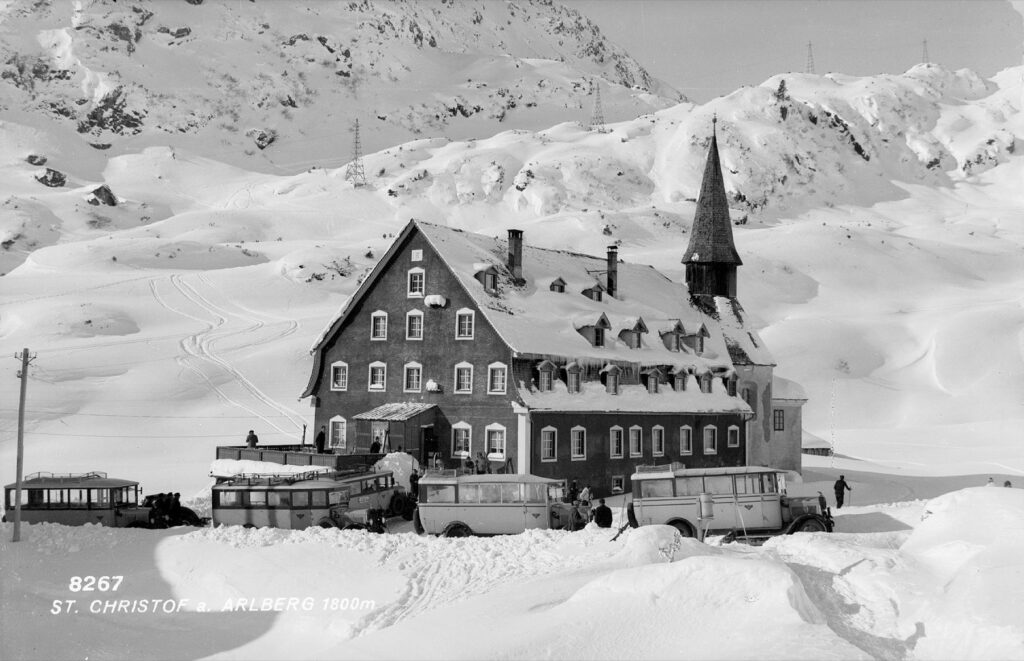
The Arlberg was a route before it was a resort: a pass between Tyrol and Vorarlberg with a hospice at St. Christoph for travellers caught out by the weather. That hospice is where the sporting history starts. In 1901 six friends founded the Ski Club Arlberg at the Hotel Hospiz in St. Christoph — a club rather than a business, and still in existence under the same name.
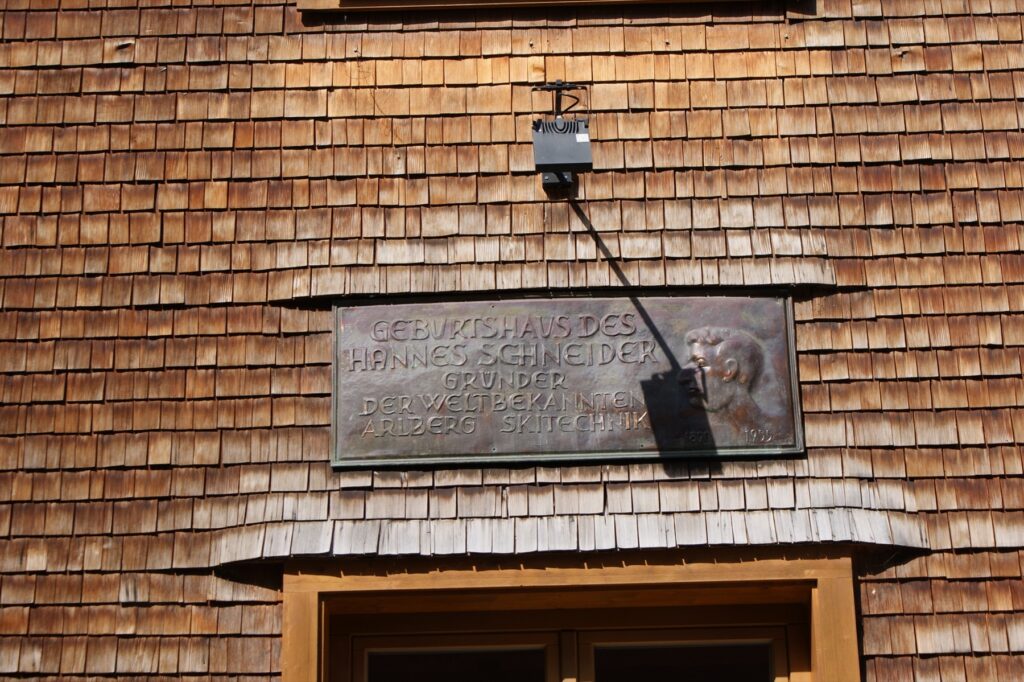
The man who turned it into a profession was born in 1890 in Stuben, a village on the Vorarlberg approach to the pass. Hannes Schneider set up one of the first organised ski schools in St. Anton am Arlberg in 1921, and the method he taught there — the Arlberg technique, taught as a graded progression rather than picked up by imitation — did something no equipment ever did: it made skiing learnable by people who had not grown up on snow. The technique was exported wherever his instructors went, and in the end so was he: Schneider was imprisoned on 12 March 1938, the day of the Anschluss, released after the American financier Harvey Gibson negotiated for him, and welcomed to North Conway, New Hampshire, in February 1939, where he ran the ski school at Cranmore until his death in 1955.
The last piece of that history is mechanical. On 19 December 1937 St. Anton opened the Galzigbahn, which Ski Arlberg, the regional ski association, describes as the world’s first cable car designed exclusively for winter use. Before it, a ski village was a place you walked up; after it, the shape of the modern resort was fixed. In Stuben, the house where he was born carries an inscription on its facade, and it stands on the road over the pass.
Getting there: airports, the Arlberg railway, and the last stretch
The three villages sit in two different valleys and are reached from different directions, which is the single thing most winter itineraries get wrong.
Kitzbühel is the easy one. The distances published by the town’s own tourist board are 81 kilometres from Salzburg airport, 96 kilometres from Innsbruck, 127 kilometres from Munich and 371 kilometres from Vienna. Kitzbühel has its own station, and by rail the route from every one of those airports passes through Wörgl, where you change: from Innsbruck that means a fifteen-minute shuttle to the central station and about an hour and ten minutes of train, and from Munich the S-Bahn to the city first.
St. Anton am Arlberg is a railway village, and this is its advantage. International Railjet and Eurocity trains call at St. Anton station every two hours, and the village centre is a walk from the platform. The region’s own figures put Innsbruck airport at 100 kilometres and Zurich at 200, both with a direct train; Friedrichshafen is 130 kilometres and Memmingen 170, and Munich, at 260 kilometres, needs a change.
Lech has no station. The nearest stops on the Arlberg line are Langen am Arlberg, on the Vorarlberg side, and St. Anton itself; from either, the last stretch is by bus or taxi over the Flexen road, and it is the part worth planning: it is short, it climbs, and in heavy snow it is a road where the driver’s familiarity matters more than the vehicle. A fixed-price private transfer booked in advance is the usual solution for travellers landing late with ski bags, and Alp Roads Alps transfers is one of the operators covering the Munich, Innsbruck, Salzburg and Zurich airports for all three villages, with Kitzbühel, Lech and St. Anton among its listed destinations. For families and groups arriving on peak Saturdays, when airport queues and resort check-ins collide, Alps holiday transfers by Alp Roads are quoted per vehicle rather than per person.
One practical note that applies to all three: the Arlberg pass road can close in heavy weather, in which case traffic is routed through the Arlberg road tunnel, and the railway — which runs in its own tunnel beneath the pass — becomes the reliable option. Travellers who plan to see both sides of the pass in one trip should treat St. Anton and Lech as two bases, not one.
What else is within reach
Both valleys are within an easy day of cities our editors have documented in detail. Innsbruck — a bridge over the Inn, inhabited since the Stone Age — is the natural stop on the way to or from either Kitzbühel or St. Anton. From Kitzbühel the historic centre of Salzburg is the other easy day out — the town’s own airport distances put Salzburg at 81 kilometres against Innsbruck’s 96 — and Salzburg Cathedral, consecrated three times between 774 and 1628 and rebuilt after fires and a bomb, is the single building that explains the city’s wealth.
Frequently asked questions
Which is the oldest of the three villages? Kitzbühel has the oldest written record — a Chiemsee document of about 1178 to 1182 — and the oldest urban status, by charter of 6 June 1271. Lech’s settlement by Walser colonists dates to around 1300, and its parish church to the early fourteenth century.
Where did skiing in Austria actually begin? Both villages have a claim, and they are not in conflict. Franz Reisch’s ski ascent and descent of the Kitzbüheler Horn on 15 March 1893 is the earliest dated event of the three. The Arlberg produced the institutions: the Ski Club Arlberg in 1901, Hannes Schneider’s ski school in St. Anton in 1921, and the teaching method that spread the sport.
Can all three be visited without a car? Kitzbühel and St. Anton, yes: both are on the railway, Kitzbühel on the line through Wörgl and St. Anton on the Arlberg line. Lech requires a bus or a transfer from Langen am Arlberg or St. Anton.
What is there to see in summer? In Lech, the Huber-Hus farmhouse museum and community archive, the church of St. Nicholas, and the Tannberg trail through the old Walser settlements. In Kitzbühel, the chartered old town. On the Arlberg, the pass itself, St. Christoph, and Stuben.
Sources
- Austria-Forum, AustriaWiki, Kitzbühel — first mention, town rights of 6 June 1271, mining and the passage between Bavaria and Tyrol, https://austria-forum.org/af/AustriaWiki/Kitzb%C3%BChel — read 18 November 2026
- Austria-Forum, AustriaWiki, Franz Reisch — the skis of 1892, the ascent of 15 March 1893, the winter sports association and his years as mayor, https://austria-forum.org/af/AustriaWiki/Franz_Reisch — read 18 November 2026
- Ski Arlberg, History of skiing on the Arlberg — Ski Club Arlberg 1901, Hannes Schneider and the ski school of 1921, the Galzigbahn of 1937, the first lifts in Zürs and Lech, https://www.skiarlberg.at/en/Ski-Arlberg/History-of-skiing-on-Arlberg — read 18 November 2026
- Warth-Schröcken Tourismus and the community of Lech, station descriptions of the Tannberg themed trail “In the footsteps of the Walser at Tannberg” — the Walser court and its Ammann of 1412, St. Nicholas, the Huber-Hus of 1590, the mining fief of 1515, https://relaunch.warth-schroecken.com/media/tannbergweg/Description-of-the-stations-on-the-Tannberg-themed-trail.pdf — read 18 November 2026
- Lech Zürs Tourismus, The Tannberg — the Walser immigration from the Canton of Valais around 1300 and the name Tannberg am Lech, https://www.lechzuers.com/en/hiking/the-tannberg — read 18 November 2026
- Kitzbühel Tourismus, Travelling by plane — airport distances and the rail routings through Wörgl, https://www.kitzbuehel.com/en/holiday/getting-here/flying/ — read 18 November 2026
- New England Ski History, biography of Hannes Schneider — the imprisonment of 12 March 1938, Harvey Gibson’s negotiation, the welcome at North Conway in February 1939 and the Cranmore ski school until his death in 1955, https://newenglandskihistory.com/biographies/schneiderhannes.php — read 18 November 2026
- Lift-World lift database, Galzigbahn I, St. Anton am Arlberg — opening on 19 December 1937, https://www.lift-world.info/en/lifts/16813/datas.htm — read 18 November 2026
- Ski Arlberg, Getting here and parking, St. Anton — airport distances and the Railjet and Eurocity services to St. Anton station, https://www.skiarlberg.at/en/st-anton/getting-here-parking — read 18 November 2026
Spotted an error? Write to the editors and we correct it the same day.