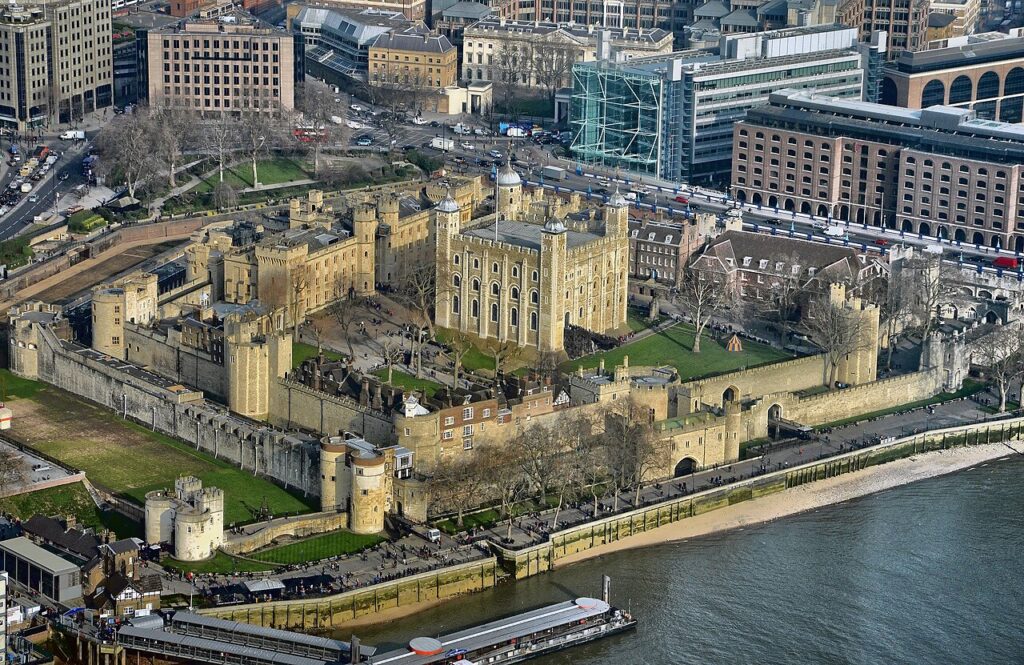
Tower of London — inscribed by UNESCO in 1988 — is the historic royal fortress and palace on the north bank of the River Thames in central London: a concentric castle of successive building campaigns from the White Tower (begun by William the Conqueror approximately 1078 CE, the largest Norman keep in England) through the 13th-century expansion by Henry III and Edward I that created the concentric curtain-wall layout visible today, serving throughout its 950-year history as a royal palace, treasury, armoury, prison, execution site, menagerie, royal mint, and repository of the Crown Jewels of England and the United Kingdom.
The White Tower, the Crown Jewels, and the Tower as prison and execution site White Tower (Norman keep, circa 1078–1100 CE) · Jewel House (Crown Jewels display) · Tower Green (execution site, Anne Boleyn 1536) · Traitors’ Gate (river water gate) — Tower Hill, London EC3
The Tower of London (its full historical title: Her Majesty’s Royal Palace and Fortress of the Tower of London) was begun by William I of England (William the Conqueror) in approximately 1078 CE, following the Norman Conquest of 1066 CE, as a statement of royal power at the eastern edge of the City of London — the dense mercantile city that William needed both to control and to protect. The White Tower (the massive square stone keep at the centre of the complex, approximately 27 × 36 metres in plan and approximately 27 metres high to the battlements, with four corner turrets of which three are square and one is rounded) was the largest and most ambitious stone building begun in England since the Romans and was deliberately designed to overawe the population of London with the physical reality of Norman military might: its walls, approximately 4.5 metres thick at the base, rising from a construction that required enormous quantities of Caen limestone (a fine cream-coloured stone shipped from Normandy) and Kentish ragstone (a local coarser limestone from the Medway valley). The White Tower housed the first Norman royal chapel in England: the Chapel of St John the Evangelist (at the second-floor level within the White Tower, an intact Romanesque chapel of approximately 1080–1100 CE — one of the best-preserved Norman interiors in England and certainly the finest Norman chapel in London), with rounded apse, barrel-vaulted nave, and massive round columns without carved capitals (an austere architectural programme that matches the defensive purpose of the building). The expansion of the Tower under Henry III (reigned 1216–1272 CE) and Edward I (reigned 1272–1307 CE) transformed the single great tower with its surrounding bailey into a concentric castle — one of the first and most complete concentric castle designs in England — with an inner curtain wall (studded with 13 towers of varying design, approximately 1220–1285 CE) and an outer curtain wall with its own set of towers (approximately 1275–1285 CE under Edward I), the outer wall surrounded by a moat (now dry, filled in 1843–1845 CE but originally water-fed from the Thames) approximately 45 metres wide. The Traitors’ Gate (the large river-gate in the outer curtain wall, approximately 1275–1280 CE) provided river access to the Tower and was used from the medieval period for the arrival of state prisoners — the name “Traitors’ Gate” reflecting the popular (though historically imprecise) identification of this entrance with the route taken by prisoners condemned for treason. The Jewel House (the building within the inner ward that since 1994 CE has housed the Crown Jewels of the United Kingdom, the historic regalia used at coronations) contains the most complete surviving set of royal regalia in the world and the most visited collection in the Tower: the St Edward’s Crown (made for Charles II in 1661 CE for his coronation, used at every subsequent coronation — most recently Charles III on 6 May 2023 CE), the Imperial State Crown (made for George VI in 1937 CE, worn by the monarch for the state opening of Parliament), the Sovereign’s Orb, the Sovereign’s Sceptre with Cross (containing the Cullinan I diamond, the largest colourless cut diamond in the world at 530.2 carats), and approximately 100 further objects from the 17th century onward. The most historically significant object among the Crown Jewels is perhaps the Koh-i-Noor diamond (currently set in the crown made for Queen Elizabeth The Queen Mother for the 1937 coronation), a diamond with a long and contested history of ownership spanning the Mughal Empire, the Sikh Empire, and the British Crown, which remains a subject of active repatriation claims from India, Pakistan, Iran, and Afghanistan.
The Tower’s history as a prison and execution site is its most widely remembered function in popular consciousness: from the imprisonment of Ranulf Flambard (Bishop of Durham, imprisoned 1100 CE and the Tower’s first recorded prisoner) to the execution of Rudolf Hess (whose flight to Britain in 1941 CE led to his imprisonment in the Tower for four days — the last person imprisoned there), the Tower held an enormous range of prisoners over nine centuries. The most historically significant executions at the Tower were conducted either on Tower Hill (the area just outside the Tower’s walls, where public executions took place) or on Tower Green (the small green within the inner ward, where a small number of high-status prisoners were executed privately to spare them the spectacle of a public execution). The six beheadings on Tower Green include: Anne Boleyn (second wife of Henry VIII, executed 19 May 1536 CE on charges of adultery and treason that most historians regard as fabricated by Henry’s minister Thomas Cromwell); Catherine Howard (fifth wife of Henry VIII, executed 13 February 1542 CE on similar charges); Lady Jane Grey (executed 12 February 1554 CE after her nine-day reign as queen was ended by the accession of Mary I — she was 16 years old at her execution); and Margaret Pole, Countess of Salisbury (executed 27 May 1541 CE at the age of approximately 67 — the oldest recorded person executed at the Tower, whose botched execution by an inexperienced headsman reportedly required eleven blows to sever her head). The site on Tower Green is marked by a glass memorial sculpture (by the artist Brian Catling, installed 2006 CE) that serves as a cushion of glass for the names of those executed there. The Tower also held the two “Princes in the Tower” — Edward V (12 years old, deposed 1483 CE) and his younger brother Richard of Shrewsbury (9 years old) — whose disappearance from the Tower in 1483 CE, almost certainly murdered (the most widely accepted hypothesis attributes the murders to their uncle Richard III, though the evidence is circumstantial), remains one of the most famous mysteries of English history.
Practical information
The Tower of London is located on the north bank of the River Thames in the City of London, adjacent to Tower Bridge, served by Tower Hill Underground station (Circle and District lines) approximately 5 minutes’ walk, and Fenchurch Street railway station approximately 8 minutes’ walk. Entry requires a ticket (advance booking strongly recommended, particularly June–August; Historic Royal Palaces manages the site and tickets are available online). The Crown Jewels display (the Jewel House) typically generates the longest queues; arriving early morning or late afternoon reduces waiting times. The Yeoman Warders (“Beefeaters” — the Tower’s ceremonial guardians, all former senior non-commissioned military officers with at least 22 years’ service) offer free guided tours that include the key historical spaces and are a particularly good way to experience the Tower’s history through vivid storytelling. Include time for: the White Tower (ground floor to upper floors, approximately 45 minutes, including the Royal Armouries collection and the Chapel of St John); the Jewel House (approximately 30 minutes, though queuing times vary); the medieval palace rooms (the furnished recreation of Edward I’s private apartment, approximately 20 minutes); and the wall walk (the outer curtain wall, accessible from the Byward Tower, with views across the Thames and Tower Bridge). Allow 3–4 hours in total. Tower Bridge (immediately adjacent, separately ticketed, managed by the City of London Corporation) is worth visiting alongside the Tower for the views from the bridge’s glass-floored high-level walkway. Best season: year-round; the ceremony of the Keys (the locking of the Tower’s gates, a nightly ceremony performed since at least the 14th century CE, free to attend but requiring advance ticket reservation up to 12 months in advance) is particularly memorable.
Frequently Asked Questions
What are the Crown Jewels and why are they kept at the Tower of London?
The Crown Jewels (formally “the Regalia”) are the collection of ceremonial objects used at the coronation of the British monarch and at other state ceremonies: approximately 140 objects in the collection, including crowns, sceptres, orbs, swords, spurs, rings, and robes, most dating from 1660–1661 CE (the coronation of Charles II following the Restoration of the monarchy, when the original medieval regalia were remelted or destroyed by the Parliamentary government during the Commonwealth period 1649–1660 CE as symbols of “the detestable rule of kings”) or later. The collection is held at the Tower of London for a combination of historical, security, and practical reasons: the Tower has served as a royal treasury and armoury from the medieval period (the original medieval regalia were indeed kept at Westminster Abbey, not the Tower, but the royal mint and treasure were associated with the Tower from at least the 12th century CE); the Tower’s massive medieval fortifications and its modern security systems make it one of the most secure locations in the United Kingdom; and the combination of historical continuity and practical security has made the Tower the unquestioned home of the Crown Jewels since at least the 17th century CE. The most significant attempt to steal the Crown Jewels was made by Colonel Thomas Blood on 9 May 1671 CE: Blood and accomplices disguised as a parson and his family gained access to the Jewel House, incapacitated the keeper, and escaped with the orb (stuffed into a bag), the sceptre (shortened by sawing), and the crown (flattened by hammering to fit under a cloak) before being caught at the Tower’s outer gate. Charles II, apparently amused by Blood’s audacity, pardoned him and granted him Irish lands — one of the more surprising royal pardons in British history. The most valuable individual object in the Crown Jewels is the Cullinan I (First Star of Africa) diamond (530.2 carats), the largest colourless cut diamond in the world, set in the Sovereign’s Sceptre with Cross: the Cullinan diamond (originally 3,106.75 carats before cutting, found in the Premier mine in South Africa in 1905 CE) was presented to King Edward VII by the Transvaal government in 1907 CE and subsequently cut by the Asscher Brothers of Amsterdam into 9 large stones and approximately 100 smaller stones, with the two largest — Cullinan I and Cullinan II (317.4 carats, set in the Imperial State Crown) — remaining part of the Crown Jewels.
Who are the Yeoman Warders (“Beefeaters”) and what is the Ceremony of the Keys?
The Yeoman Warders of His Majesty’s Royal Palace and Fortress the Tower of London (popularly known as “Beefeaters,” a nickname of uncertain etymology — possibly from the French word “buffetier” for a servant who attended the royal buffet, possibly a straightforward reference to the beef rations historically provided to palace servants) are the ceremonial guardians of the Tower, a corps of approximately 37 men and women (women were first admitted in 2007 CE) who serve as both ceremonial warders and popular historians of the Tower. To be appointed a Yeoman Warder, an applicant must have completed at least 22 years of service in the British Armed Forces, must hold the Long Service and Good Conduct Medal, and must have achieved the rank of Warrant Officer. The Yeoman Warders live within the Tower’s walls (there are residential quarters within the precincts) and provide the free guided tours of the Tower that are among the most popular visitor experiences. The Ceremony of the Keys is the nightly locking of the Tower’s main gates — a ceremony that has been performed every night for at least 700 years without interruption, including throughout the bombing of London in the Second World War (on one occasion during the Blitz, a bomb blast knocked the escort party off their feet, but the ceremony was completed). The ceremony begins at approximately 21:53 each evening: the Chief Yeoman Warder, carrying a lit candle lantern and the keys to the Tower’s gates, is escorted by a military guard from the Byward Tower. The gates are locked in sequence; at the Bloody Tower archway, a sentry calls “Halt! Who comes there?”; the Chief Warder responds “The Keys”; the sentry asks “Whose keys?”; “King Charles’s Keys” (or “Queen’s Keys” during a queen’s reign); “Advance, King Charles’s Keys — All’s well.” The party then proceeds to the main guard, where the bugler sounds “The Last Post” and the keys are taken to the Governor’s house for the night. Access to attend the Ceremony of the Keys requires a free ticket, applied for online via the Historic Royal Palaces website up to 12 months in advance — demand significantly exceeds supply, so early booking is essential.
What happened to the “Princes in the Tower” and why does the mystery remain unresolved?
The “Princes in the Tower” — Edward, Prince of Wales (born 2 November 1470 CE, uncrowned king Edward V from 9 April to 25 June 1483 CE) and Richard of Shrewsbury, Duke of York (born 17 August 1473 CE, younger brother of Edward V) — were the sons of King Edward IV of England. Following Edward IV’s sudden death on 9 April 1483 CE, the 12-year-old Edward V was the rightful heir to the throne and was escorted to London by his uncle Richard, Duke of Gloucester (subsequently Richard III), who was appointed Lord Protector of England. Edward V was lodged in the Tower of London (which was at that time still functioning as a royal residence, not primarily a prison) in April 1483 CE; his younger brother Richard was brought to join him in June 1483 CE, nominally because Edward needed a companion but effectively because the children of Edward IV needed to be controlled. On 25 June 1483 CE, Parliament declared both boys illegitimate (on the grounds, of disputed validity, that Edward IV’s marriage to their mother had been invalid) and offered the crown to Richard, Duke of Gloucester, who accepted it as Richard III on 26 June 1483 CE. After this point, both boys were seen in the Tower less and less frequently, and by the autumn of 1483 CE there are no reliable contemporary reports of either child being alive. The mystery is unresolved because: no contemporary account explicitly records the death of either boy or identifies a killer; the skeletal remains found during construction work at the Tower in 1674 CE (reburied in Westminster Abbey in an urn by order of Charles II) may or may not be those of the two princes (the bones have never been subjected to modern DNA analysis — a long-running dispute between the Royal Household, which controls access to the Abbey urn, and historians and scientists, who have repeatedly requested permission to conduct DNA testing); and the historical sources (primarily Polydore Vergil’s history, written for Henry VII, and Thomas More’s “History of Richard III,” written approximately 1513–1519 CE) are either written under Tudor political pressure to portray Richard III as a villain or are of uncertain authenticity. The most widely accepted hypothesis remains that Richard III ordered the murders of both boys in the summer or autumn of 1483 CE, but the alternative hypothesis that Henry Stafford, Duke of Buckingham (Richard’s ally who subsequently rebelled against him) ordered or committed the murders, and the more recent hypothesis that Henry VII (who also had a motive — the boys were threats to his own claim) had them killed after his accession in 1485 CE, cannot be definitively excluded without the DNA evidence that the bones in Westminster Abbey could potentially provide.
EXCERPT: Tower of London (UNESCO 1988) — William the Conqueror’s great Norman fortress on the Thames: the White Tower (circa 1078 CE, finest Norman keep in England), the Crown Jewels and Cullinan I diamond, Tower Green where Anne Boleyn was executed in 1536 CE, and the Yeoman Warders’ nightly Ceremony of the Keys — a ritual performed every night for 700 years without interruption.
META: UNESCO World Heritage Sites near Tower of London England UK: Palace of Westminster Westminster Abbey London 5 km west, Canterbury Cathedral 90 km southeast — central London heritage circuit from the Norman royal fortress to the Gothic parliamentary palace and the pilgrimage cathedral of English Christianity.
Sources
- S1 — UNESCO World Heritage Centre — Tower of London (Ref. 488) — https://web.archive.org/web/20230601000000/https://whc.unesco.org/en/list/488/
- S2 — Historic Royal Palaces — Tower of London Official Portal — https://www.hrp.org.uk/tower-of-london/
Spotted an error? Write to the editors and we correct it the same day.