
A stylized dance drama where masked male performers enact classical narratives, accompanied by narrators and the resonant sounds of traditional Thai piphat instruments.
In UNESCO’s words
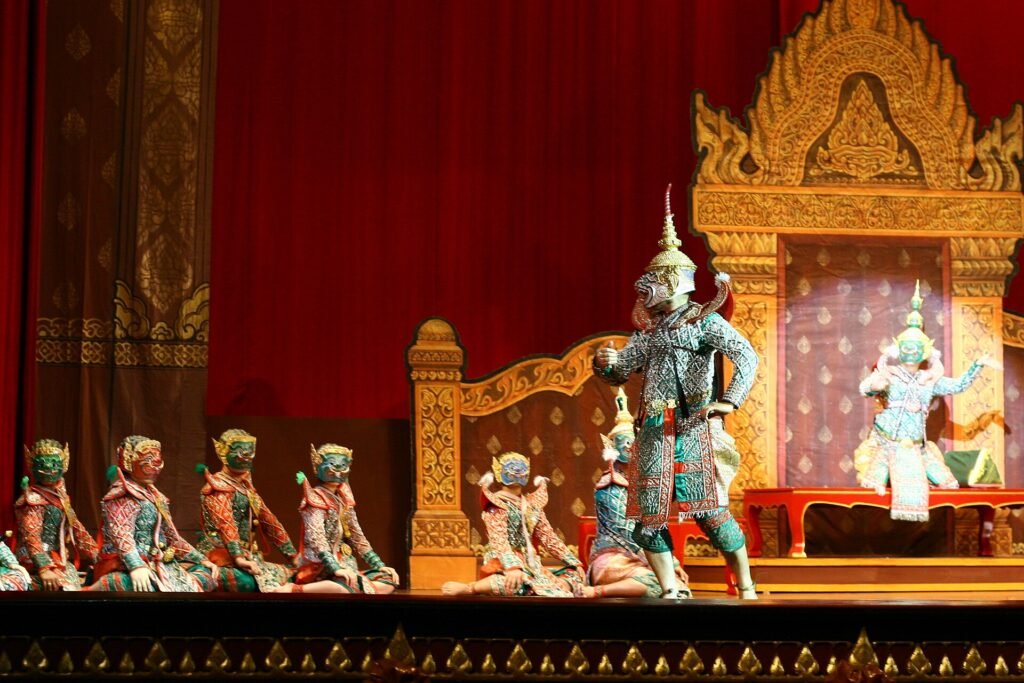
Khon, the Khon Masked Dance Drama in Thailand, is a performing art that combines musical, vocal, literary, dance, ritual and handicraft elements. Khon performances – which involve graceful dance movements, instrumental and vocal renditions and glittering costumes – depict the glory of Rama, the hero and incarnation of the god Vishnu, who brings order and justice to the world. The many episodes depict Rama’s life, including his journey in the forest, his army of monkeys, and his fights with the army of Thosakan, king of the giants. On one level, Khon represents high art cultivated by the Siamese/Thai courts over centuries, while at another level, as a dramatic performance, it can be interpreted and enjoyed by spectators from different social backgrounds. Khon has a strong didactic function, reinforcing respect for those of a higher age and status, mutual dependence between leaders and followers, the honour of rulers and the triumph of good over evil. Traditionally, Khon was transmitted in the royal or princely courts, and in dance masters’ households. Today, however, transmission occurs mostly in educational institutions, while still adhering largely to traditional methods. Concerted efforts are made to ensure the continuity of the practice, including through the establishment of training and performance clubs that help reach out to young people.
Official description, UNESCO Intangible Cultural Heritage List — Khon, masked dance drama in Thailand
At a glance
Khon is a masked dance drama that combines music, singing, literature, dance, ritual and handicraft into a single performance. Dancers in glittering costumes and masks perform graceful movements accompanied by instrumental and vocal music, enacting stories that celebrate Rama—a hero and incarnation of the god Vishnu—who brings order and justice to the world. The tradition works on two levels: as refined court art and as dramatic entertainment accessible to people from all social backgrounds.
Origins & history
Khon developed over centuries as a performing art cultivated by the Siamese and Thai courts. The tradition was passed down through royal and princely households and through the families of dance masters, maintaining its core practices while becoming a distinctive cultural expression of Thailand.
The practice
Today, Khon is taught mainly in educational institutions while preserving traditional methods. Performers wear elaborate masks and glittering costumes, executing graceful dance movements that follow centuries-refined conventions. The performance combines instrumental and vocal renditions with narration. Training and performance clubs have been established to transmit the art to young people and ensure its continuity.
Cultural significance
Khon serves a strong teaching purpose within its community, reinforcing respect for age and status, the relationship between leaders and followers, the honour of rulers, and the triumph of good over evil. The practice remains vital to Thai cultural identity, and ongoing efforts—including formal education and performance groups—work to maintain its transmission to new generations.
Key facts
- Country: Thailand
- Inscribed: 2018
- UNESCO list: Representative List of the Intangible Cultural Heritage of Humanity
- UNESCO reference: 01385
- UNESCO vocabulary: Dance; Drama; Masks
- Map: not shown — UNESCO’s official description of this element names no locality, and a living tradition is practised across a community, not at one address.
Where to experience it
Khon performances thrive throughout Thailand today, sustained by educational institutions and training clubs that reach new generations of practitioners and audiences. Visitors can encounter this masked dance drama at cultural venues and festivals across the country, where performers continue to depict the adventures of Rama with graceful movements, elaborate costumes, and traditional music. The tradition remains accessible to spectators from all backgrounds, maintaining its role as both refined court art and compelling popular drama.
Sources & resources
- UNESCO — official element page: Khon, masked dance drama in Thailand
- UNESCO — open data record: Intangible Heritage List, reference 01385
- UNESCO — official video: UNESCO film on this element — embedded on this page
- UNESCO — official photograph: Photograph of this element — Gingthong Mahapornpaisan — Department of Cultural Promotion, Thailand, 2015
- Reference — Wikipedia (secondary): Khon — consulted as a secondary reference, not as confirmation
- Cultural Heritage Online: Our archive and city guides

Sources
- S1 — Brandon, James R. Theatre in Southeast Asia. Harvard University Press, 1967. ISBN 978-0-674-87587-6.
- S2 — Rutnin, Mattani Mojdara. Dance, Drama, and Theatre in Thailand: The Process of Development and Modernization. Silkworm Books, 1996. ISBN 978-974-7100-34-1.
Spotted an error? Write to editorial@culturalheritageonline.com and we correct it the same day.