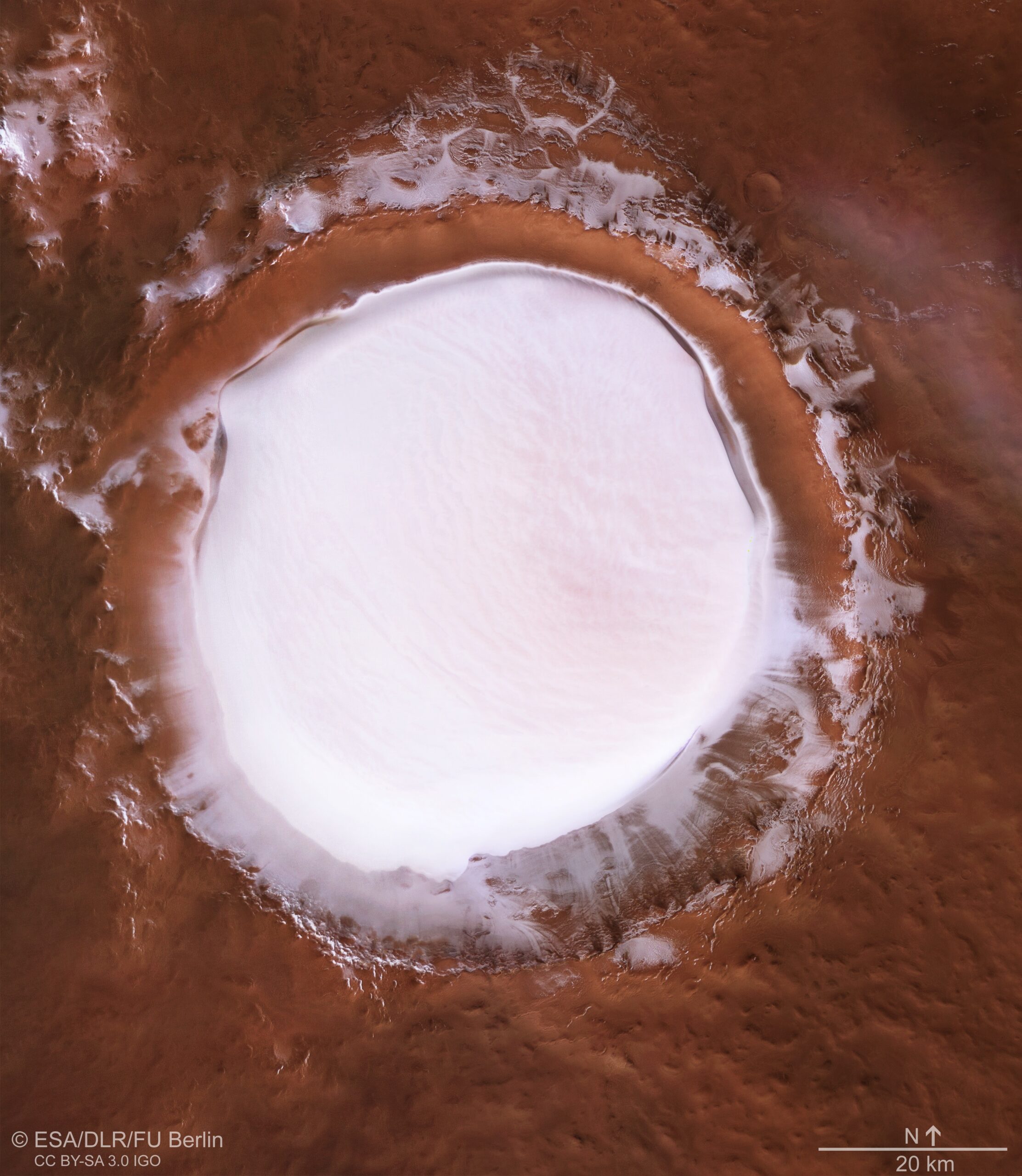
In late 2018, Italian scientists announced findings that confirmed the presence of liquid water beneath Mars’s surface for the first time. The discovery, based on data from the Marsis radar aboard the European Space Agency’s Mars Express probe, was published in Science. The research was led by Roberto Orosei of Italy’s National Institute for Astrophysics (Inaf), with participation from scientists at Inaf, the Italian Space Agency (Asi), Roma Tre University, D’Annunzio University Chieti-Pescara, the National Research Council (Cnr), and Sapienza University of Rome.
The discovery and its characteristics
The Marsis radar identified a subsurface water deposit at approximately 1.5 kilometers depth in the Planum Australe region, centred at 193°E and 81°S. The area of highly reflective subsurface material spans roughly 20 square kilometers. Despite temperatures well below freezing at that depth, the water remains liquid, likely because it is salty. The salts, probably similar to those found by NASA’s Phoenix probe in northern polar ice, act as antifreeze and help maintain the liquid state.
Scientists noted that this combination of water, salts, rock, and protection from cosmic radiation could constitute a potential biological niche. Roberto Orosei explained that the fundamental question had long been where Mars’s ancient water—evident from the Viking probe observations since 1976 showing the planet once had seas, lakes, and rivers—had gone. Much was carried away by solar wind, some remains as ice in the polar caps and near-surface layers, and some became bound in permafrost. “But a part had to remain trapped in the depths and could still be in liquid state,” Orosei noted.
Technical achievement and instrument development
The Marsis radar represents an innovative instrument conceived in the mid-1990s when Mars Express was announced by the European Space Agency. Giovanni Picardi of Sapienza University proposed using a low-frequency radar to investigate subsurface geology at great depth. The Italian Space Agency managed its development and contracted Thales Alenia Space–Italia for construction. The instrument launched on 2 June 2003.
Marsis operates at frequencies between 1.5 and 5 megahertz, capable of penetrating Martian terrain to 4 or 5 kilometers depth depending on subsurface composition. The radar’s antenna consisted of two lightweight kevlar tubes, each 20 meters long, that had to be folded into a box slightly more than one meter long for launch. For more than 12 years, the radar systematically probed the planet’s polar caps. The team analysed data from the Planum Australe region collected between May 2012 and December 2015.
Analysis and interpretation
The most complex part of the work involved quantitative analysis of radar signals to determine the dielectric constant of the reflective layer. This analysis took nearly four years but allowed the team to establish that the dielectric permittivity of the highly reflective area exceeded 15, consistent with materials containing substantial amounts of liquid water. Elena Pettinelli of Roma Tre University concluded that the findings indicate “probably the presence of a subglacial lake, similar to lakes beneath Antarctic ice, relatively extensive with a depth certainly exceeding Marsis’s penetration capability. Alternatively it could be a deep aquifer in which liquid water fills the pores and fractures of rock.” While the team cannot precisely estimate the lake’s depth, they affirmed it is at least on the order of several metres.
On video
Frequently asked questions
How deep is the discovered water beneath Mars’s surface?
The water deposit was located at approximately 1.5 kilometers depth in the Planum Australe region. The team cannot determine the exact depth of the lake bottom or aquifer base, but confirmed it extends at least several metres below the surface.
Why does liquid water exist at such cold temperatures on Mars?
The water is salty, with salts probably similar to those found in northern polar ice by NASA’s Phoenix probe. These salts act as an antifreeze, enabling the water to remain liquid despite temperatures well below freezing.
Are there likely to be other locations with liquid water on Mars?
Researchers are convinced that other zones with conditions favourable to subsurface water presence may exist on Mars, and now that the analysis method has been refined, they plan to continue investigating the planet systematically.
Sources
- S1 — Burnham, Robert, Jr. Burnham's Celestial Handbook: An Observer's Guide to the Universe Beyond the Solar System. Dover Publications, 1978. ISBN 978-0-486-23568-4.
- S2 — Kitchin, C. R. Astrophysical Techniques. CRC Press, 2013. ISBN 978-1-4665-1115-6.
Spotted an error? Write to editorial@culturalheritageonline.com and we correct it the same day.