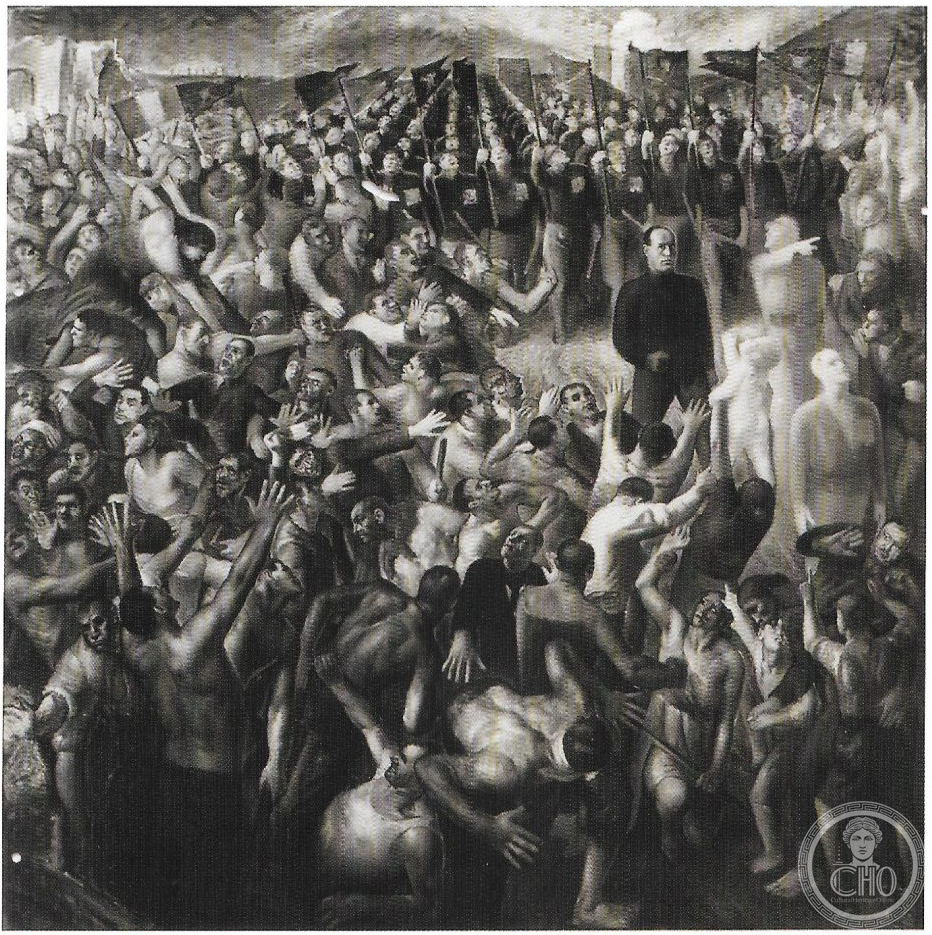
A crowd of bare-chested men crowds the frame from edge to edge, arms raised, flags topped with fasces rising above their heads. In the middle of them, upright and dressed in black, stands the single clothed figure the whole composition is built to point toward.
This is explicit Fascist propaganda, and we present it as a historical document, not as art to admire. Cultural Heritage Online publishes material like this to document what the regime commissioned and rewarded, and how, not to celebrate it. It is reproduced here because it is a documented, exhibited, prize-winning work of Italian painting from the period this section of the magazine covers — and because, as the record below shows, the physical painting itself no longer exists to be seen anywhere else.
The title, Incipit novus ordo — «a new order begins» — is Latin for a line that announces exactly what the raised arms and the flags are staging. The painting won the prize of the Partito Nazionale Fascista at the Venice Biennale of 1930; the Biennale that year had run a themed competition calling explicitly for works «inspired by figures or events in the founding of the Fasci di combattimento». Sources place the painting’s composition in 1929, with the prize following at the 1930 exhibition. It is today recorded as dispersed or destroyed: no photograph beyond period reproductions like this one is known to survive in any public collection.
Arnaldo Carpanetti (Ancona, 15 January 1898 – Milan, 5 April 1969) trained first in Manaus, Brazil, then at Brera under Ambrogio Alciati, graduating in 1923. He exhibited at the Venice Biennale in 1928, 1930, 1934 and 1936, and at the Rome Quadriennale three times. He was a friend and collaborator of Mario Sironi, the best-known painter of Fascist-era monumental art, and his other prize-winning works from the period — Bacchus Imperans (a Ministry of Education gold medal, 1928) and Il ratto delle Sabine (the Premio Principe Umberto, 1928 and again 1930) — place him inside the same circuit of state-sponsored competitions that Incipit novus ordo belongs to.
About this image. The work is still protected by copyright: under Italian law (L. 633/1941) rights run for 70 years from the death of the author, and that term has not expired. It is reproduced here for documentation, study and critical purposes only, under Art. 70 of L. 633/1941 and the fair-use provision of 17 U.S.C. §107. The scan was made by the collector from his own copy of a period reproduction — part of the material he keeps in a private archive: owning a printed reproduction is not the same as holding the rights to the work. The image is not offered for sale, no reproduction rights are granted, and any request concerning the work should be addressed to the rights holders. Cultural Heritage Online publishes this material to document it, with no celebratory intent; see our terms and the DMCA contact published there.
Sources
- S1 — Bossaglia, Rossana. Il Novecento italiano: Cronache, memorie, documenti. Feltrinelli, 1979. ISBN 978-88-07-81012-1.
- S2 — Pontiggia, Elena. Il Novecento italiano. Abscondita, 2003. ISBN 978-88-8416-048-5.
Spotted an error? Write to editorial@culturalheritageonline.com and we correct it the same day.