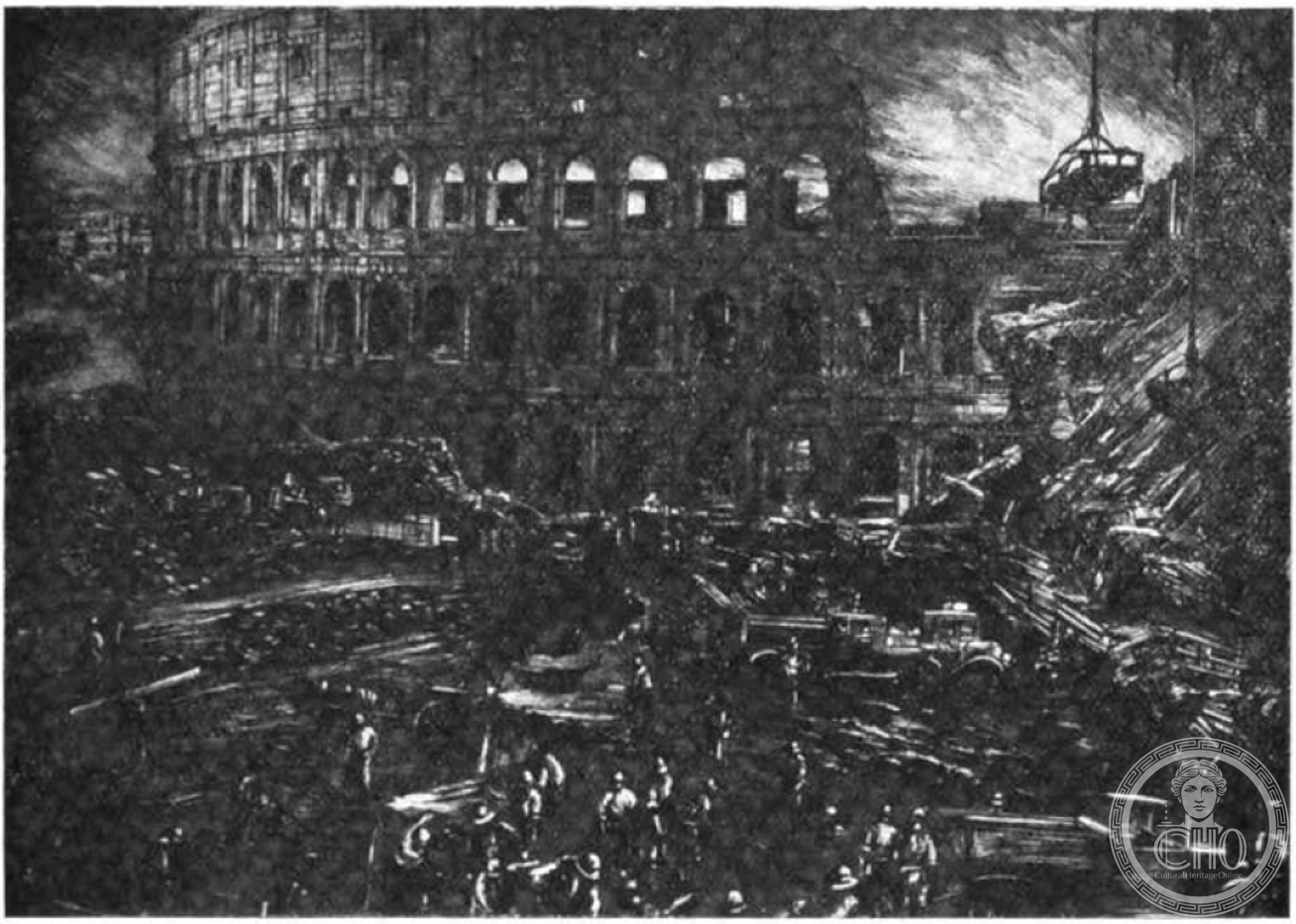
The Colosseum from below, at the height of the traffic and the dust: cars and trucks crowd the foreground, a crane lifts something out of frame to the right, and small figures in white move between the vehicles while the arena’s four tiers of arches rise, half in shadow, above all of it.
Cisari worked the print almost as a nocturne — the sky behind the Colosseum streaked and dark, the building itself picked out mostly in its window-arches, left as pale gaps in the hatching. What holds the eye is the ground level: a scene of ordinary, heavy machine-age business happening in front of a two-thousand-year-old amphitheatre, with no attempt to soften the contrast between the two.
The title Cisari (or whoever titled the print afterwards) gave it, «Roma mussoliniana», points at exactly that contrast. Between 1924 and 1932, Mussolini’s regime drove a new road, Via dell’Impero — today’s Via dei Fori Imperiali — straight from the Colosseum to Piazza Venezia, demolishing a swath of the medieval and Renaissance neighbourhood that stood over the Roman Forum to do it. The road was formally inaugurated on 28 October 1932, but the demolition and construction work around the Colosseum end of the site ran on for months afterward, into the spring of 1933. A print dated 1933 showing cranes and lorries at work by the amphitheatre sits precisely inside that documented tail end of the works.
Giulio Cisari (Como, 7 May 1892 – Milan, 1972 or 1979 depending on the source) was a working printmaker of exactly this kind of subject: trained at Brera, author of a 1926 technical manual on woodcut (La xilografia, Hoepli), and a regular exhibitor at the Venice Biennale and the Rome Quadriennale through the 1920s and 30s, alongside a career designing book covers. Public works and construction sites recur in his catalogue from as early as 1912, which is consistent with a printmaker drawn to Rome’s biggest construction site of the decade.
About this image. The work is still protected by copyright: under Italian law (L. 633/1941) rights run for 70 years from the death of the author, and on either recorded date of death that term has not expired. It is reproduced here for documentation, study and critical purposes only, under Art. 70 of L. 633/1941 and the fair-use provision of 17 U.S.C. §107. The scan was made by the collector from his own copy of the work — part of the period material he keeps in a private archive: owning the physical sheet is not the same as holding the rights to the work. The image is not offered for sale, no reproduction rights are granted, and any request concerning the work should be addressed to the rights holders. Cultural Heritage Online publishes this material to document it, with no celebratory intent; see our terms and the DMCA contact published there.
Sources
- S1 — Pallottino, Paola. Storia dell'illustrazione italiana. Zanichelli, 1988. ISBN 978-88-08-05786-0.
- S2 — Ciucci, Giorgio. Gli architetti e il fascismo: Architettura e città 1922-1944. Einaudi, 1989. ISBN 978-88-06-11652-1.
Spotted an error? Write to editorial@culturalheritageonline.com and we correct it the same day.