
In Samoa, women weave ʻie tōga—finely crafted mats that carry generations of family history and cultural meaning. These treasured textiles, never used as floor coverings but exchanged at weddings, funerals, and chiefly ceremonies, embody skill, identity, and continuity.
In UNESCO’s words
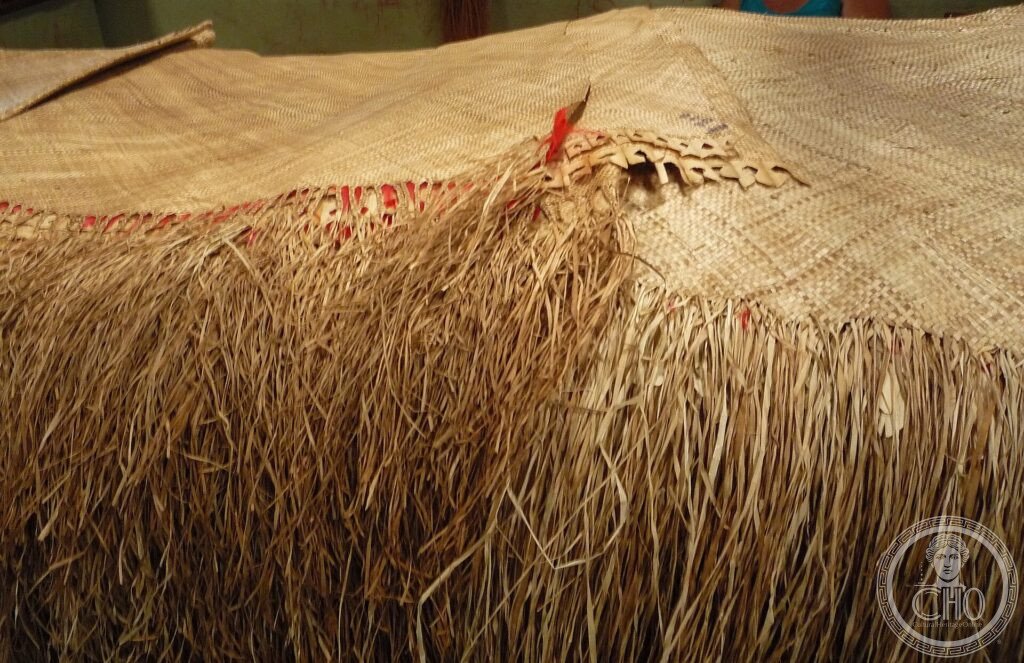
The ‘Ie Samoa is a special finely hand-woven mat fastened at the hem with two rows of green and red feathers, and a loose fringe on one end. Traditionally woven with fine strippings of the pandanus plant, the final product is silk-like. Its shiny coppery colour adds to its value as it is a testament to its age and the natural bleaching process it undergoes. The production process involves a high level of intricacy as each woven strand is as little as one millimeter wide. Producing a single ‘Ie Samoa can therefore take up to several months and even years. Nevertheless, the ‘Ie Samoa is more than a cultural product involving exceptional skill; its true value lies in its use as an object of exchange in traditional ceremonies and rituals that reaffirm kinship ties and strengthen community wellbeing. The ‘Ie Samoa is displayed and exchanged at festive celebrations or on important gatherings such as weddings and funerals, and its exchange contributes profoundly to the maintenance of the social structure. Today, an increasing number of young female weavers are involved, and even male weavers. Women and master weavers have established fine mat committees within their villages, allowing them to exchange ideas about best practice for weaving, and to boost opportunities for strengthening the transmission of the art form.
Official description, UNESCO Intangible Cultural Heritage List — 'Ie Samoa, fine mat and its cultural value
At a glance
The 'Ie Samoa is a finely hand-woven mat made from pandanus plant fibers, featuring a silk-like texture and shiny coppery colour that deepens with age and natural bleaching. It is distinguished by two rows of green and red feathers fastened at the hem and a loose fringe on one end. Beyond its exceptional craftsmanship, the 'Ie Samoa holds profound cultural value as an object exchanged in traditional ceremonies and rituals that reaffirm kinship ties and strengthen community wellbeing.
Origins & history
The tradition of ʻie tōga weaving is woven into the fabric of Samoan identity and has long been integral to women’s roles and status within their communities. The practice is inseparable from major life transitions and family obligations—matai chief title bestowals, weddings, and funerals all require the exchange of fine mats as gifts that bind families and honor relationships. Over time, the most exceptional pieces acquired their own names, marking them as heirlooms of singular importance.
The practice
Producing a single 'Ie Samoa demands exceptional skill and intricacy. Weavers work with fine strippings of the pandanus plant, with each woven strand measuring as little as one millimeter wide. The production process can take several months or even years to complete. Today, an increasing number of young female weavers participate in the tradition, alongside male weavers. Women and master weavers have established fine mat committees within their villages to exchange ideas about best practice and strengthen transmission of the art form.
Cultural significance
The 'Ie Samoa serves as an essential instrument for maintaining social structure through its exchange in traditional ceremonies and rituals. By affirming kinship ties at weddings, funerals, and other important gatherings, the mat strengthens community wellbeing. The involvement of growing numbers of young weavers and the establishment of village committees dedicated to the tradition reflect ongoing efforts to ensure the art form's survival and transmission to future generations.
Key facts
- Country: Samoa
- Inscribed: 2019
- UNESCO list: Representative List of the Intangible Cultural Heritage of Humanity
- UNESCO reference: 01499
- UNESCO vocabulary: Craft workers; Weaving
- Map: not shown — UNESCO’s official description of this element names no locality, and a living tradition is practised across a community, not at one address.
Where to experience it
The ʻIe Samoa is maintained in communities throughout Samoa, where women and increasingly young weavers and men practise the craft in homes and family settings. The mats are displayed and exchanged at festive celebrations, weddings, funerals, and important gatherings where their exchange reinforces kinship ties and strengthens community bonds. Master weavers and women have established fine mat committees within villages, creating spaces to share weaving techniques and support the transmission of this intricate art form to new generations.
Sources & resources
- UNESCO — official element page: 'Ie Samoa, fine mat and its cultural value
- UNESCO — open data record: Intangible Heritage List, reference 01499
- UNESCO — official photograph: Master weaver Vilelava Vaipae from Lepuia'i Manono was instrumental in the revitalization of 'ie Samoa. As one of the last known weavers of the traditional 'ie Samoa, she accompanied the Women in Business Development Inc. (WIBDI) trainers to introduce the art to women around the nation. — Women in Business Developmnet Inc., Samoa, 2004
- Reference — Wikipedia (secondary): %CA%BBIe t%C5%8Dga — consulted as a secondary reference, not as confirmation
- Cultural Heritage Online: Our archive and city guides

Sources
- S1 — Meleisea, Malama. The Making of Modern Samoa. Institute of Pacific Studies, 1987. ISBN 978-982-02-0031-9.
- S2 — Kirch, Patrick Vinton. On the Road of the Winds. University of California Press, 2000. ISBN 978-0-520-22347-9.
Spotted an error? Write to editorial@culturalheritageonline.com and we correct it the same day.