An editor reads the first two sentences and decides whether to read the third. Everything else — the structure, the sources, the links — exists to keep the reader who stayed. This is how an article is built for an online magazine, and what an editorial review looks for.
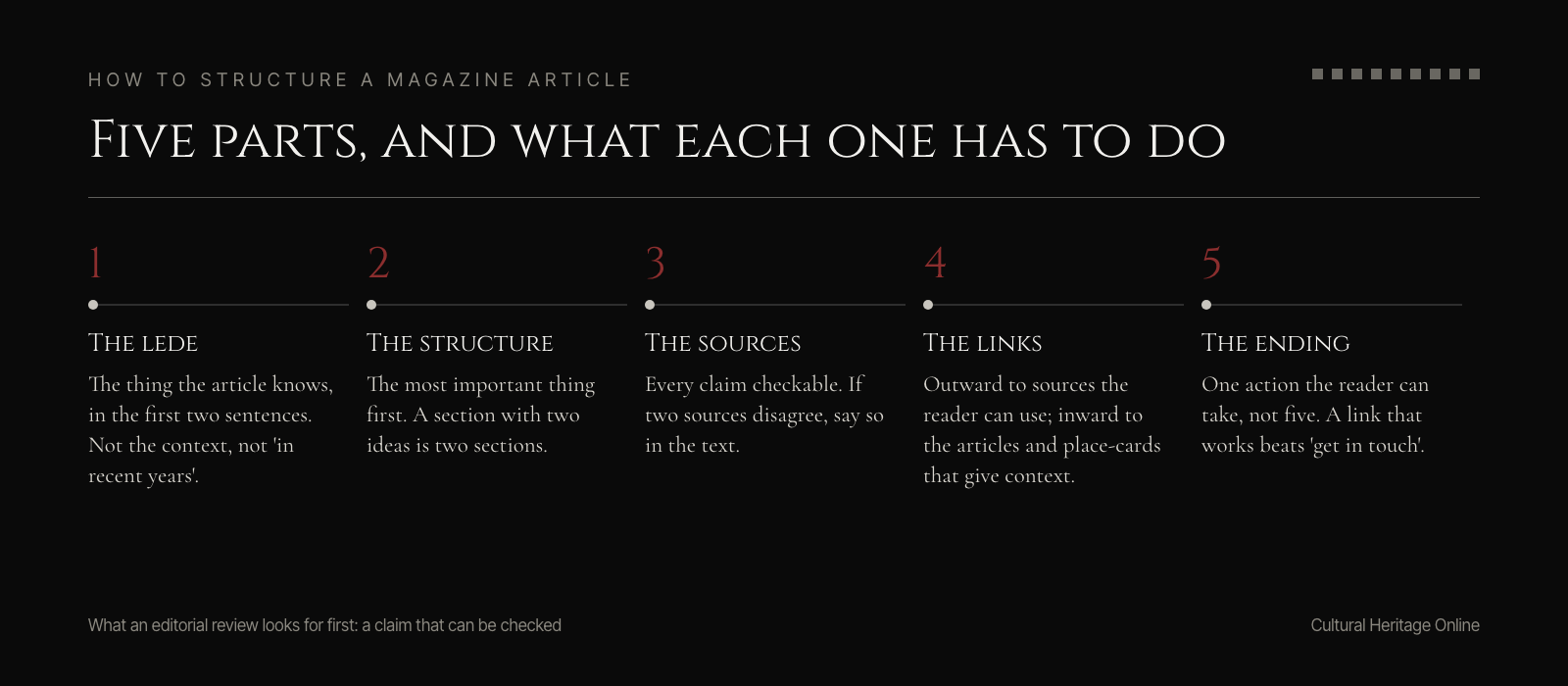
1. The lede
The first two sentences must contain the thing the article knows. Not the context, not the history of the subject, not "in recent years". The fact, the question, the scene: something that would be worth reading even if the article stopped there.
A lede that begins with a definition is a lede written for the writer, not for the reader. A lede that begins with a date, a place or a number is a lede that has something to say.
2. The structure
The inverted pyramid still works: the most important thing first, then the detail, then the background. Online, it works even better, because the reader can leave at any line.
A section with two ideas is two sections. Four elements hold an article together:
- a title that says what the article is, not what it feels like;
- a summary of two lines, which is what a reader sees before deciding;
- numbered or titled sections, each with one idea and a list where a list helps;
- a closing that says what the reader can do, not what the writer hopes.
3. The sources
Every factual claim needs a source, and the source must be checkable: an institutional page, a book, a document, a database. Wikipedia is a reference, not a citation.
The rule that saves articles from corrections: if two sources disagree, say so in the text. A sentence that reports a disagreement is more credible than one that picks a side without saying it. A source that cannot be opened is not a source, and a quote that cannot be traced is a rumour with a citation.
4. The links
An article on a magazine is not a page on a website: it is a node. It has to link outward, to the sources, and inward, to what the magazine has already published on the same subject.
Two rules:
- the outbound links point to sources the reader can use, not to the client’s homepage;
- the internal links point to the articles and place-cards that give the subject a context.
An article with no internal links enters the magazine alone, and it stays alone. The links are also how a search engine understands what the article is about: they are the subject, written in addresses. A link that opens on a 404 is worse than no link.
5. The ending
Every article ends with what the reader can do: visit, read, propose, subscribe, write. One action, not five, and the action must be possible: a link that works beats an invitation to get in touch. The call to action is the last sentence of the argument, not an advertisement attached to it.
6. What the editorial review looks for
- a claim that can be checked;
- a text that adds something the archive does not already have (the archive holds 2,458 articles; measured on 22 October 2026);
- sources cited, images credited, links relevant;
- a title that is the article, and a lede that is the reason to read it.
If the proposal has these four, the article can be written. If it has none, no amount of rewriting will save it: an editor’s no is almost always about the claim, not about the prose.
Read the three plans and send a 200-word proposal: /guest-post/