
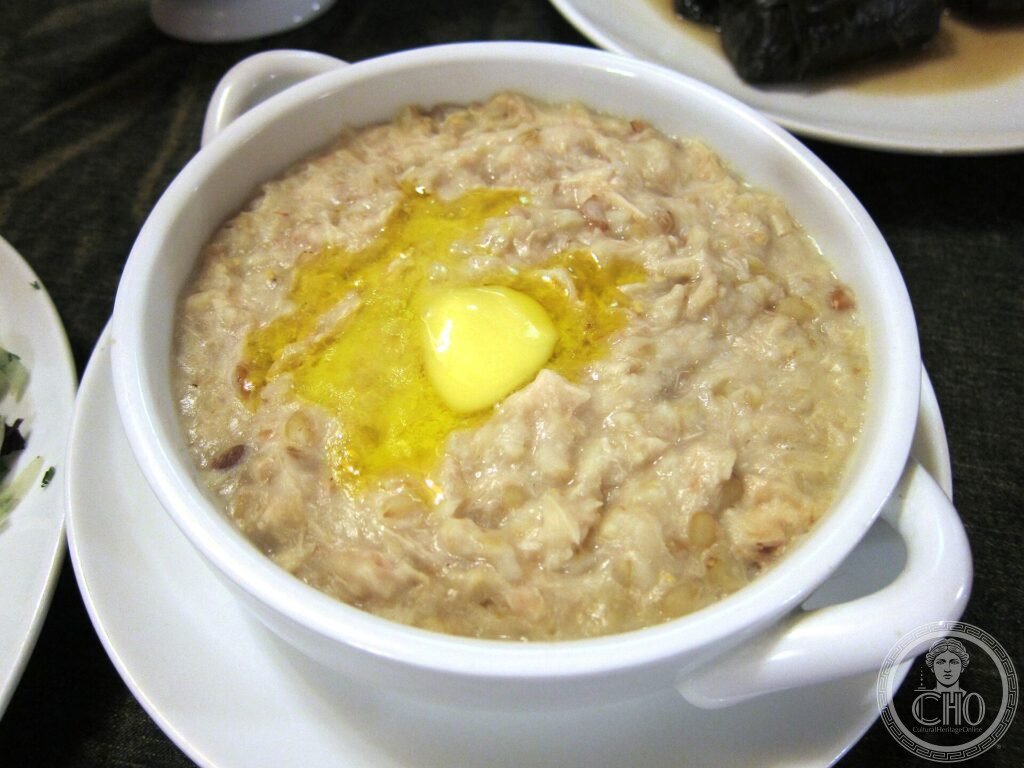
A slow-cooked wheat porridge enriched with meat and spices, harees carries centuries of culinary tradition across the Gulf and Levantine regions. Prepared with patience and ritual, it marks sacred moments—Easter tables in Armenia, Ramadan nights, and the solemn observances of Ashura.
In UNESCO’s words
Harees is a popular traditional dish made with wheat grain, meat and ghee. Typically consumed at breakfast and dinner, the dish is usually made in big quantities because of the effort required to clean and grind the grain. It is served in large dishes that are shared by several people, and eaten using the thumb and forefinger while sitting on one knee. Although harees is prepared for many occasions, it is particularly popular during Ramadan, when honouring guests, and for social events such as weddings. It is also popular during the pilgrimage season because of the simplicity of its ingredients and the ability to make and serve it in large quantities. In the United Arab Emirates, Oman and Saudi Arabia, Harees is present in many social and cultural elements such as folk stories, sayings and poetry. The related skills and knowledge are passed on from mothers to daughters, in educational institutes, restaurants and hotels, and through the media and official institutions. Preparing and serving harees is viewed as a sign of hospitality and generosity. A means of promoting social connection, the practice strengthens bonds between people and communities while enhancing cultural affinity in the societies concerned.
Official description, UNESCO Intangible Cultural Heritage List — Harees dish: know-how, skills and practices
At a glance
Harees is a traditional dish made from wheat grain, meat, and ghee, typically consumed at breakfast and dinner. The preparation requires significant effort to clean and grind the grain, so it is usually made in large quantities. The dish is served in large shared dishes and eaten using the thumb and forefinger while sitting on one knee.
Origins & history
Harees appears across a vast geography, from Armenia to the Arab states of the Persian Gulf. Its roots run deep in communities where wheat has long been a dietary staple and meat a precious ingredient reserved for celebration. The dish reflects the convergence of culinary practices across the Eastern Mediterranean and Arabian Peninsula.
The practice
Harees is prepared by combining wheat grain with meat and ghee. Because of the labour involved, it is made in substantial quantities at a time. The dish is shared among several people, served in large dishes, and traditionally eaten using the thumb and forefinger while sitting on one knee.
Cultural significance
Harees holds deep cultural importance in the United Arab Emirates, Oman, and Saudi Arabia, appearing in folk stories, sayings, and poetry. The dish is particularly popular during Ramadan, at weddings, during the pilgrimage season, and when honouring guests. Preparing and serving harees represents hospitality and generosity, strengthening social bonds and enhancing cultural affinity within communities.
Key facts
- Country: United Arab Emirates, Oman, Saudi Arabia
- Inscribed: 2023
- UNESCO list: Representative List of the Intangible Cultural Heritage of Humanity
- UNESCO reference: 01744
- UNESCO vocabulary: Food preparation; Hospitality; Religious practice; Social participation
- Map: not shown — UNESCO’s official description of this element names no locality, and a living tradition is practised across a community, not at one address.
- Related World Heritage site: Cultural Sites of Al Ain (Hafit, Hili, Bidaa Bint Saud and Oases Areas), Al-Ahsa Oasis, an Evolving Cultural Landscape (a different UNESCO designation, not the place of the tradition)
Where to experience it
Harees is encountered throughout the United Arab Emirates, Oman and Saudi Arabia, where it remains deeply woven into social life. The dish appears at family tables during Ramadan, at weddings, and during the pilgrimage season, when its ease of preparation and generous portions make it ideal for feeding large gatherings. Visitors may experience harees preparation in homes, educational institutes, restaurants and hotels across these countries, where the tradition continues to be passed from mothers to daughters and taught through official institutions. The act of sharing this communal dish—eaten by hand while seated together—reveals how harees embodies values of hospitality and social connection in these societies.
Sources & resources
- UNESCO — official element page: Harees dish: know-how, skills and practices
- UNESCO — open data record: Intangible Heritage List, reference 01744
- UNESCO — official photograph: A group of men gathered in a festive occasion eating the popular harees dish (United Arab Emirates) — Mina Adly Bekhit Gendi, K. Renative FZ-LLC, United Arab Emirates; 2020
- Reference — Wikipedia (secondary): Harees — consulted as a secondary reference, not as confirmation
- Cultural Heritage Online: Our archive and city guides

Sources
- S1 — Heard-Bey, Frauke. From Trucial States to United Arab Emirates. Longman, 1982. ISBN 978-0-582-78032-3.
- S2 — Al-Fahim, Mohammed. From Rags to Riches: A Story of Abu Dhabi. London Centre for Arab Studies, 1995. ISBN 978-1-900404-00-6.
Spotted an error? Write to editorial@culturalheritageonline.com and we correct it the same day.