
A circle dance rooted in the Armenian Highlands, performed across generations by Armenians and in variant forms by neighboring communities, each region preserving its own choreography and musical traditions.
In UNESCO’s words
Kochari is a traditional dance that is widely performed throughout Armenia during holidays, festive celebrations, family ceremonies and other social events. It is open to all participants, irrespective of age, gender or social status. Kochari provides a sense of shared identity and solidarity, contributes to the continuity of historical, cultural and ethnic memory, and fosters mutual respect among community members of all ages. It is transmitted through both non-formal and formal means, and is one of the rare traditional dances whose chain of transmission has never been interrupted. Formal means of transmission include the inclusion of a ‘folk song and dance’ course in the curricula of comprehensive schools in Armenia since 2004, educational programmes in youth arts centres, increased visibility of the element through the internet and other media outlets, and institutional initiatives. Folk dance groups have also been active in various communities since the 1960s, and non-governmental organizations regularly hold dance classes. Non-formal transmission occurs within families and through spontaneously formed dance groups. Communities, groups and individuals are actively involved in ensuring the viability of the element, notably through the ‘Our dances and we’ initiative, which has been carried out since 2008, with experienced practitioners playing a key role in safeguarding efforts.
Official description, UNESCO Intangible Cultural Heritage List — Kochari, traditional group dance
At a glance
Kochari is a traditional circle dance performed throughout Armenia at holidays, celebrations, family ceremonies and social events. Open to participants of all ages, genders and social backgrounds, it creates a shared sense of identity and solidarity within communities. The dance has maintained an unbroken chain of transmission from generation to generation—a rare distinction among traditional dances.
Origins & history
Kochari's transmission has never been interrupted, passing continuously through families and community groups. Since the 1960s, folk dance groups have actively maintained the tradition in various communities. Formal education began in 2004 with the inclusion of folk song and dance courses in Armenian school curricula, supported by youth arts centres and media visibility. The 'Our dances and we' initiative, launched in 2008, has further strengthened safeguarding efforts with experienced practitioners at the centre.
The practice
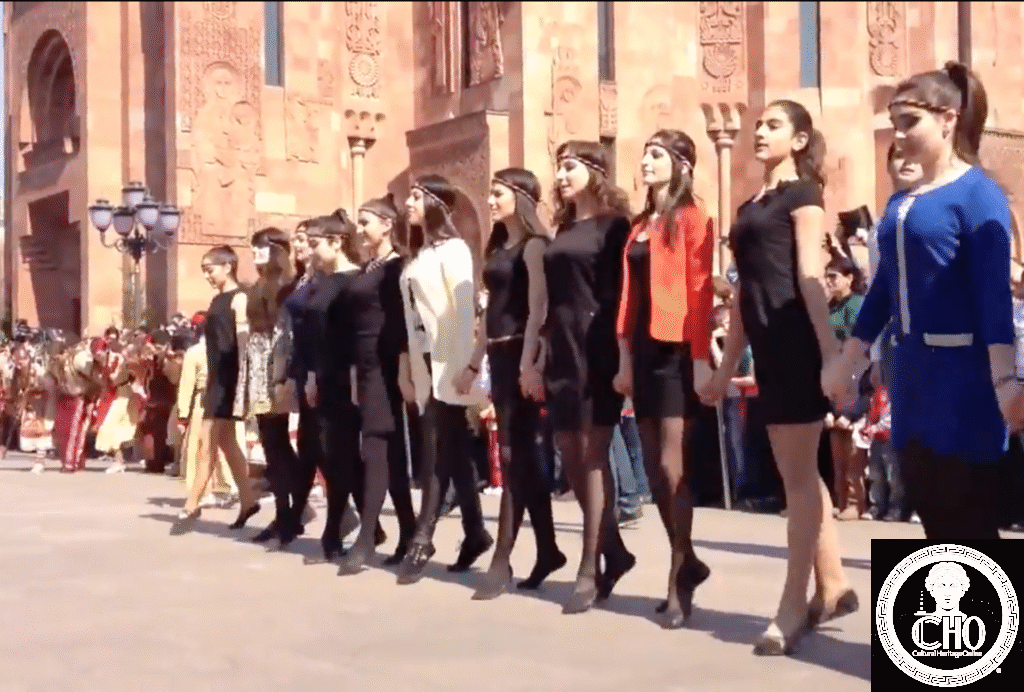
Kochari is danced in a circle formation with participants holding hands or linking arms, moving together in coordinated, rhythmic steps. It is performed at holidays, festive celebrations, family ceremonies and social events, bringing communities together. Both formal instruction—through schools, youth centres and folk dance groups—and informal transmission within families and spontaneously formed dance groups ensure the practice continues across generations.
Cultural significance
For Armenian communities, Kochari provides continuity of historical, cultural and ethnic memory while fostering mutual respect among members of all ages. It strengthens community bonds and maintains cultural identity. The dance's viability depends on active participation from communities, groups and individuals, with experienced practitioners playing a key role in passing knowledge to new generations and sustaining the tradition.
Key facts
- Country: Armenia
- Inscribed: 2017
- UNESCO list: Representative List of the Intangible Cultural Heritage of Humanity
- UNESCO reference: 01295
- UNESCO vocabulary: Dance; Instrumental music
- Map: not shown — UNESCO’s official description of this element names no locality, and a living tradition is practised across a community, not at one address.
Where to experience it
Kochari thrives throughout Armenia, where it remains central to holidays, family ceremonies, and community gatherings of all ages. The dance is transmitted through families, comprehensive schools where folk song and dance courses have been taught since 2004, youth arts centres, and folk dance groups active in various communities. Visitors can experience Kochari at festive celebrations and social events, while the 'Our dances and we' initiative, running since 2008, regularly offers opportunities to learn from experienced practitioners. Armenian cultural organizations worldwide also maintain the tradition, ensuring this unbroken chain of transmission continues.
Sources & resources
- UNESCO — official element page: Kochari, traditional group dance
- UNESCO — open data record: Intangible Heritage List, reference 01295
- UNESCO — official video: UNESCO film on this element — embedded on this page
- UNESCO — official photograph: Photograph of this element — Gagik Ginosyan, 2013
- Reference — Wikipedia (secondary): Kochari — consulted as a secondary reference, not as confirmation
- Cultural Heritage Online: Our archive and city guides

Sources
- S1 — Lisitsian, Srbui. Starinnye pliaski i teatralnye zrelishcha armianskogo naroda. Izdatelstvo AN Armianskoi SSR, 1958. / Maranci, Christina. The Art of Armenia. Oxford University Press, 2018. ISBN 978-0-19-067409-0.
- S2 — Redgate, Anne Elizabeth. The Armenians. Wiley-Blackwell, 2000. ISBN 978-0-631-22037-4.
Spotted an error? Write to editorial@culturalheritageonline.com and we correct it the same day.