
A refined vocal art form for mixed voices, gagok cycles through classical Korean poetry accompanied by ensemble instruments, preserving centuries of aristocratic musical tradition.
In UNESCO’s words
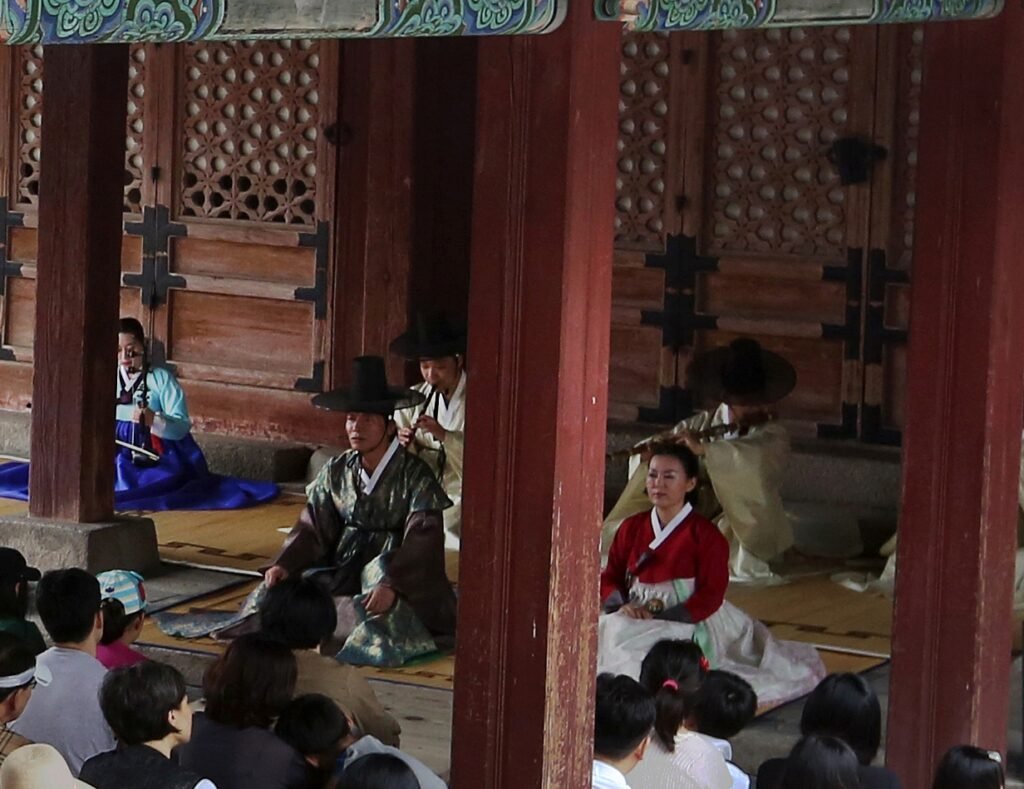
Gagok is a genre of traditional Korean vocal music sung by men and women to the accompaniment of a small orchestra, one of several forms of singing that together constitute ''jeongga,'' or ‘right song’. Formerly a music associated with the higher classes, Gagok is today widely popular throughout the country. Gagok comprises twenty-six ''namchang'' or songs for men, and fifteen ''yeochang'' or songs for women. ''Namchang'' are characterized by strong, deep, resonant voices, while ''yeochang'' are characterized by high-pitched, thin voices. Gagok songs are composed either in a solemn, peaceful key or a melancholic one, and use 10-beat or 16-beat rhythm. The traditional instrumentation of the orchestra includes the ''geomungo'' six-string zither, ''daegeum'' bamboo transverse flute, ''gayageum'' twelve-string zither and ''piri'' (small double-reed pipe). Gagok songs are acclaimed for their lyrical patterns, balance, refined melodies and advanced musical composition. Acquiring skill as a singer takes extensive time and effort and performance requires dedication and extreme control. Gagok is preserved and transmitted by practitioners, their communities and related organizations in local heritage training centres. Gagok has played an important role in the establishment of Korean identity.
Official description, UNESCO Intangible Cultural Heritage List — Gagok, lyric song cycles accompanied by an orchestra
At a glance
Gagok is a genre of traditional Korean vocal music performed by men and women with an accompanying orchestra. The tradition comprises twenty-six songs for male singers and fifteen for female singers, each group distinguished by vocal characteristics—men's songs feature strong, deep, resonant voices, while women's songs are characterized by high-pitched, thin voices. Gagok songs are composed in either solemn, peaceful or melancholic keys, using 10-beat or 16-beat rhythms. The form is acclaimed for its lyrical patterns, balance, refined melodies and advanced musical composition.
Origins & history
Gagok is one of several forms that together constitute jeongga, or 'right song'. It was formerly associated with the higher classes but is today widely popular throughout the country. The tradition represents a significant chapter in Korean cultural development and has played an important role in the establishment of Korean identity.
The practice
Gagok performances feature singers accompanied by a small traditional orchestra. The standard instrumentation includes the geomungo six-string zither, daegeum bamboo transverse flute, gayageum twelve-string zither and piri small double-reed pipe. Acquiring skill as a gagok singer requires extensive time and effort, and performance demands dedication and extreme control from the vocalist.
Cultural significance
Gagok is preserved and transmitted by practitioners, their communities and related organizations in local heritage training centres. The tradition's refined musical and lyrical sophistication has established it as a valued expression of Korean cultural heritage. Mastery of this form represents a significant commitment to maintaining Korea's musical legacy.
Key facts
- Country: Republic of Korea
- Inscribed: 2010
- UNESCO list: Representative List of the Intangible Cultural Heritage of Humanity
- UNESCO reference: 00444
- UNESCO vocabulary: Instrumental music; Vocal music
- Map: not shown — UNESCO’s official description of this element names no locality, and a living tradition is practised across a community, not at one address.
Where to experience it
Gagok is preserved and transmitted throughout Korea by practitioners, their communities, and related organizations working in local heritage training centres. Visitors can encounter this refined vocal tradition through performances by recognized masters and their apprentices, as well as through workshops and cultural programmes offered by these community-based organizations dedicated to maintaining this essential element of Korean identity.
Sources & resources
- UNESCO — official element page: Gagok, lyric song cycles accompanied by an orchestra
- UNESCO — open data record: Intangible Heritage List, reference 00444
- UNESCO — official photograph: Photograph of this element — Kim Sang-su — National Research Institute of Cultural Heritage, 2009
- Reference — Wikipedia (secondary): Gagok — consulted as a secondary reference, not as confirmation
- Cultural Heritage Online: Our archive and city guides

Sources
- S1 — Howard, Keith, ed. Korean Pop Music: Riding the Wave. Global Music Centre, 2006. ISBN 978-1-905246-14-4.
- S2 — Hwang, Byungki. Philosophy and Aesthetics in Korean Traditional Music. Ewha Womans University Press, 2002. ISBN 978-89-7300-476-8.
Spotted an error? Write to editorial@culturalheritageonline.com and we correct it the same day.