
Khmer shadow puppeteers move large, articulated leather figures across a glowing screen, enacting the Ramayana while narrators and a pinpeat orchestra bring the ancient epic to life. This sacred performance embodies centuries of Cambodian belief rooted in Brahmanist and Buddhist mythology.
In UNESCO’s words
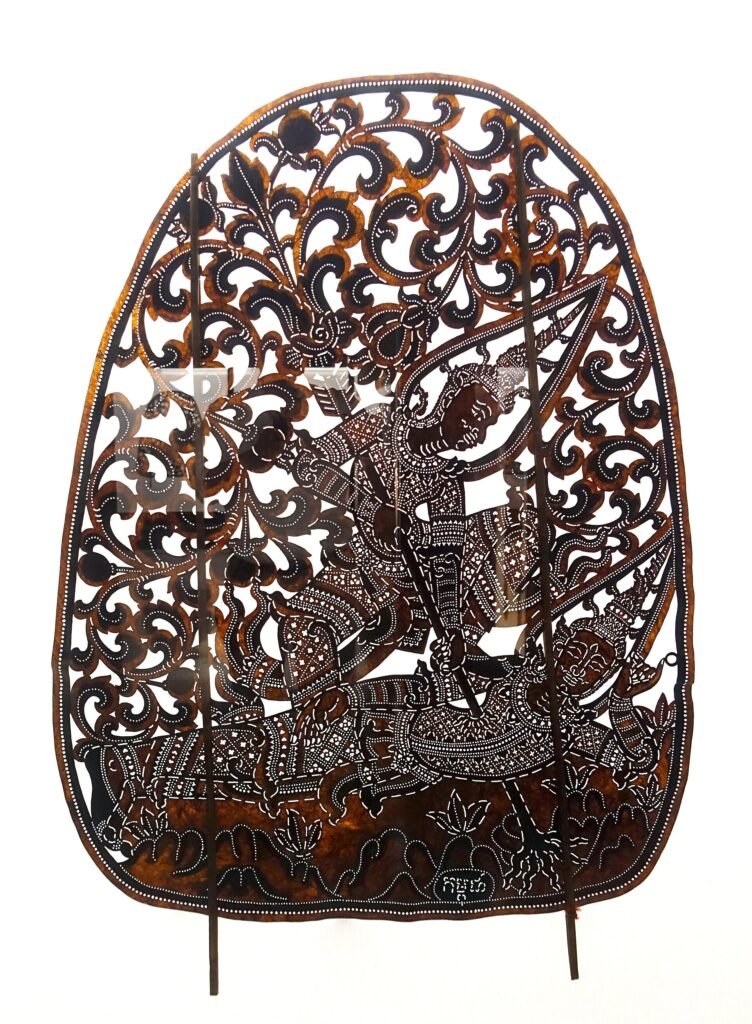
The Sbek Thom is a Khmer shadow theatre featuring twometre high, non-articulated puppets made of leather openwork. Dating from before the Angkorian period, the Sbek Thom, along with the Royal Ballet and mask theatre, is considered sacred. Dedicated to the divinities, performances could only take place on specific occasions three or four times a year, such as the Khmer New Year, the King’s birthday or the veneration of famous people. After the fall of Angkor in the fifteenth century, the shadow theatre evolved beyond a ritualistic activity to become an artistic form, while retaining its ceremonial dimension. The puppets are made from a single piece of leather in a special ceremony for each character representing gods and deities. The hides are dyed with a solution made from the bark of the Kandaol tree. The artisan draws the desired figure on the tanned hide, then cuts it out and paints it before attaching it to two bamboo sticks enabling the dancer to control the puppet. The performances traditionally take place at night outdoors beside a rice-field or pagoda. A large white backdrop is held between two tall bamboo screens in front of a large fire or, nowadays, projectors. The shadows of the puppet’s silhouettes are projected onto the white screen. The animators bring the puppets to life with precise and specific dance steps. The performance is accompanied by an orchestra and two narrators. Inspired from the Reamker, the Khmer version of the Ramayana, the performances stage scenes of this epic, which may last several nights and require up to 160 puppets for a single presentation. Many of them were destroyed under the repressive Khmer Rouge regime, which almost annihilated this sacred art. Since 1979, Sbek Thom has been gradually revitalized thanks to the few surviving artists. So far, three shadow theatres have managed to rise from their ashes, ensuring the transmission of the knowledge and skills, including those relating to puppet making.
Official description, UNESCO Intangible Cultural Heritage List — Sbek Thom, Khmer shadow theatre
At a glance
Sbek Thom is a Khmer shadow theatre that uses large leather puppets, each two metres high, to project silhouettes onto a white screen. The puppets are non-articulated—they do not move their limbs—and are made from a single piece of leather cut and painted to represent gods and deities. Performances take place at night outdoors, traditionally beside a rice-field or pagoda, with a fire or projectors behind the screen to cast the shadows.
Origins & history
Dating from before the Angkorian period, Sbek Thom was originally a sacred ritual art, performed only three or four times a year on specific occasions such as the Khmer New Year, the King's birthday, or the veneration of famous people. After the fall of Angkor in the fifteenth century, it evolved beyond a purely ritualistic activity to become an artistic form while retaining its ceremonial character. The tradition was nearly destroyed under the Khmer Rouge regime, but since 1979 it has been gradually revitalized by surviving artists, with three shadow theatres now working to pass on the knowledge and skills to new generations.
The practice
Puppets are made in a special ceremony from a single piece of hide, dyed with a solution from the bark of the Kandaol tree. The artisan draws the figure on the tanned hide, cuts it out, paints it, and attaches it to two bamboo sticks for the dancer to control. Performances traditionally feature an orchestra and two narrators who tell stories from the Reamker, the Khmer version of the Ramayana. A single presentation may use up to 160 puppets and last several nights, with the animators bringing each character to life through precise and specific dance steps behind the illuminated screen.
Cultural significance
Sbek Thom is considered sacred and holds deep ceremonial importance for the Khmer community. The performances serve a spiritual function, dedicated to divinities and reinforcing cultural and religious traditions. The tradition faced near annihilation during the Khmer Rouge period, when many puppets were destroyed. Its survival and ongoing revival by the few remaining artists represents an effort to preserve this sacred art form and transmit its knowledge and skills to future generations.
Key facts
- Country: Cambodia
- Inscribed: 2008
- UNESCO list: Representative List of the Intangible Cultural Heritage of Humanity
- UNESCO reference: 00108
- UNESCO vocabulary: Puppets; Shadow play; Theatre
- Map: not shown — UNESCO’s official description of this element names no locality, and a living tradition is practised across a community, not at one address.
Where to experience it
Sbek Thom performances traditionally take place at night outdoors beside rice fields or pagodas, where a white backdrop is held between tall bamboo screens in front of a fire or projectors to cast the puppets' silhouettes. The art form is performed during temple ceremonies and on special occasions such as the Khmer New Year and the King's birthday. Since 1979, three shadow theatres have been revitalized by surviving artists, working to transmit the knowledge and skills of this sacred tradition—including the specialized craft of puppet making from leather—to new generations across Cambodia.
Sources & resources
- UNESCO — official element page: Sbek Thom, Khmer shadow theatre
- UNESCO — open data record: Intangible Heritage List, reference 00108
- UNESCO — official video: UNESCO film on this element — embedded on this page
- UNESCO — official photograph: The shadow theatre Sbek Thom features large non-articulated puppets made of leather, brought to life by the animators’ precise gestures and dance steps. Accompanied by an orchestra and narrators, the puppet dancers stage scenes of the Ramayana epic, known in Cambodia as Reamker. — National Museum of Cambodia
- Reference — Wikipedia (secondary): Khmer shadow theatre — consulted as a secondary reference, not as confirmation
- Cultural Heritage Online: Our archive and city guides

Sources
- S1 — Brandon, James R. Theatre in Southeast Asia. Harvard University Press, 1967. ISBN 978-0-674-87587-6.
- S2 — Phim, Toni Samantha, and Ashley Thompson. Dance in Cambodia. Oxford University Press, 1999. ISBN 978-983-56-0059-3.
Spotted an error? Write to editorial@culturalheritageonline.com and we correct it the same day.