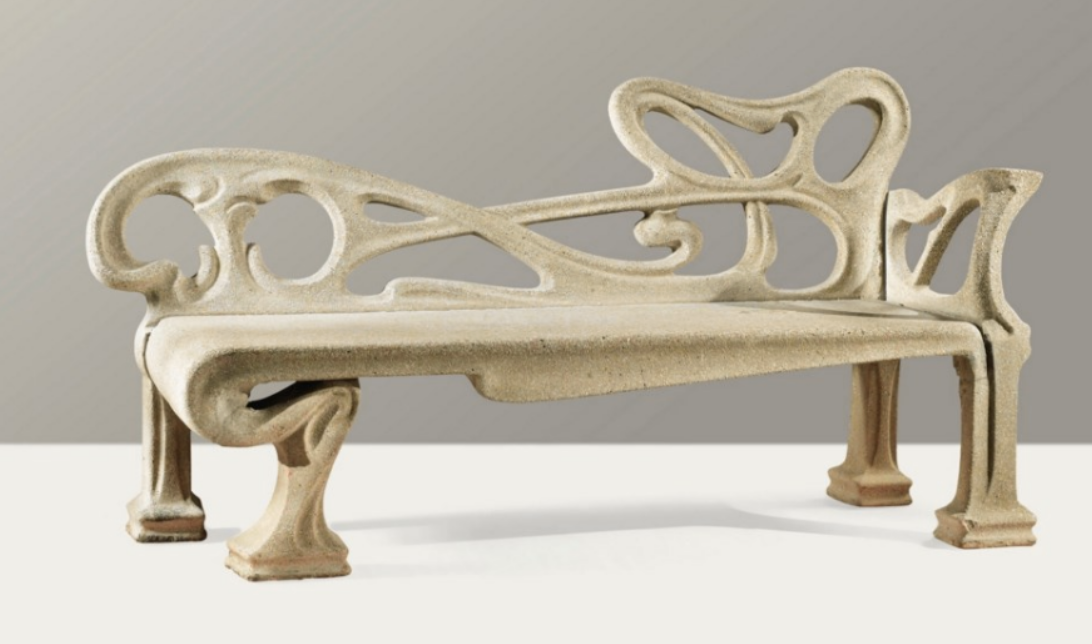
A stone bench from approximately 1906–1914, attributed to designer Antoni Gaudí, represents the formal vocabulary of Art Nouveau applied to functional furniture. The bench comprises four removable elements crafted in modelled stone.
Design and Structure
The rectangular seat is flanked on the right by a splayed, perforated armrest. On the left, the seat curves downward and wraps beneath itself, extending into a whip-like foot at the front. The asymmetrical backrest employs sinuous curves and counter-curves articulated with ribbed detailing, creating rounded cavities through the interplay of opposing forms. Three additional feet are moulded with ribbed patterns, each terminating in a widened base.
Material and Craftsmanship
The entire piece is executed in modelled stone, a labour-intensive technique suited to Gaudí’s sculptural approach to design. The perforated surfaces and curved elements demonstrate the material’s capacity for both structural and decorative expression. The removable component system suggests both practical considerations and a modular design philosophy characteristic of early-twentieth-century experimentation.
Frequently asked questions
When was this bench made?
The bench dates to approximately 1906–1914, a period of mature Art Nouveau design.
Is the attribution to Gaudí confirmed?
The piece is attributed to Antoni Gaudí; the attribution is noted as such without definitive confirmation.
What materials were used?
The bench is constructed entirely from modelled stone, composed of four removable elements.
Sources
- S1 — De Fusco, Renato. Storia del design. Laterza, 2002. ISBN 978-88-420-6623-1.
- S2 — Sparke, Penny. Italian Design: 1870 to the Present. Thames & Hudson, 1988. ISBN 978-0-500-23531-7.
Spotted an error? Write to editorial@culturalheritageonline.com and we correct it the same day.