
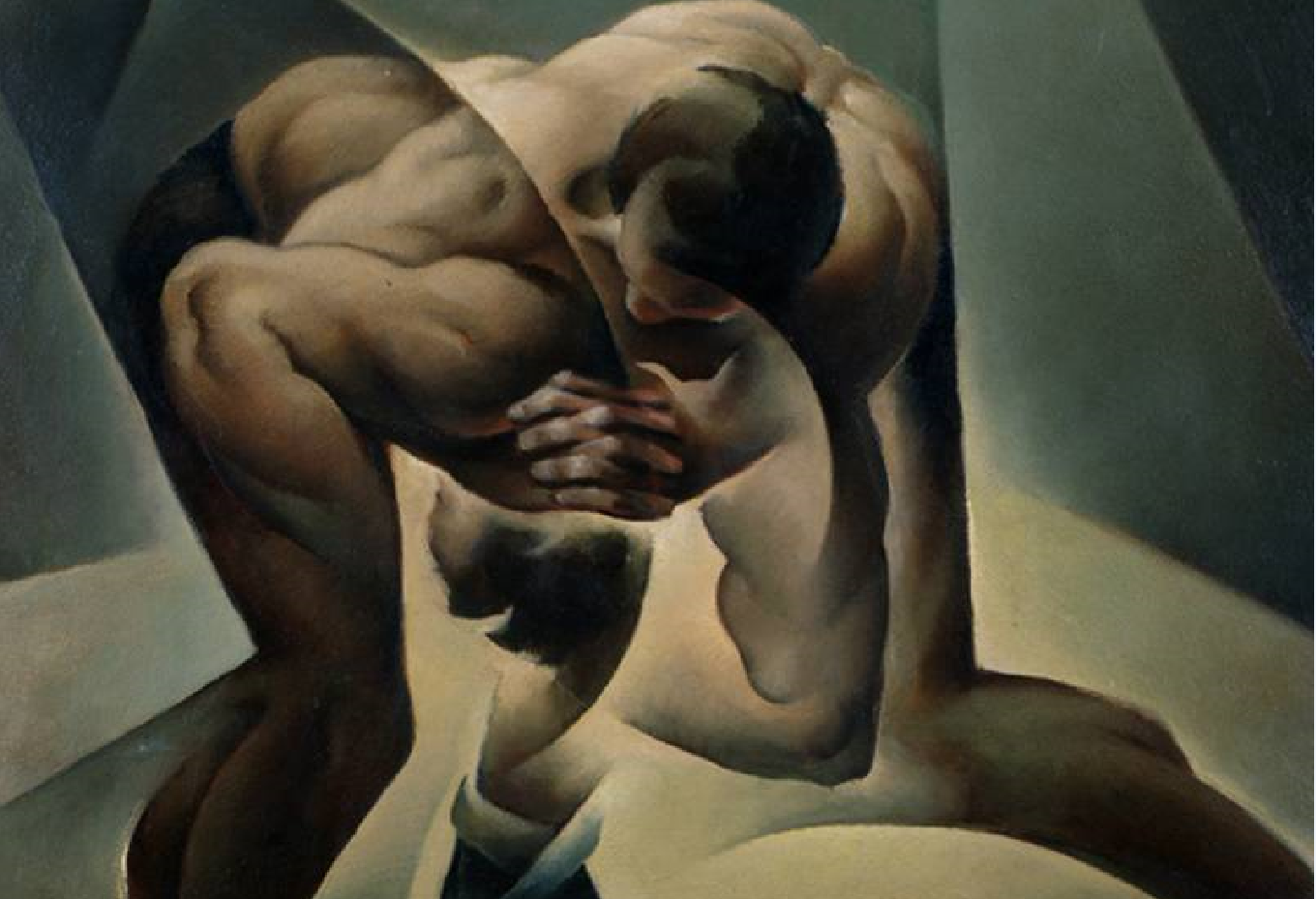
Lotta greco romana is a painting by Tullio Crali created in 1935. The work takes classical Greco-Roman wrestling as its subject, channelled through the artist’s engagement with Futurist aesthetics and his preoccupation with movement and dynamism.
Crali, a Dalmatian Italian painter who joined the Futurist movement in 1929, brought his distinctive visual language to this traditional theme. Though known for realistic paintings that foreground speed, aerial mechanisation and the dynamics of flight, Crali worked across multiple styles throughout his career, and Lotta greco romana demonstrates his ability to synthesise classical content with modernist formal concerns.
About Tullio Crali
A self-taught painter, Crali came to Futurism as a late adherent, joining the movement during its mature phase. His work often explored the visual possibilities of movement and mechanical forms, establishing him as a significant if somewhat unconventional figure within the Futurist programme.
Details
- Artist: Tullio Crali
- Year: 1935
- Movement: Futurism
- Medium: Painting
Frequently asked questions
Who created this work?
Tullio Crali, a Dalmatian Italian painter who joined the Futurist movement in 1929, created Lotta greco romana in 1935.
What movement was Crali associated with?
Crali was a late adherent to Futurism, known for realistic paintings combining speed, aerial mechanisation and the dynamics of movement, though he worked in other styles throughout his long career.
What is the subject of this painting?
The work takes Greco-Roman wrestling as its subject, exploring classical athletic tradition through a modernist Futurist perspective.
Sources
- S1 — Pontiggia, Elena. Il Novecento Italiano. Abscondita, 2003. ISBN 978-88-8416-048-5.
- S2 — Bossaglia, Rossana. Il Novecento italiano. Electa, 1995. ISBN 978-88-435-6178-0.
Spotted an error? Write to editorial@culturalheritageonline.com and we correct it the same day.


