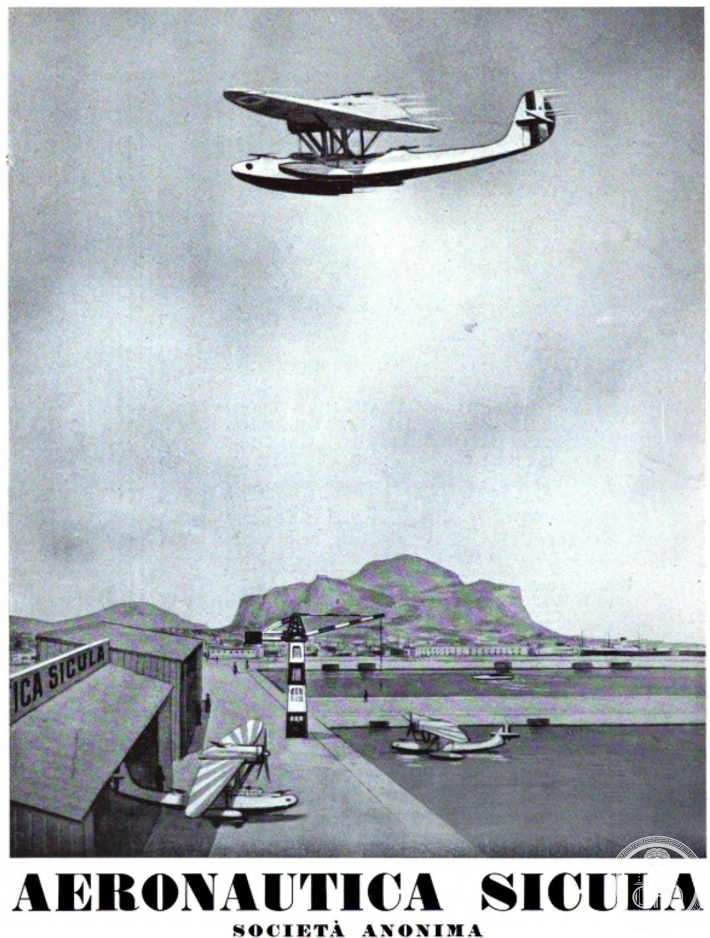
A single-engined flying boat crosses the top of the sheet, high and slightly nose-down. Below it, a slipway, a hangar with the company name on its flank, a second machine on the water and a third being handled on the apron — and closing the horizon, unmistakable, the flat block of Monte Pellegrino. Across the foot, in fat serif capitals: AERONAUTICA SICULA, SOCIETÀ ANONIMA.
The aircraft is a high-wing flying boat with a single engine mounted above the wing on a pylon, a single hull and floats outboard — the arrangement of the CANT Z.501 «Gabbiano», the long-range maritime reconnaissance machine that the Regia Aeronautica used all round the Mediterranean. The mountain places the scene: this is the seaplane base of Palermo, at the foot of Pellegrino, and the hangar in the left foreground carries the letters …ICA SICULA in a broken run.
From Basile’s cabinets to the Regia Marina
Behind the sheet is one of the more surprising turns in Italian industrial history. Aeronautica Sicula descends from the Officine Ducrot of Palermo — the furniture and interiors firm of Vittorio Ducrot, the workshop that executed the interiors of the great Sicilian Art Nouveau, and fitted out ships. In 1916, to meet wartime orders, Ducrot converted it: with the Florio family he founded the Vittoria Aeronautica Ducrot to build seaplanes for the Regia Marina, producing the FBA Type H reconnaissance biplane under licence from the Franco-British Aviation Company and testing the machines in the gulf of Mondello. Its own design, the Ducrot SLD fighter of 1918 by the engineers Manlio Stiavelli and Guido Luzzatti, was said to reach 300 km/h; the first prototype came out in October 1918 and the armistice ended the experiment. Through the 1920s the business ran on for a time as Società Aeronautica Ducrot & Florio.
In 1935 Ducrot joined Giovanni Battista Caproni to set up the Società Caproni-Ducrot costruzioni aeronautiche, and the following year it became Aeronautica Sicula S.A. It built seaplanes under licence at the naval shipyard of Palermo: more than two hundred CANT Z.501 «Gabbiano» came out of it. A Regia Aeronautica contract of 19 May 1941 ordered fifty-two of the twin-engined CANT Z.515 from the firm, but none was finished; the works also overhauled and repaired Savoia-Marchetti S.M.79 bombers. Ducrot died in 1942. In August 1943, after the Allied landings in Sicily, twelve incomplete Z.501s were captured in the plant, and the company afterwards repaired a number of them for Allied use.
How the name dates the sheet
The name across the bottom is the one piece of dating the paper gives up by itself. The firm was called Aeronautica Sicula S.A. only from 1936; the sheet therefore cannot be earlier than that year, and the aircraft it shows was in production there from about the same time. The note that came with the scan proposes 1936–38 and the magazine L’Ala d’Italia; the first is compatible with the sheet, the second we have not been able to check.
There is no signature anywhere on the page. The article is published without an author.
About this image. The work is still protected by copyright: under Italian law (L. 633/1941) rights run for 70 years from the death of the author. Since the author has not been identified, that term cannot be considered expired, and the image is treated as fully protected. It is reproduced here for documentation, study and critical purposes only, under Art. 70 of L. 633/1941 and the fair-use provision of 17 U.S.C. §107. The scan was made by the collector from his own copy of the sheet, part of the period material he keeps in a private archive: owning the physical sheet is not the same as holding the rights to the work. The image is not offered for sale, no reproduction rights are granted, and any request concerning the work should be addressed to the rights holders. Cultural Heritage Online publishes this material to document it, with no celebratory intent; see our terms and the DMCA contact published there.
Sources
- S1 — Sgarlato, Nico. Aeronautica Sicula: Storia di un'industria aeronautica a Palermo. Delta Editrice, 2004. ISBN 978-88-87322-03-3.
- S2 — Curami, Andrea. Gli idrovolanti CRDA Cant Z: Dalle origini alla guerra. Giorgio Apostolo Editore, 2001. ISBN 978-88-87261-09-7.
Spotted an error? Write to editorial@culturalheritageonline.com and we correct it the same day.