
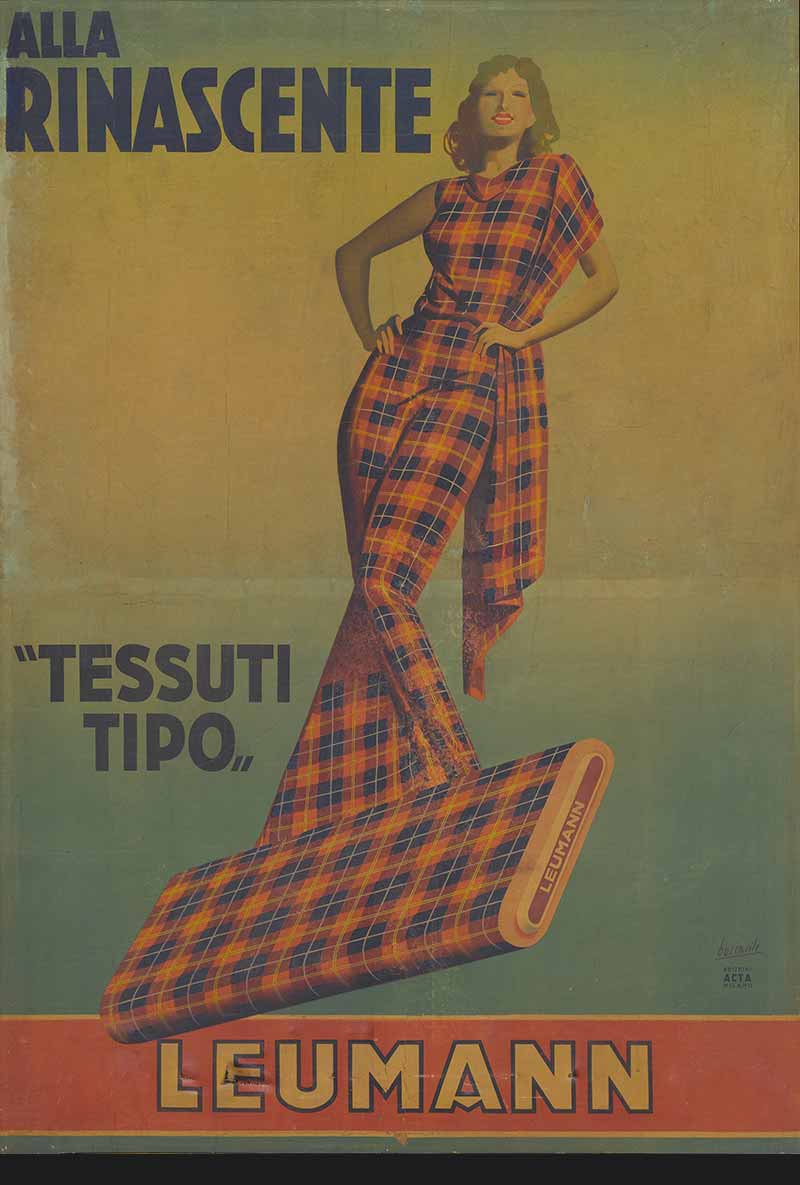
This advertising poster was designed by Gino Boccasile around 1941. Boccasile (1901–1952) was an Italian illustrator and graphic designer, and one of the most significant poster artists of the Fascist era.
Born in Bari, Boccasile moved to Milan in 1925 after his father’s death. He worked at the Mauzan-Morzenti Agency, where he developed his reputation for stylized figure work and commercial design. After time in Buenos Aires and Paris—where his work was featured in an issue of Paris Tabou in 1932—he returned to Milan and established the publicity agency ACTA with Franco Aloi. His graphic practice combined advertising work with illustration for fashion magazines, establishing a visual language marked by confident line and commercial appeal.
About Gino Boccasile
Boccasile was born on 14 July 1901 in Bari and trained at his hometown’s fine art school. Despite losing sight in his left eye in an accident during youth, he pursued a prolific career in graphic design and illustration. He worked extensively in the commercial sphere, producing posters and magazine illustrations throughout the 1930s and 1940s. He died on 10 May 1952.
Details
- Creator: Gino Boccasile
- Date: circa 1941
- Type: advertising poster
- Medium: graphic design and illustration
On video
Frequently asked questions
Who was Gino Boccasile?
Gino Boccasile was an Italian illustrator and graphic designer born in Bari in 1901. He was one of the most important poster artists of the Fascist era, known for his commercial work in advertising and magazine illustration.
Where did Boccasile work?
After early studies in Bari, Boccasile moved to Milan in 1925, where he worked at the Mauzan-Morzenti Agency. He later spent time in Buenos Aires and Paris before returning to Milan to establish his own publicity agency, ACTA, in the Galleria del Corso.
What was Boccasile’s artistic approach?
Boccasile was known for sensuous and stylized renderings of the human form, particularly figures in commercial and advertising contexts. His work combined graphic design with illustration and was widely used in poster and magazine design throughout the 1930s and 1940s.
Sources
- S1 — Menegazzi, Luigi. Il manifesto italiano: 1882-1925. Electa, 1995. ISBN 978-88-435-5134-7.
- S2 — De Fusco, Renato. Storia del design. Laterza, 2002. ISBN 978-88-420-6623-1.
Spotted an error? Write to editorial@culturalheritageonline.com and we correct it the same day.


