
A healing practice spanning millennia, moxibustion harnesses the warmth of burned mugwort to restore balance in the body according to principles of traditional Chinese medicine.
In UNESCO’s words
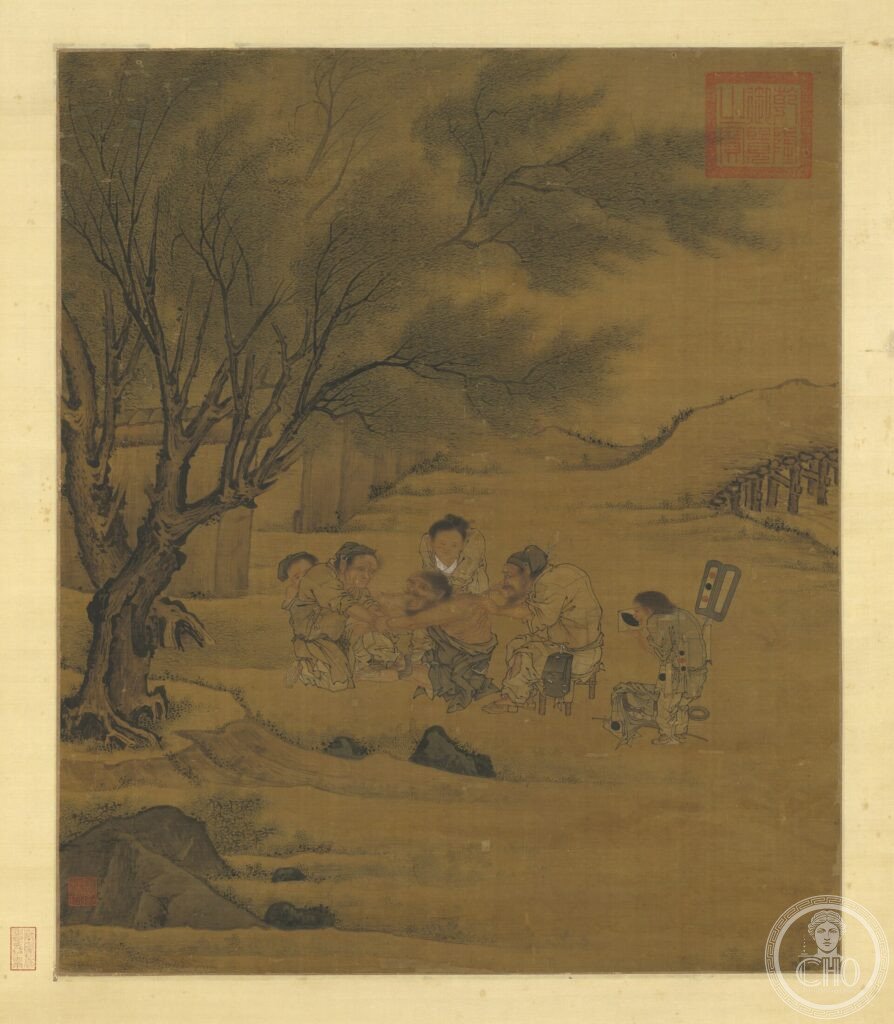
Acupuncture and moxibustion are forms of traditional Chinese medicine widely practised in China and also found in regions of south-east Asia, Europe and the Americas. The theories of acupuncture and moxibustion hold that the human body acts as a small universe connected by channels, and that by physically stimulating these channels the practitioner can promote the human body’s self-regulating functions and bring health to the patient. This stimulation involves the burning of moxa (mugwort) or the insertion of needles into points on these channels, with the aim to restore the body’s balance and prevent and treat disease. In acupuncture, needles are selected according to the individual condition and used to puncture and stimulate the chosen points. Moxibustion is usually divided into direct and indirect moxibustion, in which either moxa cones are placed directly on points or moxa sticks are held and kept at some distance from the body surface to warm the chosen area. Moxa cones and sticks are made of dried mugwort leaves. Acupuncture and moxibustion are taught through verbal instruction and demonstration, transmitted through master-disciple relations or through members of a clan. Currently, acupuncture and moxibustion are also transmitted through formal academic education.
Official description, UNESCO Intangible Cultural Heritage List — Acupuncture and moxibustion of traditional Chinese medicine
At a glance
Acupuncture and moxibustion are forms of traditional Chinese medicine based on the theory that the human body is a small universe connected by channels. Practitioners stimulate these channels to promote the body's self-regulating functions and restore health. Moxibustion involves burning moxa, made from dried mugwort leaves, either directly on the skin or held at a distance to warm specific points. Acupuncture uses needles inserted into these same points to achieve similar therapeutic aims.
Origins & history
Acupuncture and moxibustion developed as part of traditional Chinese medicine and are now widely practised in China and found across south-east Asia, Europe, and the Americas. Historically, the knowledge was transmitted through verbal instruction and demonstration between masters and disciples, or within family clans. Today, the practices are also taught through formal academic education.
The practice
In moxibustion practice, dried mugwort leaves are shaped into cones or sticks. Direct moxibustion places moxa cones on the body's points, while indirect moxibustion holds moxa sticks at a distance from the skin to warm the area. In acupuncture, needles are selected according to the patient's individual condition and inserted into specific points on the body's channels. The choice of technique and points depends on the practitioner's assessment of each person's needs.
Cultural significance
By stimulating the body's channels, acupuncture and moxibustion aim to restore balance and prevent or treat disease. These practices embody a worldview in which the body functions as a unified system capable of self-healing when properly balanced. The transmission of these traditions through generations—whether by master-disciple teaching or modern formal education—ensures their continued role in health and wellness within their communities.
Key facts
- Country: China
- Inscribed: 2010
- UNESCO list: Representative List of the Intangible Cultural Heritage of Humanity
- UNESCO reference: 00425
- UNESCO vocabulary: Health; Holism; Traditional medicine
- Map: not shown — UNESCO’s official description of this element names no locality, and a living tradition is practised across a community, not at one address.
Where to experience it
Acupuncture and moxibustion are practised throughout China and in regions of south-east Asia, Europe and the Americas. The therapy is offered in traditional Chinese medicine clinics, hospitals, and wellness centers where visitors can observe or receive treatment from established medical practitioners trained in these techniques. Formal academic institutions now teach these practices alongside the traditional master-disciple transmission that remains central to their continued cultivation and refinement.
Sources & resources
- UNESCO — official element page: Acupuncture and moxibustion of traditional Chinese medicine
- UNESCO — open data record: Intangible Heritage List, reference 00425
- UNESCO — official video: UNESCO film on this element — embedded on this page
- UNESCO — official photograph: Photograph of this element — Huang Longxiang — Institute of Acupuncture and Moxibustion, 2009
- Reference — Wikipedia (secondary): Moxibustion — consulted as a secondary reference, not as confirmation
- Cultural Heritage Online: Our archive and city guides

Sources
- S1 — Unschuld, Paul U. Medicine in China: A History of Ideas. University of California Press, 1985. ISBN 978-0-520-05023-5.
- S2 — Needham, Joseph, and Lu Gwei-Djen. Celestial Lancets: A History and Rationale of Acupuncture and Moxa. Cambridge University Press, 1980. ISBN 978-0-521-21512-1.
Spotted an error? Write to editorial@culturalheritageonline.com and we correct it the same day.