
Curated Itinerary
Linea del Piave: From Caporetto to Victory — A WWI RoadBook
Three memorials across 150 kilometres of northeastern Italy and Slovenia trace the full arc of the Italian Army’s last year of war: the disaster that made…
Take this route into Google Maps
From Kobariški muzej — The Caporetto Museum of the First World War to Military Memorial of Fagarè – Virtual Tour 360°, in the order we curated them.
➤ Turn on the navigator in Google MapsIt opens in the Google Maps app with every stop already loaded, in the order we put them in. From there the route is yours: pick how you travel — on foot, by bike, by public transport or by car — change where you start and where you end, drag the stops into a different order, and add places of your own along the way.
Three memorials across 150 kilometres of northeastern Italy and Slovenia trace the full arc of the Italian Army’s last year of war: the disaster that made the Piave the final line, the battle that held it, and the crossing that ended the war.
Get this route — explore at your own pace
The walk and the notes are open to everyone, right here. To take the route with you — the GPX and KML tracks for your phone — you need a CHO account, and a free one is enough. We do not sell these routes: we build them ourselves and give them to the people who read us.
Create a free accountAlready have one? Log in.
This route was built with the tools we give operators.
Guides, associations and cultural operators build their own routes here: pick the stops from the archive, add your notes, and the map, the GPX and the printable version come out on their own. Your programme gets a permanent page, your events go on the city pages people read while planning — and if you sell your route as a road-book or a virtual tour, you receive 80% of the price net of tax.
See how an operator account worksBefore you go
A word from your host
This route covers the full arc of Italy's worst military year — from the disaster at Caporetto (October 1917) that required a new defensive line, to the hill where that line was tested and held (Montello, June 1918), to the river crossing that ended the war (Fagarè, October 1918). Three sites, three episodes, one connected story. The Kobariški muzej is the strongest single museum on the Isonzo Front in any language. The two Italian sacrari are quieter and less visited, but the numbers on the plaques — 9,325 at Montello, 10,541 at Fagarè — give the abstraction of casualty figures a specific, local weight.
Getting around
This is a car route — there is no practical public transport connection between all three sites. Total driving distance is approximately 150 km; total driving time approximately 2.5 hours without stops. The route runs from Kobarid in Slovenia south through the Soča/Isonzo valley, crosses into Italy near Nova Gorica or Robič, then continues west and south through Friuli and into Veneto. Border crossing between Slovenia and Italy is free (both Schengen); bring a valid passport or EU ID. Petrol stations are available throughout. The Slovenian section of the drive, through the Soča valley, is scenic and worth allowing extra time for stops at viewpoints. Best season: May–October; mountain passes near Kobarid can be affected by snow November–April.
Step by step
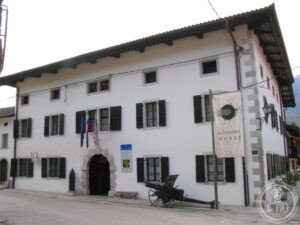
Kobariški muzej — The Caporetto Museum of the First World War
Allow at least 90 minutes for the museum — the permanent exhibition is dense and deserves time. After the museum, consider the 15-minute uphill walk to the Italian Charnel House on Taborska Hill before you drive south. The museum gift shop stocks English-language books on the Isonzo Front.
The storyKobarid sits in the upper Soča/Isonzo valley, terrain the Italian Army never successfully held despite eleven costly attempts to advance from 1915 to 1917. The valley is narrow and steep — artillery had to be hauled up mountain tracks by mule, and attacks often required climbing exposed ridgelines under fire. The Twelfth Battle (Caporetto) reversed everything in hours: Austro-Hungarian and German infiltration units, attacking before dawn on 24 October 1917 with phosgene and thermite artillery, broke through near Tolmino and raced downhill faster than the Italian command could respond. The museum documents this collapse with particular precision, using after-action reports and prisoner testimony to reconstruct the sequence. What it also does — unusually for a war museum of its era — is ask what the war looked like to the Slovenian-speaking population who lived here: neither Italian nor Austro-Hungarian, drafted into the Habsburg army or displaced by Italian advance, and never consulted about whose territory this would become when it was over.
Insider tipThe section on the civilian population of the Soča valley is on the first floor and easy to pass through quickly — do not. The photographs of evacuees, the records of requisitioned livestock and food stores, and the documentation of the Italian occupation period after 1920 form the most distinctive part of the exhibition. Experienced visitors also take the Kobarid Historical Trail (5 km, allow 2 hours), which visits bunker remnants and observation points on the surrounding slopes that give the topography physical meaning the museum's maps cannot fully convey.
A fitting stopKobarid's main square has several cafés and the restaurant Topli Val (regional Slovenian cuisine, reservations recommended in summer). The town is small — most options are within 200 metres of the museum.

Military Memorial of Montello – Virtual Tour 360°
The 32-metre tower is the memorial's defining feature — climb to the upper level for the panorama over the Piave floodplain. Budget 45–60 minutes for the tower, the museum corridor on the third floor, and the artillery pieces in the forecourt. The access road from Nervesa della Battaglia is well signposted.
The storyThe Montello is not a dramatic hill by Alpine standards — it rises only about 170 metres above the Piave — but its strategic value in June 1918 was enormous. Holding the Montello meant controlling the northern flank of the Piave defensive line. Losing it would have given Austro-Hungarian forces a high ground from which to roll up the Italian positions downstream. When the Austro-Hungarian offensive opened on 15 June 1918, units crossed the Piave and seized roughly half the hill in the first assault. The Italian 22nd Army Corps fought for six days to recover it. By 22 June they had. What made the difference, according to most accounts, was the split nature of the Austrian offensive: Conrad's forces attacked simultaneously in the Trentino while Boroevic attacked on the Piave, dividing the effort and preventing either thrust from achieving the concentration needed for a decisive breakthrough. The Italian Army's performance also reflected the rebuilding that had taken place since Caporetto — new leadership, reformed tactics, better use of reserves.
Insider tipMost visitors spend their time in the lower entrance area and miss the museum corridor on the third floor, which holds the best documentary material on the June 1918 battle. The panorama from the upper level of the tower is the practical reward for climbing: on a clear day you can identify the line of the Piave, the flat land to the south where Fagarè lies, and the start of the Dolomite foothills to the north. The bronze artillery pieces in the forecourt are original materiel from the surrounding terrain — field howitzers of the type used on both sides of the Piave in 1918.
A fitting stopNervesa della Battaglia has a small selection of bars and a trattoria in the town centre, about 2 km from the sacrario. Pack lunch if you want to eat on site — there are no facilities at the memorial itself.

Military Memorial of Fagarè – Virtual Tour 360°
Walk the full length of the curved portico slowly — reading the marble plaques transforms the aggregate number into individual names. The fragment of the soldiers' graffiti wall is in the garden behind the main structure. The central chapel displays Hemingway's poem in memory of Lieutenant Edward McKey.
The storyFagarè della Battaglia sits on the lower Piave, where the river runs through flat alluvial farmland between Treviso and Oderzo. During the June 1918 battle, this section of the Piave was a secondary front compared to the Montello — but in October 1918, when the Battaglia di Vittorio Veneto began, Fagarè became a primary crossing point. Italian forces bridged the river here under difficult conditions — the Piave was in flood — and established the bridgeheads that allowed the final advance to begin. The memorial's inscription fragments come from soldiers defending this position in June 1918. The verse that reads "Either the Piave or all killed" was not written for posterity; it was a unit's statement of intent on a wall near the river, preserved because someone thought to save it when the sacrario was built. Ernest Hemingway, who served as a Red Cross ambulance driver near the Italian Front in 1918, knew this landscape and the soldiers who fought in it. His connection to Lieutenant Edward McKey, buried here, added an Anglophone literary thread to a site that otherwise features almost entirely in Italian sources.
Insider tipThe graffiti wall fragments are easy to miss — they are in the garden behind the main portico structure, not on the approach. Walk through the building and out the back before leaving. The marble plaques in the eight outer naves are all individually legible: regiments, ranks, and hometowns span the entire Italian peninsula, which gives a concrete sense of how national the sacrifice was. Read a few hundred at random and the geographic spread becomes striking.
A fitting stopSan Biagio di Callalta has bars and a pizzeria in the town centre, about 1 km from the sacrario. Treviso, 20 km west, offers the full range of Venetian restaurant options for an evening meal.
Download for tour navigation
🔒 The walk and the notes are open to everyone on this page. The files to take with you — the stop list as a PDF, and the GPX and KML tracks for your phone — come with a CHO account, and the free one includes them.
Walk it with the navigator on
It opens in the Google Maps app with every stop already loaded, in the order we put them in. From there the route is yours: pick how you travel — on foot, by bike, by public transport or by car — change where you start and where you end, drag the stops into a different order, and add places of your own along the way.