
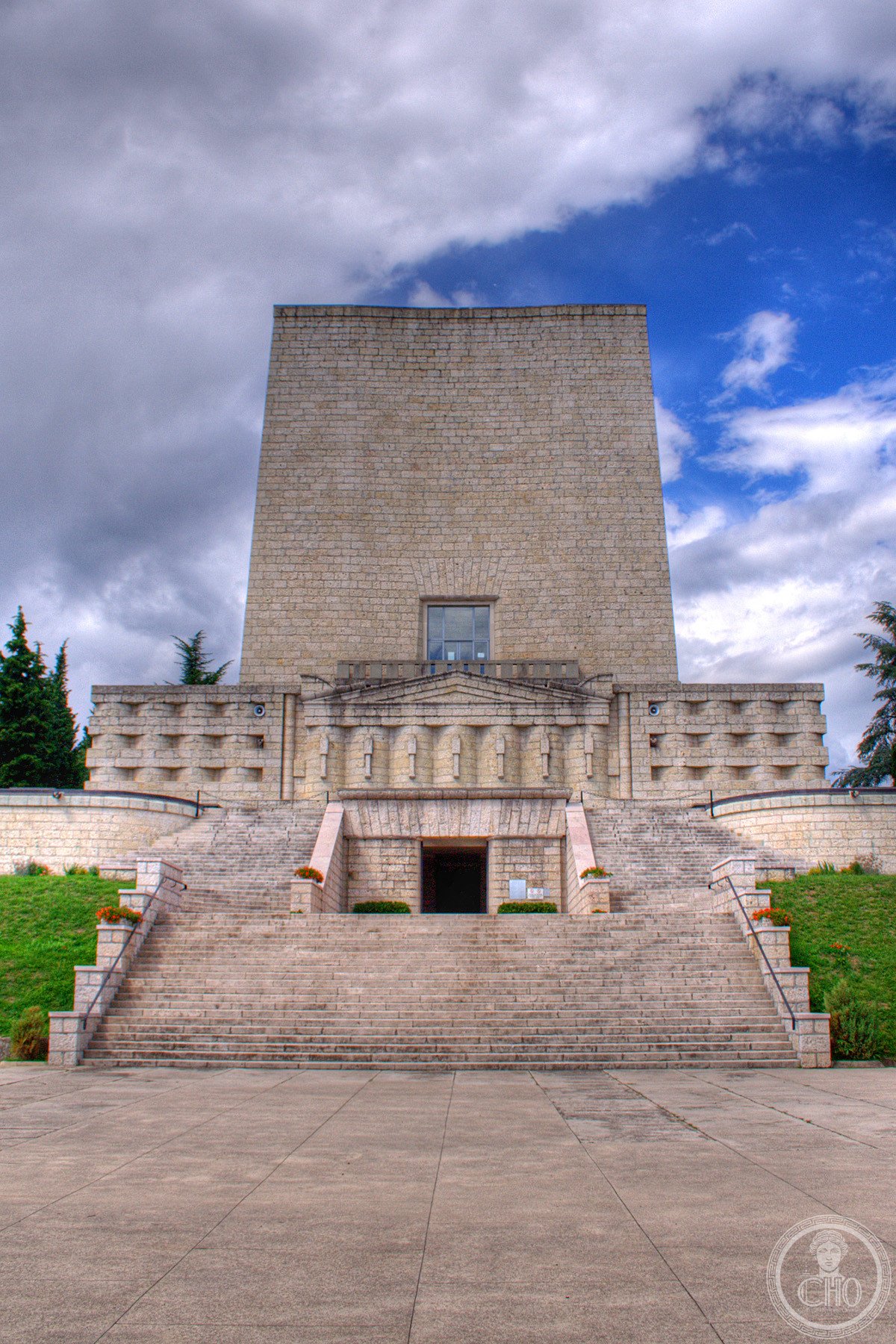
A 32-metre square tower rises from the eastern edge of the Montello hill, holding the remains of 9,325 soldiers who died in the June 1918 battle that turned the war’s momentum on the Italian Front.
At a glance
The Sacrario Militare del Montello stands at an elevation of 176 metres on the eastern end of the Montello — the long, wooded hill above the Piave river in the Treviso province of Veneto. Designed by Roman architect Felice Nori and completed in 1935, the building consolidates remains exhumed from 120 military cemeteries along the middle Piave. The town below, once called Nervesa, added “della Battaglia” to its name after the war to mark what was fought there.
History
The Montello is a low, elongated hill running roughly east–west along the northern bank of the Piave between Nervesa and Montebelluna. Its wooded slopes and commanding views made it a key terrain feature from the moment the Italian front stabilised along the Piave after Caporetto in late 1917. For seven months, Austrian forces held the eastern approaches while Italian units fortified the hill’s western and southern faces.
The critical test came on 15 June 1918, when Austro-Hungarian forces launched the offensive that Italians call the Battaglia del Solstizio — the Battle of the Solstice. The Montello was among the primary objectives. Austro-Hungarian troops crossed the Piave and managed to seize roughly half of the hill in the first hours of the assault. General Pennella’s forces and the 22nd Army Corps under General Vaccari counterattacked persistently over the following days. By 20 June the Austrians had been pushed back to the river; by 22 June, Boroevic’s armies had re-crossed to the eastern bank. Austrian losses across the entire front ran to approximately 150,000 casualties. The Italian Army had held.
The town of Nervesa had been occupied and heavily damaged during these battles. When reconstruction and renaming took place after the armistice, the municipality formally adopted “della Battaglia” — a permanent marker in the town’s legal name of what the landscape recorded in blood. Four months after the June battle, the Battle of Vittorio Veneto (24 October – 3 November 1918) concluded the war on the Italian Front, with the Austro-Hungarian Empire signing an armistice on 3 November 1918.
The sacrario was designed in the early 1930s and completed in 1935, though it was formally inaugurated in 1938 on the twentieth anniversary of the Battle of the Solstizio. The remains interred here came from 120 field cemeteries spread along the middle Piave, gathered over years of exhumation work conducted by the Commissariato Generale per le Onoranze ai Caduti in Guerra.
What you see
Felice Nori designed a tower rather than a portico — a conscious choice that sets Montello apart from most contemporary Italian ossuaries. The structure rises as a massive square tower, 32 metres tall, tapering slightly as it climbs. Its surface is plain stone with minimal ornamentation, in a style loosely referencing Roman funerary architecture without direct quotation. The tower is open internally across four floors, with an annular corridor on the third floor housing a museum collection of materials and testimonies related to the Piave and Montello fighting. Bronze artillery pieces stand in the forecourt, recovered from the surrounding terrain. From the terrace near the top, the panorama takes in the Piave floodplain to the south, the Montello plateau spreading westward, and on clear days the eastern edge of the Dolomites.
Cultural significance
The Montello Sacrario is one of the largest First World War ossuaries in northeastern Italy. Its 9,325 interred — 6,095 identified, the remainder unknown — represent fighters drawn from across the former Kingdom of Italy, concentrated in a structure that functions simultaneously as tomb, monument, and regional history museum. The Battle of the Solstizio is considered a turning point in the Italian campaign: the failure of the June 1918 Austrian offensive hastened the dissolution of the Austro-Hungarian Empire and made the October 1918 Italian counter-offensive possible. Nervesa della Battaglia’s legally embedded name is among the rarer instances in which a town’s administrative identity has been permanently shaped by a single military engagement.
Key facts
- Address: Viale degli Eroi 2, Nervesa della Battaglia, Treviso, Veneto
- Coordinates: 45.8278° N, 12.1972° E
- Built: Completed 1935; inaugurated 1938
- Architect: Felice Nori (Rome)
- Height: 32 metres
- Elevation: 176 metres above sea level
- Burials: 9,325 total — 6,095 identified, remainder unknown
- Source cemeteries: 120 military cemeteries, middle Piave valley
- Administered by: Commissariato Generale per le Onoranze ai Caduti in Guerra (Italian Ministry of Defence)
Practical information
Open Tuesday through Saturday, 09:00–12:00 and 13:00–17:00. Weekend openings depend on volunteer availability — telephone ahead to confirm. Admission is free. Phone: +39 0423 544840. The third-floor museum corridor is included in the visit. The site is an active war memorial; visitors are expected to behave accordingly.
Getting there
From Treviso, take the SP 248 (Castellana road) toward Montebelluna, then follow signs for Nervesa della Battaglia. The sacrario is signposted from the town centre and sits about 2 kilometres northeast of Nervesa on the Montello ridge. Parking is available at the base of the access road. There is no regular public transport to the sacrario itself; the nearest bus stop is in Nervesa della Battaglia town centre. From Venice or Treviso, a rental car or taxi from Treviso station is the practical option.
Sources & resources
Find it on the map
See this place and what’s around it →📷 Become a Cultural Heritage Online photographer
Share your photos of places: they stay published under your name as the author. The more they're seen, the more you get noticed — and soon a contest will reward the most appreciated photos.
Log in or sign up free to add a photoIs this page about you?
This page is read by travellers and heritage enthusiasts who find it on Google. Tell us how you are connected to this place and we will take it from there.