
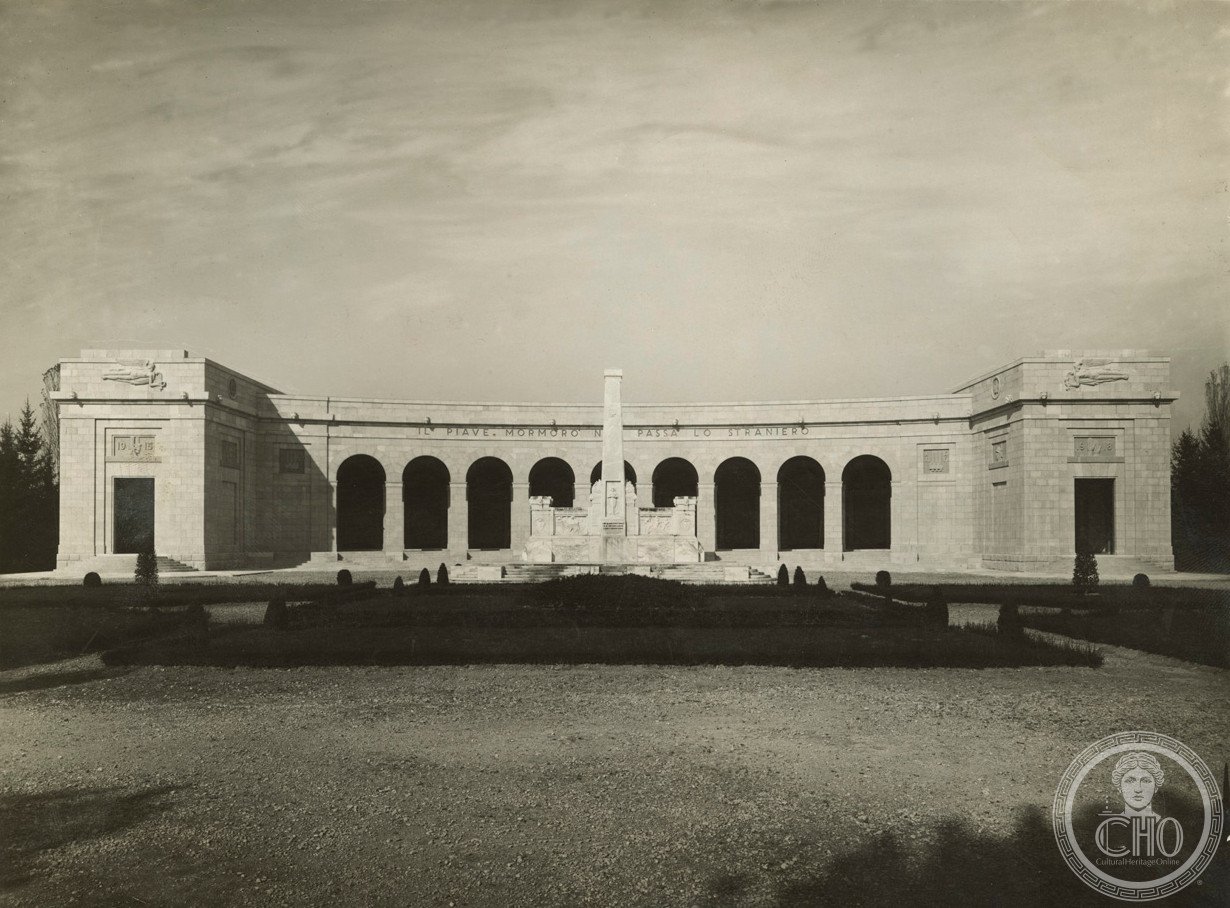
On a flat stretch of the Treviso plain where Italian troops crossed the Piave in the war’s final weeks, a curved marble portico holds the remains of 10,541 soldiers — the largest ossuary on the lower Piave.
At a glance
The Sacrario Militare di Fagarè della Battaglia stands on Via Postumia Est in the municipality of San Biagio di Callalta, roughly 20 kilometres from Treviso. Completed in 1935 to a design by architect Pietro Del Fabro, it consolidates remains gathered from 80 military cemeteries scattered across the lower Piave valley. The neoclassical structure, built entirely in pale marble, takes the form of an elongated exedra — a curved, roofed portico — flanked by two solid terminal buildings.
History
The ground around Fagarè della Battaglia was fought over repeatedly during the final eighteen months of the First World War. After the catastrophic Italian retreat following Caporetto in October 1917, the Piave river became the last defensive line. Austrian forces held the eastern bank while Italian troops dug in on the western side, and the flatlands at Fagarè — where the river bends — became a critical stretch of that line.
The bloodiest episode came during the Battle of the Piave River, fought 15–22 June 1918. Known in Italy as the Battaglia del Solstizio, the Austrian assault sent roughly 100,000 troops across the Piave along a wide front. At Fagarè, both banks saw intense fighting as Austro-Hungarian forces attempted to exploit their bridgeheads. The Italian Second Army, supported by Allied units, gradually contained the breakthrough. By 22 June the Austrians had withdrawn back across the river, having suffered approximately 150,000 casualties across the entire front. Italian losses were severe too — the official tally ran to around 90,000 total casualties for the June battle.
Four months later the situation reversed. The Battle of Vittorio Veneto, launched on 24 October 1918, saw Italian forces go on the offensive. Units crossed the Piave at Fagarè and other points, pushing northward and eastward as Austro-Hungarian resistance collapsed. By 3 November 1918 an armistice was signed. The name “della Battaglia” had already been attached to the locality by then, acknowledging what those fields had witnessed.
On the site where soldiers had written impromptu graffiti on a wall during the June fighting, a temporary monument was erected shortly after the armistice. That structure was replaced by the current sacrario, decreed under the interwar administration and completed in 1935. Among the graffiti preserved in the garden — fragments of that original wall — are the phrases: “It is better to live one day as a lion than one hundred years as a sheep” and “All heroes. Either the Piave or all killed.”
One of the identified burials carries an unusual literary connection. Lieutenant Edward McKey, an American Red Cross officer, was a personal friend of Ernest Hemingway. Hemingway composed a poem in McKey’s memory, the text of which is displayed in the central chapel of the memorial.
What you see
The portico curves across the forecourt in a broad arc, supported by nine arches that open into nine short radial naves. Each nave is barrel-vaulted, and marble niches line the walls in tiers. The eight outer naves hold the loculi of 5,191 identified soldiers, each sealed with a marble plaque inscribed with name, rank, and unit. Two lateral naves contain collective urns with the remains of 5,350 unidentified fallen. The two terminal pavilions at either end of the exedra serve as entrance vestibules, their interiors plain and austere. At the rear of the ensemble, facing the road, a low staircase leads to the main entrance. The whole complex is executed in the same light marble — no coloured stone, no fresco — giving the memorial an intentional pallor that reads as solemn restraint rather than ornament.
Cultural significance
Fagarè is one of a network of Italian military ossuaries built during the 1930s to consolidate scattered field cemeteries into permanent, state-maintained memorials. The Commissariato Generale per le Onoranze ai Caduti in Guerra — the body responsible for Italy’s war dead — administers the site today. Among the 10,541 interred are two recipients of the Medaglia d’Oro al Valor Militare, the Italian armed forces’ highest decoration: Lieutenant Colonel Ernesto Paselli and Major Francesco Mignone. At least five further Gold Medal recipients lie among the unidentified. The Hemingway connection adds an Anglophone literary thread to a site otherwise little known outside Italy and to veterans’ descendants from the former Austro-Hungarian Empire whose relatives fell on the same ground.
Key facts
- Address: Via Postumia Est 89, San Biagio di Callalta, Treviso, Veneto
- Coordinates: 45.7036° N, 12.4339° E
- Built: 1935
- Architect: Pietro Del Fabro
- Burials: 10,541 total — 5,191 identified, 5,350 unknown
- Source cemeteries: 80 military cemeteries, lower Piave valley
- Administered by: Commissariato Generale per le Onoranze ai Caduti in Guerra (Italian Ministry of Defence)
Practical information
Open Tuesday through Saturday, 09:00–12:00 and 14:00–17:00. Closed Mondays. Holiday openings are managed by volunteer associations — call ahead to confirm. Admission is free. Phone: +39 0423 544840. The sacrario is an active place of commemoration; quiet, respectful conduct is expected.
Getting there
From Treviso, take the SS13 (Via Postumia) east toward Oderzo for approximately 20 kilometres. The sacrario stands directly on Via Postumia Est in San Biagio di Callalta; parking is available on the roadside. By public transport, take a regional bus toward Oderzo from Treviso bus station and alight at San Biagio di Callalta; the memorial is a short walk from the stop. The nearest railway station is Treviso Centrale, about 20 km west.
See the place
Sources & resources
Find it on the map
See this place and what’s around it →📷 Become a Cultural Heritage Online photographer
Share your photos of places: they stay published under your name as the author. The more they're seen, the more you get noticed — and soon a contest will reward the most appreciated photos.
Log in or sign up free to add a photoIs this page about you?
This page is read by travellers and heritage enthusiasts who find it on Google. Tell us how you are connected to this place and we will take it from there.