
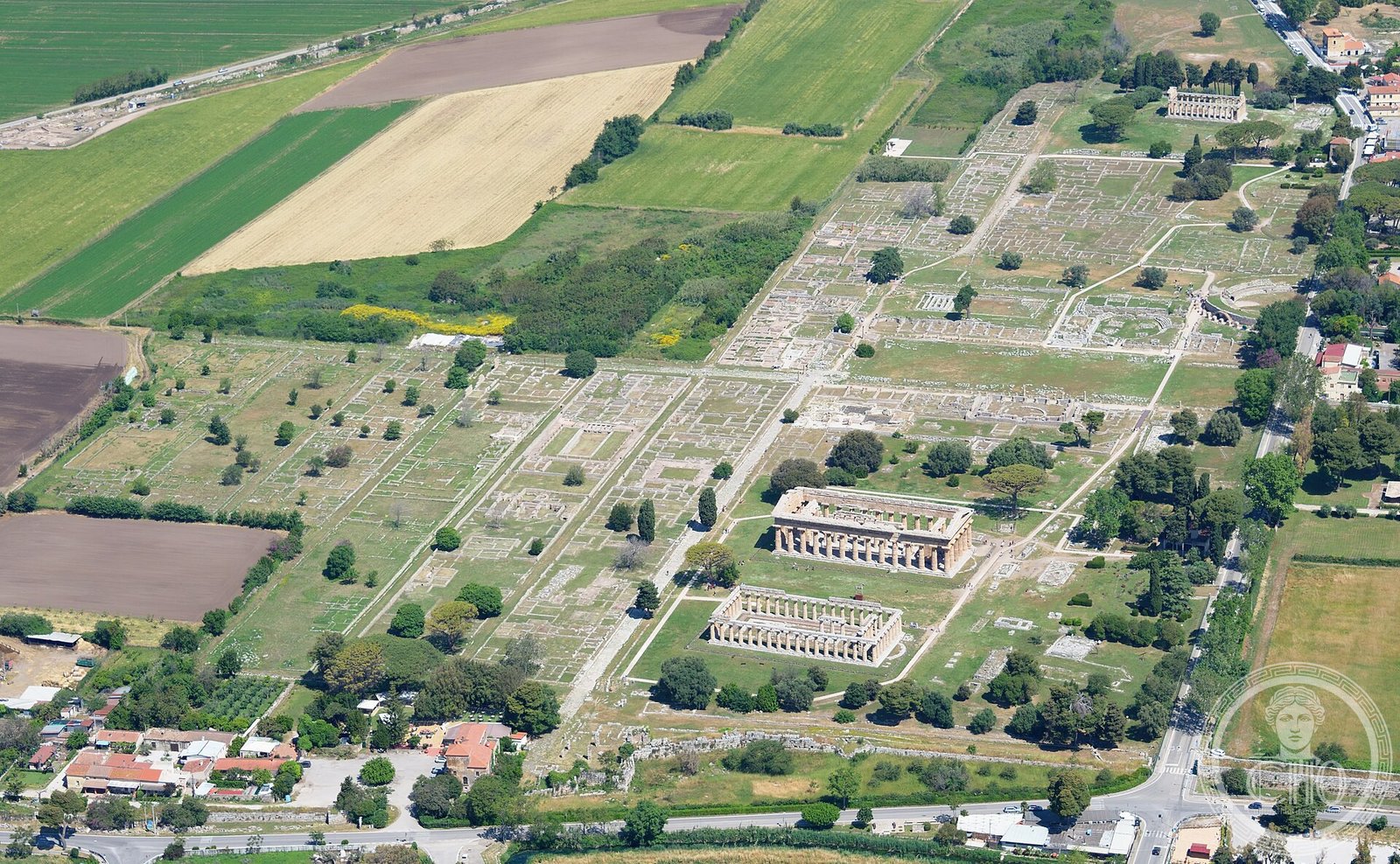
Founded by Greek colonists as Poseidonia and later renamed by its Lucanian conquerors, this exceptionally preserved ancient city reveals three civilizations layered across the Campanian coast.
At a glance
Paestum stands as one of Italy’s most significant archaeological sites, its Greek walls and temples still defining the ancient urban landscape. The city was inhabited from prehistoric times and shaped by successive Greek, Lucanian, and Roman occupation. Today the site encompasses temples, civic structures, and a necropolis—all enclosed within defensive walls that remain clearly visible.
History
Greek settlers founded the city around the 6th century BCE, naming it Poseidonia in honor of the sea god, though the community also venerated Hera and Athena. The Lucanians conquered Paestum and renamed it—the Latin form Paestum derives from their Paistom. Roman domination followed, each period leaving architectural and urban imprints. The city was also known historically as Pesto.
What you see
The archaeological area preserves an unusually intact Greek city plan bounded by walls modified during the Lucanian and Roman periods. Doric temples dedicated to Hera and Athena dominate the site. Visitors encounter an amphitheater, forum, swimming pool, and extensive necropolis. The temples remain the most striking monuments, their limestone columns and entablatures rising from the Campanian plain with remarkable completeness.
Cultural significance
Paestum exemplifies the reach and achievements of Magna Graecia—the Greek colonies that flourished across southern Italy. Its three-layered history documents the cultural transitions of the ancient Mediterranean. The site’s exceptional architectural preservation provides rare insight into Greek urban life, religious practice, and construction technique as experienced far from the Aegean homeland.
Key facts
- Address: Via Magna Graecia, 917/919, 84063 Capaccio Paestum
- Coordinates: 40.423696, 15.006147
- Official website: https://museopaestum.beniculturali.it/
- Phone: 0828 811023
Practical information
The museum is open daily 8:30 am–7:30 pm (last entry 6:50 pm), with reduced hours (8:30 am–1:40 pm; last entry 1:00 pm) on the 1st and 3rd Monday of each month. The archaeological area is accessible daily 8:30 am–7:30 pm (last entry 6:50 pm); after sunset, access is limited to the southern sanctuary. For the most current hours and closure information, consult the official website.
Getting there
Paestum lies in Campania’s Cilento region, approximately 40 km south of Salerno. The site is accessible by car via the A3 motorway or by train via the Salerno–Reggio Calabria line, which serves the nearby Paestum station. Ample parking is available on-site.
See the place
Sources & resources
Find it on the map
See this place and what’s around it →
Events here — now on & upcoming
- BMTA – Borsa Mediterranea del Turismo Archeologico XXVIII edizione29 Oct 2026 — 01 Nov 2026See the event →
Historical events at this place (4)
📷 Become a Cultural Heritage Online photographer
Share your photos of places: they stay published under your name as the author. The more they're seen, the more you get noticed — and soon a contest will reward the most appreciated photos.
Log in or sign up free to add a photo