

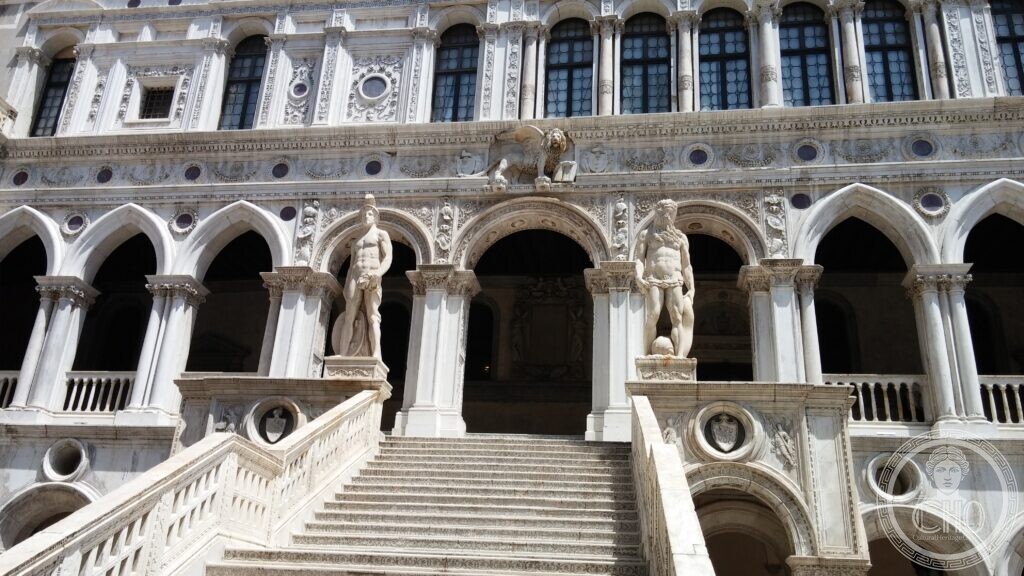
The monumental ceremonial staircase in the courtyard of the Doge’s Palace, designed by Antonio Rizzo between 1486 and 1497 and completed with two colossal statues by Jacopo Sansovino in 1565.
At a glance
The Giant’s Staircase stands in the inner courtyard of the Doge’s Palace, between the Renaissance loggias. It is the work of architect Antonio Rizzo, who designed it between 1486 and 1497, and it was used for the formal investiture of the Doge and the reception of important visitors to the Palace.
Key facts
- Where: Cortile di Palazzo Ducale, San Marco, Venezia
- What: Structure
- When: 1486–1497 designed by Antonio Rizzo; 1565 completed by Jacopo Sansovino
- GPS: 45.4343, 12.3403 · Open in Google Maps
History
The staircase was designed by Antonio Rizzo and built between 1486 and 1497. In 1565 Jacopo Sansovino completed it with the monumental statues of Mars and Neptune, symbols of the power of the Republic of Venice on land and sea. The staircase formed the main ceremonial entrance used by the Doge to reach his apartments and was the scenographic route by which ambassadors and illustrious guests were received. It was here that the Doge’s investiture ceremony took place: the new Doge received the zoia and the Doge’s horn, and climbed to the upper level to be seen from all sides of the courtyard and the loggias.
What you see
The photograph shows the white marble staircase rising through the courtyard, with a carved balustrade and two large statues at the upper landing. The staircase leads up between the palace walls, with an arched loggia visible behind. The two colossal statues of Mars and Neptune stand on either side of the top of the steps. The first flight of the staircase inside the palace continues as the Scala d’Oro, the Golden Staircase, with gilded stucco ornamentation.
Do you know more about this place?
If you know a date, a name, a document, a plaque or a photograph that tells its story, write to Sofia through the contact page. What arrives with a source goes into this page, with your name as the contributor.
Nearby
- Doge’s apartment – Virtual Tour 360° — 42 m away, the private rooms of the Doge inside the palace
- Monument of the Tetrarchs — 49 m away, the porphyry sculpture group at the Porta della Carta
- Patriarchal Basilica of San Marco — 50 m away, the cathedral of Venice
- Bridge of Sighs – Virtual Tour 360° — 58 m away, the enclosed bridge connecting the palace to the prisons
- The Porta della Carta — the Gothic Gate Where Venice’s Doges Entered Their — 62 m away, the ceremonial entrance to the palace
- The Doge’s Palace (Palazzo Ducale), Venice — 71 m away, the palace that houses the staircase
Sources
- Palazzo Ducale Venezia, La Scala dei Giganti: un nuovo progetto di restauro: dates of design (1486–1497), architect Antonio Rizzo, completion by Jacopo Sansovino in 1565, location in the courtyard, ceremonial use.
- Doge’s Palace Venice, The Giants’ Staircase at the Doge’s Palace in Venice: History and Architecture: details of the investiture ceremony, the role of the Council of Ten, the zoia and the Doge’s horn, the statues by Sansovino, the continuation as Scala d’Oro.
- Bubbly Living, Scala dei Giganti: The Grand Staircase of Venice’s Doge’s Palace: the late 15th-century design by Antonio Rizzo, the statues by Jacopo Sansovino in the mid-16th century, the ceremonial significance for the Doge’s coronation.
- Scala dei Giganti, photographs and notes to the editorial staff (2026): identification of the subject. Not a published source.
Find it on the map
See this place and what’s around it →📷 Become a Cultural Heritage Online photographer
Share your photos of places: they stay published under your name as the author. The more they're seen, the more you get noticed — and soon a contest will reward the most appreciated photos.
Log in or sign up free to add a photoIs this page about you?
This page is read by travellers and heritage enthusiasts who find it on Google. Tell us how you are connected to this place and we will take it from there.
This entry stays online and free either way — and a free account lets you add to it yourself.