
360° from outside
360° from inside
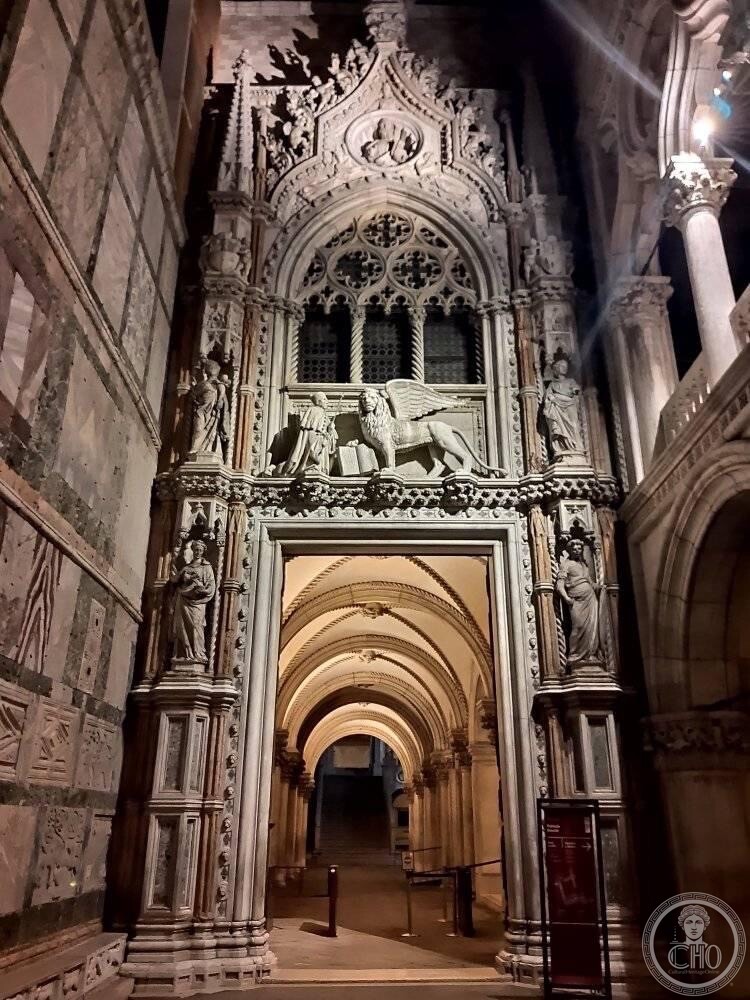
A flamboyant Gothic gateway wedged between the Doge’s Palace and the Basilica di San Marco, carved between 1438 and 1442 by Bartolomeo Bon for Doge Francesco Foscari — kneeling in stone before the winged lion of St Mark above the door he commissioned.
At a glance
The Porta della Carta is the main ceremonial entrance to the Doge’s Palace (Palazzo Ducale), set into the narrow gap between the palace and the Basilica di San Marco. Bartolomeo Bon, working with his father Giovanni, built it between 1438 and 1442 under contract with the Provveditori del Sal, the Republic’s salt magistracy, which financed much of the palace’s Gothic decoration. Above the arch, a kneeling figure of Doge Francesco Foscari faces the winged lion of St Mark — a pairing of doge and lion repeated on Venetian buildings across the Republic’s territories, though the figures visible today are a 19th-century replacement for the originals destroyed after the fall of the Republic in 1797.
Key facts
- Where: between the Doge’s Palace and the Basilica di San Marco, Piazza San Marco, Venice
- Built: 1438–1442, contract signed 10 November 1438
- Architect/sculptor: Bartolomeo Bon, with his father Giovanni Bon
- Commissioned by: the Provveditori del Sal, for Doge Francesco Foscari
- Above the door: Doge Francesco Foscari kneeling before the winged lion of St Mark (19th-century replacement; the original was destroyed in 1797)
- In the niches: four statues personifying Charity, Prudence, Fortitude and Temperance
- Name: disputed origin — either from the state decrees and laws once posted here, or from the nearby archives (carte)
A gate for a doge who commissioned his own portrait in stone
By the 1430s the Doge’s Palace had been substantially rebuilt in Gothic style, and Doge Francesco Foscari — whose long reign (1423–1457) also saw the palace’s Gothic facade onto the Piazzetta completed — wanted a fitting formal entrance linking the palace to the basilica beside it. The Provveditori del Sal, the magistracy that controlled the lucrative state salt monopoly and regularly funded major public works, signed the contract with Giovanni and Bartolomeo Bon on 10 November 1438 for what the document called “the grand door at the base of the palace beside the church of San Marco.” Father and son completed the gate by 1442.
The name Porta della Carta (“Gate of the Paper”) is not fully explained by any single source: some accounts tie it to state decrees and notices once posted on or near the door, others to the nearby state archives. What the gate certainly did was put Doge Foscari’s own image, kneeling in perpetual homage before the Republic’s winged-lion emblem, on permanent public display at the building’s most ceremonial threshold — the doge whose own long and eventually tragic reign (he was forced to resign shortly before his death) is memorialised in the very stone of his own palace’s front door. When the Republic fell to Napoleon in 1797, the original doge-and-lion group was destroyed as a symbol of the old order; the figures seen today date from a 19th-century restoration.
What you see
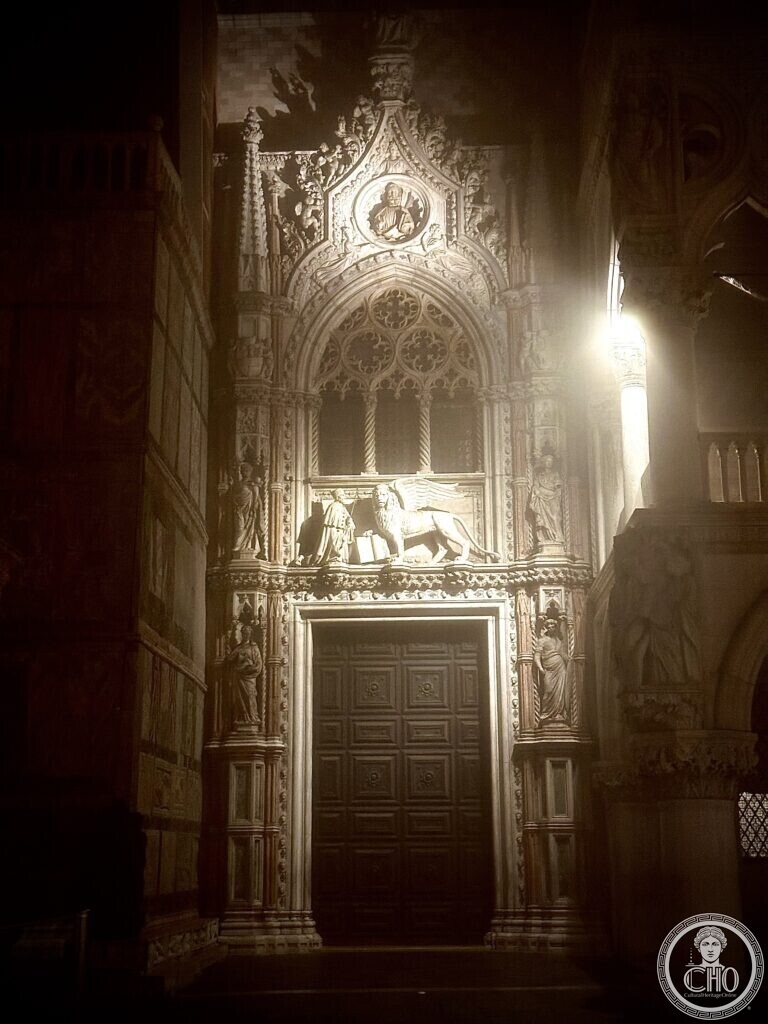
The gate rises in a single ornate composition: a pointed Gothic arch under a tall, richly carved pinnacle, with four statues of the Cardinal Virtues — Charity, Prudence, Fortitude and Temperance — standing in niches on either side of the doorway. Above the arch, the relief of the kneeling doge and the lion of St Mark sits inside an elaborate tracery frame, with a further roundel above it. Little of the gate’s original colour survives: when new, the carving was picked out in gold and ultramarine blue against different coloured marbles, a polychrome scheme typical of Venetian Gothic sculpture that has since worn away to bare stone. Passing through the arch leads into the palace’s inner courtyard, from which the Scala dei Giganti climbs to the upper loggias.
Getting there
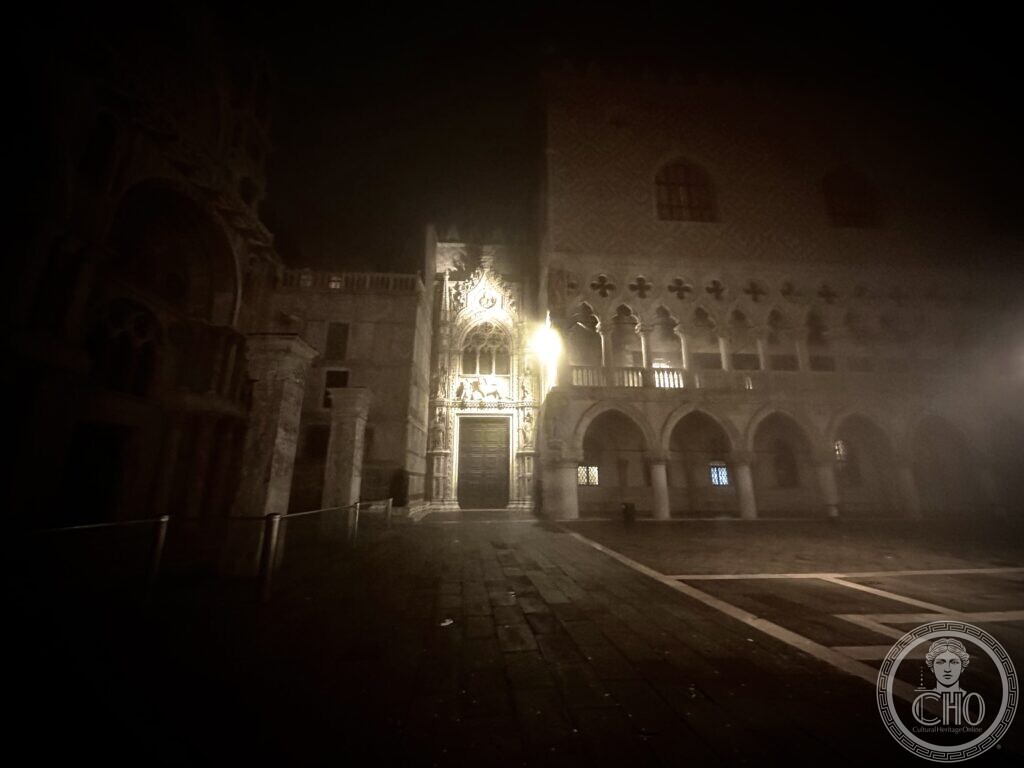
The Porta della Carta is on Piazza San Marco, in the corner between the Basilica and the Doge’s Palace. It serves as the ticketed entrance to the Palazzo Ducale museum; the nearest vaporetto stops are San Marco Vallaresso and San Zaccaria.
Sources
- arte.it, “Porta della Carta — Bartolomeo Bon” — on the 1438 contract, the Provveditori del Sal, and the sculptural programme.
- Wikipedia (English), “Bartolomeo Bon” — on the gate’s construction and authorship.
- veravenezia.com, on the four Cardinal Virtue statues and the 1797 destruction of the original doge-and-lion group.
- Luigi De Marchi, who photographed the gate.
Gallery
Find it on the map
See this place and what’s around it →Record researched and written by Luigi De Marchi for Cultural Heritage Online, 2026.
📷 Become a Cultural Heritage Online photographer
Share your photos of places: they stay published under your name as the author. The more they're seen, the more you get noticed — and soon a contest will reward the most appreciated photos.
Log in or sign up free to add a photo