

Curated Itinerary
Chicago Art Deco: a walk through 1920s and 1930s landmarks
See four iconic Art Deco buildings, from the Carbide & Carbon Building to the Civic Opera Building, ending at the lakefront Adler Planetarium.

Take this route into Google Maps
From Carbide & Carbon Building to Adler Planetarium, Chicago, in the order we curated them.
➤ Turn on the navigator in Google MapsIt opens in the Google Maps app with every stop already loaded, in the order we put them in. From there the route is yours: pick how you travel — on foot, by bike, by public transport or by car — change where you start and where you end, drag the stops into a different order, and add places of your own along the way.
This 6.2 km walk through downtown Chicago links five Art Deco landmarks built between 1929 and 1932. It begins at the Carbide & Carbon Building on Michigan Avenue, moves west to the Merchandise Mart on the Chicago River, then south along Wacker Drive to the Civic Opera Building and the Chicago Board of Trade Building, ending at the Adler Planetarium on Northerly Island. Allow around 200 minutes at a steady pace.
The route follows the commercial spine of the Loop, where the decorative language of the 1920s and 1930s takes concrete form. At 230 N. Michigan Avenue, the Carbide & Carbon Building rises as a black and dark green terracotta shaft capped in gold leaf. The Merchandise Mart fills an entire city block with limestone piers and a 25-storey tower, its 6.2 million square feet making it a city within a city. The Civic Opera Building combines a 3,500-seat opera house with a 45-storey office tower, its auditorium still the second-largest in North America.
Further south, the Chicago Board of Trade Building closes the vista down LaSalle Street, its 44 storeys topped by a 31-foot statue of Ceres. The walk then leaves the high-rises for the lakefront, reaching the Adler Planetarium, a twelve-sided granite drum opened in 1930 as the western hemisphere’s first planetarium. The lakefront stretch is most comfortable from late spring to early autumn, when the paths along Northerly Island are clear and the skyline views from the planetarium steps are unobstructed.
Read the article
The magazine has a longer piece on this walk: Chicago Art Deco: a walk through 1920s and 1930s landmarks.
Step by step
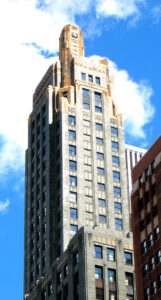
Carbide & Carbon Building
Black granite, dark-green terracotta and a gold-leaf crown: the most theatrical Art Deco tower on Michigan Avenue, designed by the sons of Daniel Burnham.
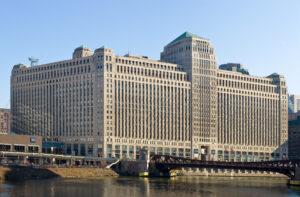
Merchandise Mart
Rising eighteen stories above the north bank of the Chicago River, the Merchandise Mart stands as one of the most commanding commercial landmarks in the…
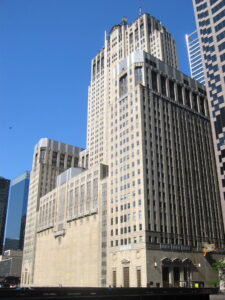
Civic Opera Building (1929), Chicago
Samuel Insull’s 1929 commission produced both the largest opera house in North America and a 45-story office tower designed to fund it—a building whose…
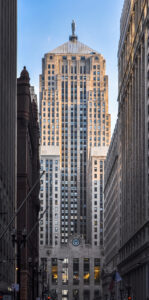
Chicago Board of Trade Building
A 44-storey Art Deco tower closing the LaSalle Street canyon, crowned by a faceless aluminium goddess of grain who has watched over Chicago's markets since…

Adler Planetarium, Chicago
The hemisphere's first planetarium - a deco dodecagon of rainbow granite on the lake, zodiac bronzes ringing the dome since 1930.
Download for tour navigation
PDF is the stop list with GPS, to print or keep on the phone. GPX for Garmin / Komoot / OsmAnd. KML for Google Earth and Maps.
Walk it with the navigator on
It opens in the Google Maps app with every stop already loaded, in the order we put them in. From there the route is yours: pick how you travel — on foot, by bike, by public transport or by car — change where you start and where you end, drag the stops into a different order, and add places of your own along the way.
To keep the route in the app instead of opening it once, download the KML above and import it into Google My Maps — Create a new map, then Import: the route then sits among your own maps in Google Maps, with the stops and our notes attached to each one.