

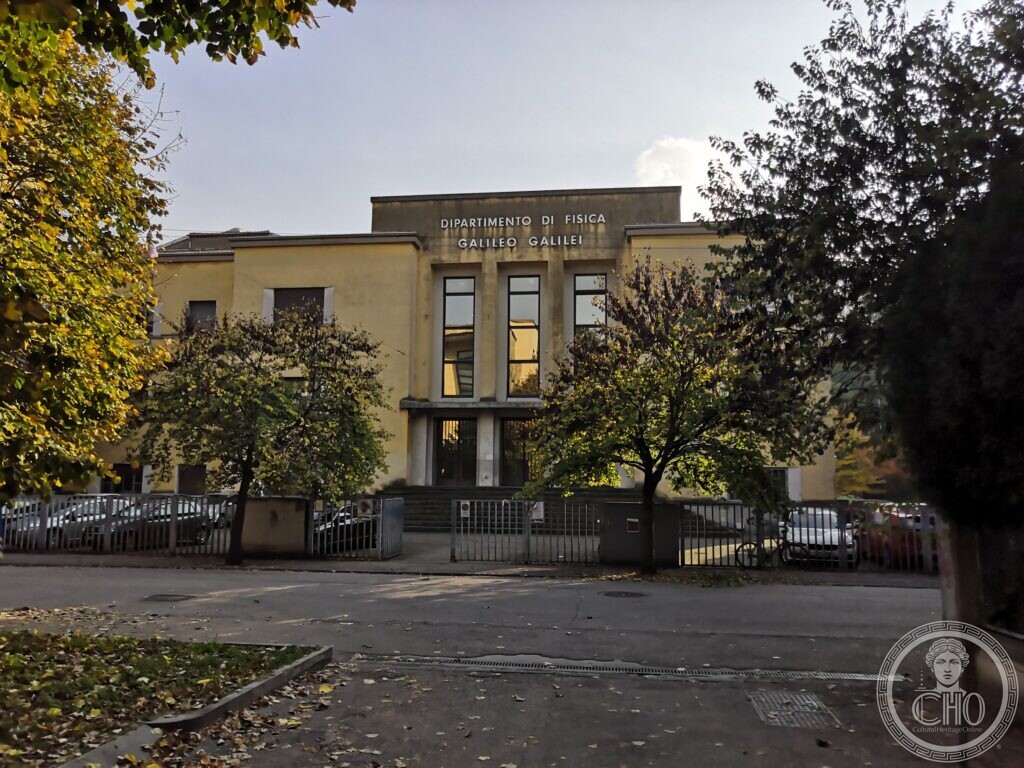
The building that the physicist Bruno Rossi planned and opened in 1937 for the Institute of Physics, with a laboratory for cosmic-ray research in its tower, a year before the racial laws drove him out of Italy. It still houses the department that bears Galileo’s name.
At a glance
The Physics building stands at Via Marzolo 8, in the scientific quarter that the University of Padua built inside the Portello walls in the 1930s. It was opened in 1937 and is credited to Bruno Rossi, the professor of experimental physics who had come to Padua in 1932 and designed the new institute for his research on cosmic rays; a laboratory for that research, shielded with metal mesh, was placed in the tower. The university’s catalogue describes it as a work with the typical characters of rationalist architecture, built in reinforced concrete with floors on air chambers, linoleum in laboratories and classrooms and compressed asphalt in the workshops, and with installations that were innovative for their time, part of which has since been lost. The physics collection moved here from Palazzo del Bo in the same year, and the complex was transformed between the 1950s and the 1980s.
Key facts
- Opened: 1937, under the rectorship of Carlo Anti (1932–1943)
- Planned by: Bruno Rossi, professor of experimental physics, who left Italy in 1938 after the racial laws
- Built for: the Istituto di Fisica; today the Dipartimento di Fisica e Astronomia Galileo Galilei
- Construction: reinforced concrete, floors on air chambers, linoleum and compressed asphalt; a cosmic-ray laboratory in the tower shielded with metal mesh
- Later: transformed between the 1950s and the 1980s
- GPS: 45.4092, 11.8859 · Open in Google Maps (OpenStreetMap)
History
Bruno Rossi, born in Venice in 1905, was called to the chair of experimental physics at Padua in 1932, when he was already one of the founders of cosmic-ray physics as a field of its own. The university, under the rector Carlo Anti, was moving its sciences to Via Marzolo, and Rossi was given the task of designing the new institute: he described it himself in 1937 in La Ricerca Scientifica, and the architectural review Casabella devoted its issue of March 1936 to the building, quoting the architect on the sloping site and on the separation of the mechanical workshop from the rest of the building to keep vibrations away from the instruments. The institute opened in 1937, and the collection of physical instruments that had been at the Bo since the eighteenth century came with it.
Rossi enjoyed his building for one year. In 1938 the racial laws expelled him from the university because he was Jewish; he left Italy and ended at the Massachusetts Institute of Technology, where he became one of the founders of space physics. The institute he had built went on without him, was enlarged and altered between the 1950s and the 1980s, and is today the department of physics and astronomy named after Galileo, whose instruments are shown in the museum next door.
What you see
A composition of plain yellow volumes under flat roofs, in the rationalist manner. The central block rises above the wings and carries, over a recessed entrance reached by a wide flight of steps, three tall vertical windows between piers, with the department’s name in metal letters on the attic above. The wings to either side are lower, with regular rectangular windows and no ornament, and the tower that held the cosmic-ray laboratory rises behind. A low wall and railing separate the forecourt from the street, where lime trees in autumn colour half hide the front.
Nearby
- The Pharmaceutical Sciences building — Giuseppe Merlo’s institute of 1935–38, next door
- The Physiology Institute — at Via Marzolo 3
- The former Casa dello Studente Fusinato — the students’ house of 1922–35 across the street
Sources
- Università di Padova, Palazzi novecenteschi — Edificio di Fisica: Via Francesco Marzolo 8, opened in 1937 by Bruno Rossi, the rationalist characters, the reinforced concrete, air-chamber floors, linoleum and asphalt, the cosmic-ray laboratory in the tower with its metal-mesh shielding, the installations partly lost, the transformations of the 1950s–80s, and the building campaign of rector Anti
- Università di Padova, Biblioteca di Fisica e Astronomia, The library: the Venetian professor of experimental physics who built the present physics department, opened in 1937; his expulsion in 1938 under the racial laws and his later career at MIT
- Sapienza Università di Roma, Polo museale, Dall’edificio al museo (PDF): the Casabella issue of March 1936 devoted to the Padua institute, the sloping site and the separation of the workshop; Rossi’s 1937 article in La Ricerca Scientifica and A. Drigo’s of 1939 in L’Energia Elettrica
- Finestre sull’Arte, A Padova apre il nuovo Museo della Fisica: the physics collection moved in 1937 from Palazzo del Bo to the Via Marzolo building
Find it on the map
See this place and what’s around it →📷 Become a Cultural Heritage Online photographer
Share your photos of places: they stay published under your name as the author. The more they're seen, the more you get noticed — and soon a contest will reward the most appreciated photos.
Log in or sign up free to add a photoIs this page about you?
This page is read by travellers and heritage enthusiasts who find it on Google. Tell us how you are connected to this place and we will take it from there.