

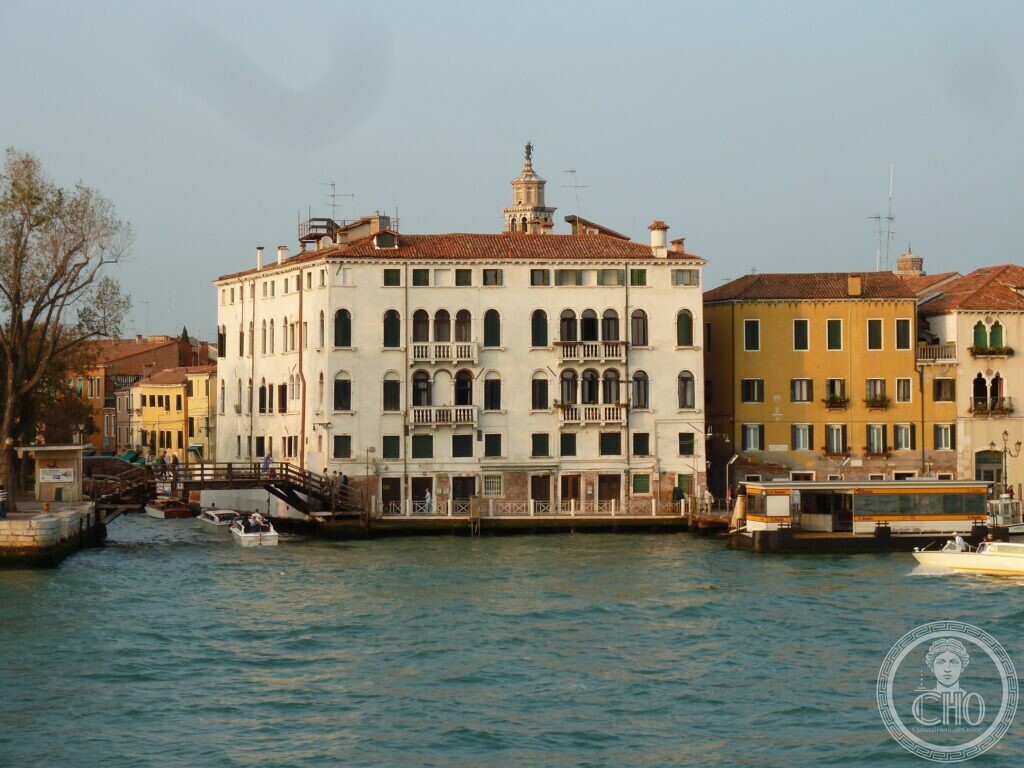
Where the Zattere begin, by the San Basilio landing stage and the cruise terminal, a white Gothic palace of the fifteenth century looks across the Giudecca Canal. It has long housed public offices, and the wooden bridge beside it carries its name.
At a glance
Palazzo Molin stands at the western end of the Fondamenta delle Zattere, the long quay along the southern shore of Dorsoduro, between the Ponte Molin and the San Basilio vaporetto stop. Guides describe it as a fifteenth-century Gothic building that now houses the river-basin authority for the Adriatic; OpenStreetMap records it as Palazzo Molin a San Basegio, from the campo behind it. The campo takes its name from the church of St Basil, San Basegio in Venetian, rebuilt after the earthquake of 1347 and later demolished: only its doorway survives.
What this page does not say. We found no monograph or official record on the palace: the fifteenth-century date and the Gothic attribution come from a guide, and the identity of the offices inside it is not confirmed by an official source. What is described below is what the photograph shows.
Key facts
- Period and style: fifteenth century, Venetian Gothic (as described by guides; no primary source found)
- Where: Fondamenta Zattere al Ponte Longo, at the San Basilio end, facing the Giudecca Canal
- Beside it: the Ponte Molin, the step-free wooden bridge at the end of the square by the San Basilio terminal; the San Basilio vaporetto stop in front
- Use: public offices; a guide names the Adriatic river-basin authority
- GPS: 45.4309, 12.3208 · Open in Google Maps (OpenStreetMap)
The place
The Zattere were paved in the early sixteenth century as the landing for the timber rafts, the zattere, and the quay has kept the name. Its western stretch, the Zattere al Ponte Longo, runs from the San Basilio area, where the cruise terminal and the university’s teaching hub now stand, to the long bridge over the Rio di San Trovaso. San Basilio itself was once a parish with a large church of its own; the church is gone, and the campo behind the palace keeps its name and the old doorway. Palazzo Molin is the first palace a visitor meets walking east from the terminal, and the only one on this stretch that a guide dates to the Gothic fifteenth century.
What you see
Four storeys in white plaster above a stone base, with the water door and a row of small square openings at canal level. The two upper floors have Gothic windows with pointed, trefoiled heads: on the first piano nobile two pairs with stone balconies on balusters, on the second a wider group of three in the middle flanked by singles, all with balconies; the attic has small rectangular windows under a shallow roof with two chimneys. The front is not symmetrical, and a larger arched window at the left of the first floor marks the main room. On the left the wooden Ponte Molin crosses the rio with its stepped ramp; on the right the yellow floating landing stage of the San Basilio stop; behind, over the roofs, the bell tower of San Sebastiano.
Do you know more about this palace?
If you know the history of Palazzo Molin a San Basegio, the family that built it, a restoration or a document about it, write to Sofia at sofia@culturalheritageonline.com or through the contact page. What arrives with a source goes into this page, with your name as the contributor.
Nearby
- Street Art in Campo San Basegio — the campo behind the palace
- Chiesa di San Sebastiano — the bell tower behind the palace, and Veronese’s church
- Palazzo Clary — the red palace further east on the Zattere, by the Ponte Longo
- Zattere V-A-C Foundation — on the same quay
Sources
- A View On Cities, Zattere, Venice: the quay from the Marittima and San Basilio to the Punta della Dogana, the paving in the early sixteenth century and the timber rafts, the lost church of San Basilio, and Palazzo Molin as a fifteenth-century Gothic structure housing the Adriatic basin authority
- Università Ca’ Foscari, Percorso accessibile dal Polo Didattico San Basilio a Palazzo Cosulich (PDF): the Ponte Molin at the end of the square by the San Basilio terminal, step-free, and the San Basilio landing stage on the Fondamenta delle Zattere
- Nizioleti di Venezia (Confartigianato Venezia), Campo San Basegio: the church of St Basil rebuilt after the earthquake of 1347, demolished, with only its doorway surviving
- OpenStreetMap, Palazzo Molin a San Basegio, Ponte Molin: the names and positions of the palace, the bridge and the church of San Sebastiano behind
Find it on the map
See this place and what’s around it →📷 Become a Cultural Heritage Online photographer
Share your photos of places: they stay published under your name as the author. The more they're seen, the more you get noticed — and soon a contest will reward the most appreciated photos.
Log in or sign up free to add a photoIs this page about you?
This page is read by travellers and heritage enthusiasts who find it on Google. Tell us how you are connected to this place and we will take it from there.