

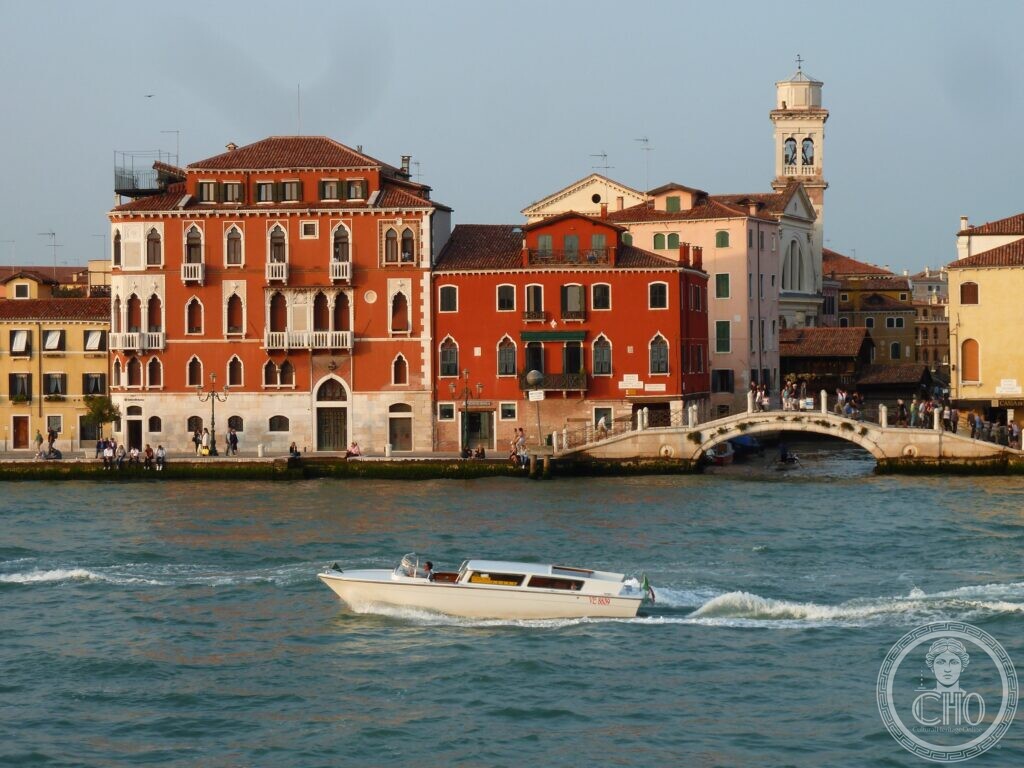
Once Palazzo Priuli-Bon, the red palace with the Gothic-arched loggias beside the Ponte Longo was bought in 1855 by an Austrian prince for his father-in-law, the diplomat Ficquelmont, and still belongs to the Clary-Aldringen family.
At a glance
Palazzo Clary faces the Giudecca Canal on the Fondamenta Zattere al Ponte Longo, next to Palazzo Giustinian Recanati on one side and, on the other, Ca’ Foscari Zattere and the long bridge over the Rio di San Trovaso. Built in the late seventeenth century for a Venetian noble family and known then as Palazzo Priuli-Bon, it was remodelled in the nineteenth century, when the pointed arches of its loggias were given the Gothic look the front has today. The name comes from Prince Edmund Clary-Aldringen, who bought it in 1855 as a residence for his father-in-law, Count Karl Ludwig von Ficquelmont, a leading figure of Austrian diplomacy, who died in Venice in 1857.
What this page does not say. The general references on the palace are the Touring Club guide to Venice and the encyclopaedia entry that draws on it; we could not consult a primary source on the building. The dates and names above are reported from those references and from the biographies of the owners, and marked where they rest on a single source.
Key facts
- Built: late seventeenth century, for a Venetian noble family (as Palazzo Priuli-Bon)
- Remodelled: nineteenth century
- Name: from Prince Edmund Clary-Aldringen, who bought it in 1855 for Count Karl Ludwig von Ficquelmont
- Later use: part of the palace served as the French consulate general after the Second World War (reported by a single reference)
- Owners today: the Clary-Aldringen family
- GPS: 45.4303, 12.3245 · Open in Google Maps (OpenStreetMap)
History
The Zattere were laid out in the early sixteenth century as the landing for the timber rafts that gave the quay its name; the palaces along the Ponte Longo stretch came later, and Palazzo Priuli-Bon was among those built in the late seventeenth century. It changed hands several times before 1855, when Edmund, fourth Prince of Clary-Aldringen, bought it for Count Karl Ludwig von Ficquelmont, the Austrian diplomat and statesman whose daughter the prince had married. Ficquelmont lived his last years here and died in Venice in 1857. The palace has carried the Clary name since, and the family still occupies part of it; after the Second World War another part was let to France as its consulate general, until the consulate moved to Trieste at the end of the 1990s.
What you see
Four storeys in deep red plaster with white stone trim. The ground floor has a pointed-arched portal on the quay and a water door. The first piano nobile is the ceremonial floor: eight single windows, the four in the middle opened into a loggia of pointed, cusped arches on a balustrade, the others in pairs at the sides. The second piano nobile repeats the scheme with a glazed four-light loggia in the middle and four single windows. The top floor has eight small square windows under a dentilled cornice, and a roof terrace rises at the left end. To the right stands the smaller red building of Ca’ Foscari Zattere, then the stone Ponte Longo over the Rio di San Trovaso, with the bell tower of San Trovaso beyond.
Nearby
- Zattere V-A-C Foundation — a few doors away on the quay
- The squero di San Trovaso — the gondola boatyard up the rio, beyond the bridge
- San Trovaso Church — the bell tower in the photograph
- The Church of Santa Maria del Rosario — the Gesuati, further along the Zattere
- Palazzo Molin a San Basegio — the Gothic palace at the far western end of the quay
Sources
- Wikipedia, Palazzo Clary (citing Guida d’Italia – Venezia, Touring Club Italiano, 1987, p. 451, and Carlo Moretti, Venice: Her Art-treasures and Historical Associations, 1872): the former name Priuli-Bon, the late seventeenth-century construction, the nineteenth-century remodelling, the loggias and the window scheme, the French consulate general after the Second World War, the family’s continued ownership. A tertiary source, used for the description and reported as such
- Wikipedia, Edmund, 4th Prince of Clary-Aldringen: the purchase of Palazzo Priuli-Bon in 1855 as a residence for his father-in-law Count Karl Ludwig von Ficquelmont
- Deutsche Biographie, Ficquelmont, Karl Ludwig Graf von: the diplomat and statesman, his death in Venice in 1857
- A View On Cities, Zattere, Venice: the quay paved in the early sixteenth century for the timber rafts
- La Biennale di Venezia, Zattere al Ponte Longo: the Ponte Longo at the foot of the Zattere stretch of the same name
- OpenStreetMap, Palazzo Clary, Fondamenta Zattere al Ponte Longo: the position, and the neighbours Palazzo Giustinian Recanati and Ca’ Foscari Zattere
Find it on the map
See this place and what’s around it →📷 Become a Cultural Heritage Online photographer
Share your photos of places: they stay published under your name as the author. The more they're seen, the more you get noticed — and soon a contest will reward the most appreciated photos.
Log in or sign up free to add a photoIs this page about you?
This page is read by travellers and heritage enthusiasts who find it on Google. Tell us how you are connected to this place and we will take it from there.