
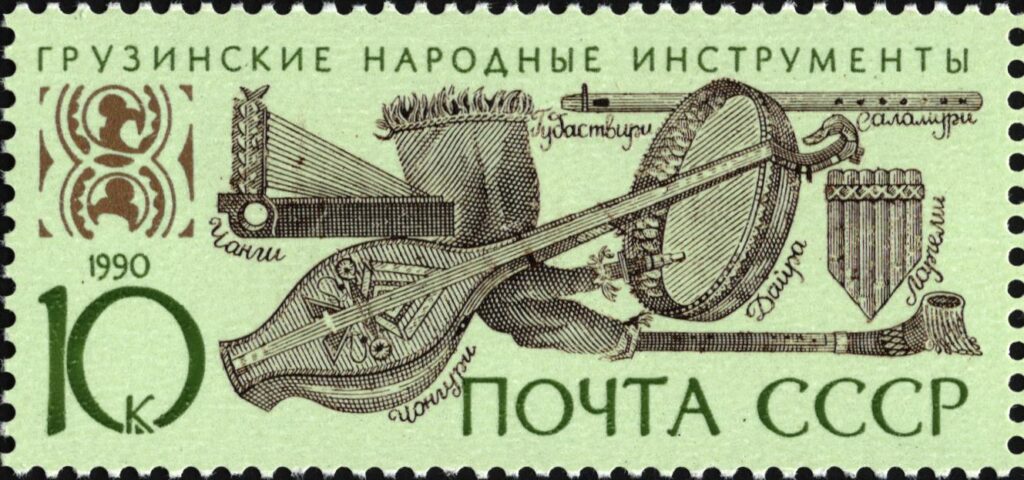
Georgian music traditions span polyphonic singing rooted in the Christian church and urban styles that blend native polyphony with Middle Eastern monophony and European harmony.
In UNESCO’s words
Popular singing has a highly valued place in Georgian culture. Polyphonic singing, in the Georgian language, is a secular tradition in a country whose language and culture have often been oppressed by invaders. There are three types of polyphony in Georgia: complex polyphony, which is common in Svaneti; polyphonic dialogue over a bass background, prevalent in the Kakheti region in Eastern Georgia; and contrasted polyphony with three partially improvised sung parts, characteristic of western Georgia. The Chakrulo song, which is sung at ceremonies and festivals and belongs to the first category, is distinguished by its use of metaphor and its yodel, the krimanchuli and a “cockerel’s crow”, performed by a male falsetto singer. Some of these songs are linked to the cult of the grapevine and many date back to the eighth century. The songs traditionally pervaded all areas of everyday life, ranging from work in the fields (the Naduri, which incorporates the sounds of physical effort into the music) to songs to curing of illnesses and to Christmas Carols (Alilo). Byzantine liturgical hymns also incorporated the Georgian polyphonic tradition to such an extent that they became a significant expression of it. Having previously suffered the drawbacks of socialist cultural policies, traditional Georgian music is now threatened by rural exodus as well as by the increasing success of pop music. In many archives one finds recordings of polyphonic songs from the beginning of the twentieth century; these recordings are, however, not secure enough to guarantee the long-term preservation.
Official description, UNESCO Intangible Cultural Heritage List — Georgian polyphonic singing
At a glance
Georgian polyphonic singing is a vocal tradition performed in the Georgian language. Three regional types exist: complex polyphony from Svaneti, polyphonic dialogue with a bass background from Kakheti in eastern Georgia, and contrasted polyphony with three partly improvised parts from western Georgia. The Chakrulo song, performed at ceremonies and festivals, features metaphorical lyrics, a yodel called the krimanchuli, and a male falsetto "cockerel's crow." Many songs date to the eighth century and are linked to the cult of the grapevine.
Origins & history
Georgian polyphonic singing is a secular tradition rooted in the country's language and culture. Byzantine liturgical hymns incorporated the Georgian polyphonic tradition so thoroughly that they became a significant expression of it. Songs traditionally accompanied all areas of everyday life—from fieldwork to healing rituals to Christmas carols—woven into the fabric of community life across centuries.
The practice
Polyphonic songs are performed by groups of singers, with the human voice as the sole instrument. The Naduri, a work song, incorporates the sounds of physical effort into its music. Performance requires skill in layered vocal lines and ornamental techniques. Singers traditionally learned and passed down these songs through community participation in daily work, ceremonies, and festivals rather than formal training.
Cultural significance
Polyphonic singing holds a highly valued place in Georgian culture as an expression of national identity during periods when the language and culture faced oppression. The tradition now faces threats from rural exodus and the rising popularity of pop music. Early twentieth-century recordings exist in archives, though their preservation remains uncertain for the long term.
Key facts
- Country: Georgia
- Inscribed: 2008
- UNESCO list: Representative List of the Intangible Cultural Heritage of Humanity
- UNESCO reference: 00008
- UNESCO vocabulary: Polyphonic singing; Vocal music
- Map: Svaneti — the locality named in UNESCO’s official description of this element
- Related World Heritage site: Upper Svaneti (a different UNESCO designation, not the place of the tradition)
Where to experience it
Georgian polyphonic singing thrives across the country's distinct regions, each maintaining characteristic styles. The complex polyphony of Svaneti, the polyphonic dialogue traditions of Kakheti in Eastern Georgia, and the contrasted three-part singing of western Georgia represent living practices within their communities. Visitors can encounter these songs at ceremonies, festivals, and cultural gatherings, while recordings from the early twentieth century document the depth of this heritage. Georgian performers also appear on international opera and concert stages, bringing these ancient vocal traditions to audiences worldwide.
Sources & resources
- UNESCO — official element page: Georgian polyphonic singing
- UNESCO — open data record: Intangible Heritage List, reference 00008
- UNESCO — official video: UNESCO film on this element — embedded on this page
- UNESCO — official photograph: Polyphonic singing is a popular tradition that used to pervade all areas of everyday life in Georgia, ranging from field work to songs for curing illnesses and Christmas carols. There are three types of polyphony in Georgia, each performed in a different region. — Research Center of Traditional Poliphony
- Reference — Wikipedia (secondary): Music of Georgia (country) — consulted as a secondary reference, not as confirmation
- Cultural Heritage Online: Our archive and city guides

Find it on the map
See this place and what’s around it →📷 Become a Cultural Heritage Online photographer
Share your photos of places: they stay published under your name as the author. The more they're seen, the more you get noticed — and soon a contest will reward the most appreciated photos.
Log in or sign up free to add a photo