
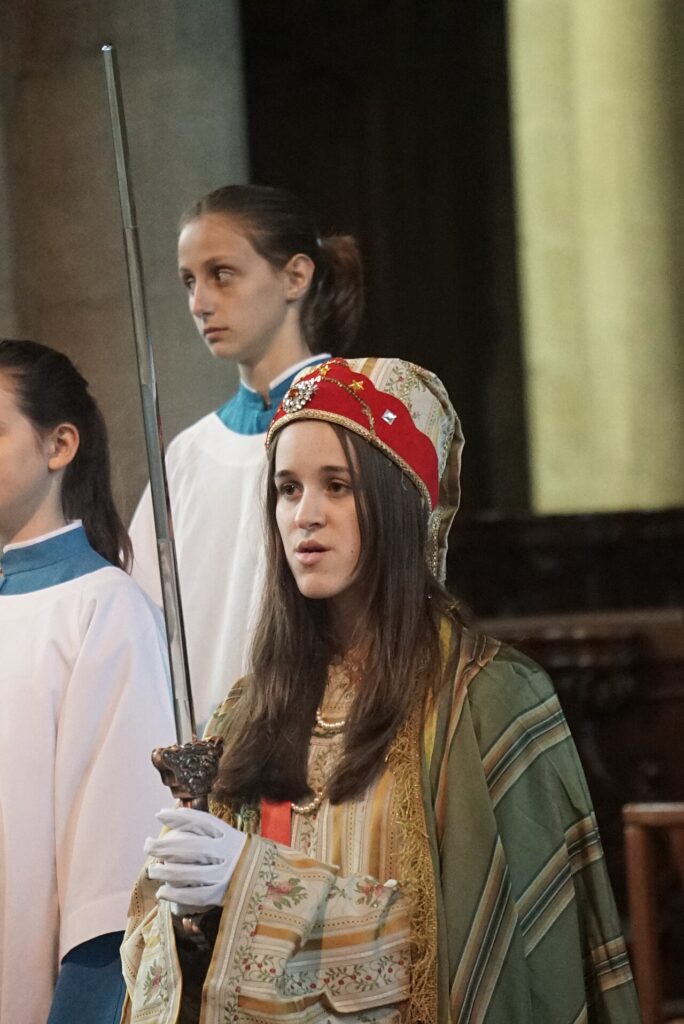
A medieval Gregorian chant performed on Christmas Eve in Catalan churches, in which a sibyl sings a prophecy of the Apocalypse, unbroken since the Middle Ages.
In UNESCO’s words
The chant of the Sybil is performed at matins on the night of 24 December in churches throughout Majorca. The chant marks the annual Christmas Vigil, and is sung by a boy or girl accompanied by two or more altar boys or girls. During the chant they walk through the church towards the chancel, the singer carrying a sword in his or her hands, held upright in front of the face, while the altar boys or girls carry candles. At the end of the song a cross is drawn in the air with the sword. The versions of the chant performed on the island vary little from their Gregorian roots: each is sung a cappella with music between the verses provided by an organ. The costume worn by the singers usually consists of a white or coloured tunic, sometimes embroidered around the neck and hem, and often worn with a cape. The head is covered with a cap of the same colour as the tunic. The rite involves all the church parishes on Majorca with old and young generations working side-by-side as singers, costume-makers, celebrants and other helpers, thus ensuring its transmission.
Official description, UNESCO Intangible Cultural Heritage List — Chant of the Sybil on Majorca
At a glance
The Chant of the Sybil is a liturgical song performed at matins on Christmas Eve night in churches throughout Majorca. A boy or girl sings the chant while walking through the church toward the chancel, carrying a sword held upright before the face. Two or more altar boys or girls accompany the singer carrying candles. The song is sung without instrumental accompaniment, though an organ provides music between verses. At the chant's end, a cross is drawn in the air with the sword.
Origins & history
The chant has deep roots in the Gregorian tradition, and the versions performed across Majorca maintain these musical foundations with little variation. The practice has been maintained through continuous performance over generations, with the rite involving all church parishes on the island. This ensures the transmission of the tradition through the participation of both old and young generations.
The practice
During performance, the singer wears a white or coloured tunic, sometimes embroidered at the neck and hem, often accompanied by a cape, with a matching cap covering the head. The singer carries a sword upright in front of the face while proceeding through the church, while accompanying altar boys or girls carry candles. The chant is sung a cappella with organ music provided between verses. The performance concludes with a cross drawn in the air using the sword.
Cultural significance
All church parishes on Majorca participate in the rite, creating a community practice that involves singers, costume-makers, celebrants and other helpers across generations. This intergenerational participation—old and young working together—directly ensures the tradition's survival and transmission to future generations, embedding the chant within the living practice of the island's churches.
Key facts
- Country: Spain
- Inscribed: 2010
- UNESCO list: Representative List of the Intangible Cultural Heritage of Humanity
- UNESCO reference: 00360
- UNESCO vocabulary: Vocal music
- Map: Majorca — the locality named in UNESCO’s official description of this element
Where to experience it
The chant is performed at matins on Christmas Eve in churches throughout Majorca, where it forms part of the island's living liturgy. Visitors can experience this centuries-old tradition by attending a Christmas Eve service in any of the parish churches across Majorca, where a young singer in ceremonial tunic and cap carries a sword while altar assistants hold candles. The performance remains deeply rooted in local communities, with generations of families participating as singers, costume-makers, and supporters, ensuring the tradition's continuity through collective practice and celebration.
Sources & resources
- UNESCO — official element page: Chant of the Sybil on Majorca
- UNESCO — open data record: Intangible Heritage List, reference 00360
- UNESCO — official photograph: Photograph of this element — Donald Murray — Donald Murray
- Reference — Wikipedia (secondary): The Song of the Sibyl — consulted as a secondary reference, not as confirmation
- Cultural Heritage Online: Our archive and city guides

Find it on the map
See this place and what’s around it →📷 Become a Cultural Heritage Online photographer
Share your photos of places: they stay published under your name as the author. The more they're seen, the more you get noticed — and soon a contest will reward the most appreciated photos.
Log in or sign up free to add a photo