
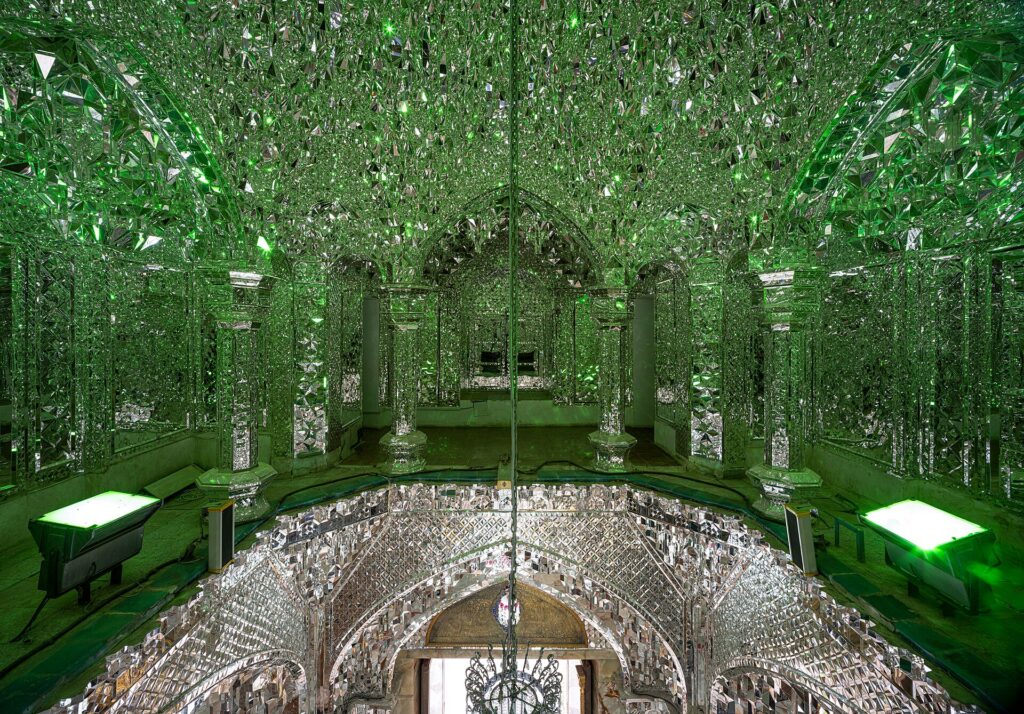
Iranian artisans assemble finely cut mirrors into geometric, calligraphic and botanical forms that fragment light into intricate abstract patterns. This ancient decorative practice also serves as a durable protective covering for interior walls and ceilings.
In UNESCO’s words
Ayeneh-Kari, or mirror-work, refers to the handcrafted art of decorating architectural surfaces such as ceilings, walls, domes, columns and panels using cut pieces of mirrors. The process entails cutting and shaping mirrors into geometric patterns or organic shapes and gluing them onto the surfaces to create designs that reflect light and brighten the space. The art combines several skills, from design, mirror cutting and plastering to painting and mosaic work. For practising communities, mirrors and water are symbols of purity and illumination, and Ayeneh-Kari embodies the importance of light and enlightenment. The practice of Ayeneh-Kari is passed down both informally through apprenticeships and workshops and formally through universities, non-governmental organizations and training institutes. In most cases, Ayeneh-Kari is a career transmitted across several generations, taught by grandfathers, fathers and uncles to descendants. Ayeneh-Kari masters occupy a highly respected social position, and the art is recognized simultaneously as a luxurious and spiritual expression, ornamenting all kinds of traditional and contemporary spaces, from holy shrines and religious sites to royal palaces and private residences. An inclusive art form, Ayeneh-Kari is practised across various groups and continues to hold significance in both historical restoration and modern design.
Official description, UNESCO Intangible Cultural Heritage List — Ayeneh-Kari, the art of mirror-work in Persian architecture
At a glance
Ayeneh-Kari is the handcrafted art of decorating architectural surfaces with cut mirror pieces arranged into geometric or organic patterns. Artisans glue these shaped fragments onto ceilings, walls, domes, columns and panels to create designs that reflect and brighten interior spaces. The practice combines multiple skills including design, mirror cutting, plastering, painting and mosaic work. For practising communities, mirrors symbolize purity and illumination, and the craft embodies the spiritual importance of light and enlightenment.
Origins & history
Mirror work emerged as a refinement of Persian interior decoration, developing its own aesthetic language over centuries. The practice reflects the broader tradition of light-play in Islamic architecture, where reflective surfaces were valued for their spiritual and practical qualities.
The practice
Artisans cut mirror into shaped pieces and glue them onto surfaces in predetermined patterns, creating geometric or organic designs. The work requires skills in design, mirror cutting, plastering, painting and mosaic work. Practitioners range from individual craftspeople to those working in formal settings, and the practice is transmitted through apprenticeships, workshops, universities, NGOs and training institutes. Ayeneh-Kari ornaments holy shrines, religious sites, royal palaces and private residences alike.
Cultural significance
Ayeneh-Kari is passed down across generations, often taught by grandfathers, fathers and uncles to their descendants as a career. Masters occupy a highly respected social position within their communities. The art is recognized as both a luxurious and spiritual expression, valued for its symbolic connection to purity and illumination. As an inclusive practice, it remains significant in historical restoration and modern design work.
Key facts
- Country: Iran (Islamic Republic of)
- Inscribed: 2025
- UNESCO list: Representative List of the Intangible Cultural Heritage of Humanity
- UNESCO reference: 02319
- UNESCO vocabulary: Decorative arts; Interior architecture; Optical instruments; Technical skills
- Map: not shown — UNESCO’s official description of this element names no locality, and a living tradition is practised across a community, not at one address.
Where to experience it
Ayeneh-kari practitioners work across various communities where the tradition remains active and valued. Visitors can encounter this mirror-work art adorning holy shrines, religious sites, royal palaces, and private residences, where it serves both spiritual and decorative purposes. Master artisans continue to pass the craft through apprenticeships and formal training at universities and institutes, maintaining ayeneh-kari's role in historical restoration and contemporary design. The tradition's combination of mirror-cutting, geometric patterning, and light-reflection techniques remains central to how communities express purity and illumination through their built spaces.
Sources & resources
- UNESCO — official element page: Ayeneh-Kari, the art of mirror-work in Persian architecture
- UNESCO — open data record: Intangible Heritage List, reference 02319
- UNESCO — official video: UNESCO film on this element — embedded on this page
- UNESCO — official photograph: An Ayeneh-Kari Master is cutting mirrors and making mirror pieces — Shahab Nikman — @IMCHTH, 2024
- Reference — Wikipedia (secondary): Ayeneh-kari — consulted as a secondary reference, not as confirmation
- Cultural Heritage Online: Our archive and city guides
