
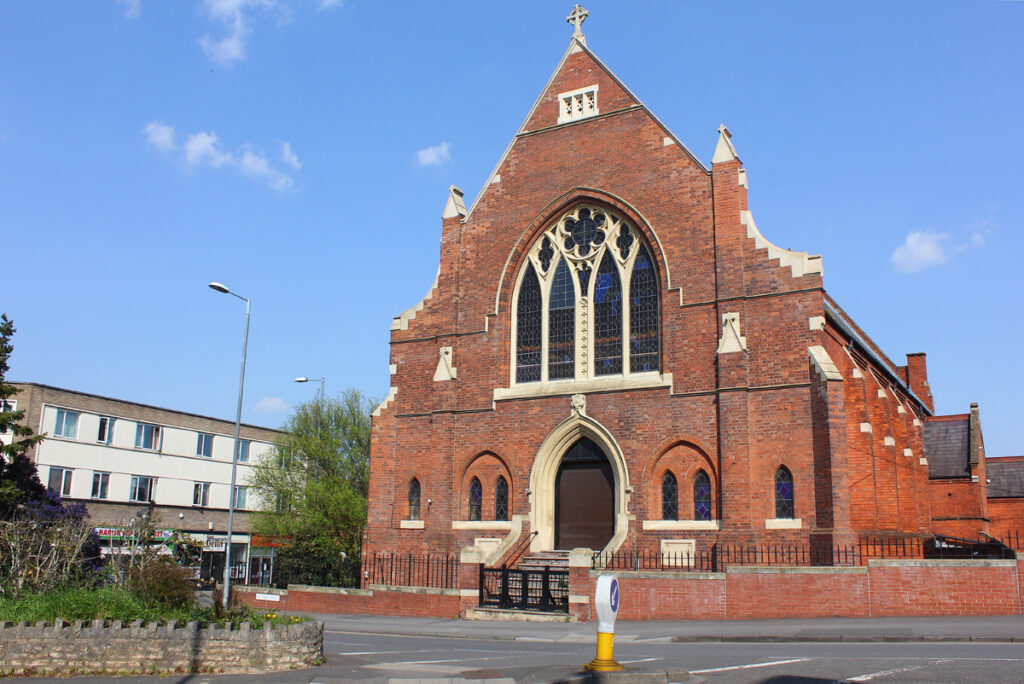

A red-brick Gothic church built for a congregation of incomers to the railway town, later a nursery, and in 2026 a church again. It is not a listed building; its history is recorded by the Victoria County History.
At a glance
Trinity Hall stands at the bottom of Victoria Road, the hill that joins Swindon’s Old Town to the new town below, at its corner with Groundwell Road. It was built in 1899 as Trinity Church for the Presbyterian Church of England, to designs by William Wallace of London, in red brick with Bath stone dressings and in the manner of the thirteenth century. The congregation left in 1990, and for years the building served as a nursery. In 2026 it was bought by Equippers Church, which has returned it to worship and begun uncovering the Victorian interior. The building is not on the National Heritage List for England, and we have not found it on a local list. We document it for its history, recorded in the Victoria County History of Wiltshire.
Key facts
- Where: Victoria Road at the corner of Groundwell Road, Swindon SN1 3AL, Wiltshire
- Built: 1899, as Trinity Church, later Trinity Presbyterian Church
- Architect: William Wallace, of London
- Materials and style: red brick with Bath stone dressings, thirteenth-century Gothic; seating for 400, with schoolrooms and vestry in the basement
- Protection: not listed
- Current use: church and community space of Equippers Church Swindon, since 2026
- Coordinates: 51.558135, -1.779238 · open in Google Maps
History
The Victoria County History of Wiltshire, in its account of Swindon’s churches, credits the Presbyterian congregation to workers who came to the town from the north of England. They first met in the Mechanics’ Institute, and in 1885 opened a lecture hall for 250 people in Dixon Street. By 1898 it was clear that, against expectations, the town was not growing in that direction, and a more central site was sought. The Dixon Street hall was sold to the Moravians, and in 1899 Trinity Church was built in Victoria Road. Local historians today tie the congregation to Scots who came to work for the Great Western Railway.
The twentieth century was uneven. In 1939 the church had 110 members, no minister, and a building in disrepair; the 1950s brought a restoration and a membership of 160. In 1978 five town-centre congregations, Trinity Presbyterian among them, closed their separate buildings and came together as one ecumenical congregation in Trinity Church, calling themselves Central Church, Swindon. In November 1990 they moved to the new Pilgrim Centre, built on the site of the Baptist Tabernacle.
Renamed Trinity Hall by its new users, the building became home to a day nursery and was renovated in 2015. Later plans approved for offices and thirteen flats were overtaken when Equippers Church bought the building early in 2026, obtained permission for religious use and received the keys that summer. Services began at once while volunteers and builders worked around them. Removing modern partitions and a raised floor has uncovered stained glass, a hardwood herringbone floor and the Victorian timber roof, which the local historian Graham Carter called “possibly the greatest roof in Swindon”.
What you see
The photograph shows the church’s gabled front from across the road junction. It is built of red brick with pale stone dressings. The centre of the gable is filled by one large pointed window divided into lights, with stone tracery of circles in its head, set in a stone frame. Below it a pointed doorway with a moulded stone surround stands at the top of a flight of steps, flanked by small round-headed windows with coloured glass. Buttresses at the corners and to either side of the centre are stepped and finished with stone copings and small pinnacles, and a stone cross stands on the apex above a small opening near the top of the gable.
The church sits above a brick boundary wall with iron railings, and the side wall running back along the street shows a row of tall windows between buttresses. Inside, not visible here, a later floor was inserted across the height of the old church; it cuts across the lower part of some of the stained-glass windows, while the timber roof survives above.
Practical information
- Trinity Hall is used by Equippers Church for services; restoration work is continuing.
- The church plans a community café opening onto the street and an auditorium for events and performances.
- The exterior can be seen from Victoria Road and Groundwell Road at any time.
Getting there
Trinity Hall is at the foot of Victoria Road, close to Regent Circus and the town centre, and within walking distance of Swindon railway station. Buses serving the town centre stop nearby.
Nearby
- Holy Rood Church, the Catholic church a short walk away.
- The Town Hall at Regent Circus, listed Grade II.
- The former Technical School on Victoria Road, listed Grade II.
- The former Clarence Street School, listed Grade II.
Sources
- A History of the County of Wiltshire, vol. 9, Swindon: Churches (Victoria County History): the Presbyterian Church of England in Swindon, Dixon Street hall (1885), Trinity Church built 1899 in Victoria Road to designs by William Wallace of London, red brick with Bath stone dressings, 13th-century style, 400 seats, basement schoolrooms; membership 1939 and 1950s.
- Central Church Swindon, Our Story: the union of five congregations in Trinity Church in 1978 and the move to the Pilgrim Centre in November 1990.
- Swindon 24, 5 September 2026: purchase by Equippers Church, permission for religious use, features uncovered, inserted floor, plans, Graham Carter’s remarks.
- Duncan and Mandy’s Swindon website, Trinity Presbyterian Church: position at Victoria Road and Groundwell Road, renaming as Trinity Hall, nursery use and the 2015 renovation.
- Historic England, National Heritage List for England (open data): no entry for the building; the Town Hall (1355877), former Technical School (1418756) and Clarence Street School (1389600) are listed Grade II.
- OpenStreetMap: building footprint on Victoria Road, SN1 3AL.
Find it on the map
See this place and what’s around it →📷 Become a Cultural Heritage Online photographer
Share your photos of places: they stay published under your name as the author. The more they're seen, the more you get noticed — and soon a contest will reward the most appreciated photos.
Log in or sign up free to add a photo