

A French religious order bought a gentleman’s house on a hill outside Paignton, through a local miller so that the seller would not know who the buyer was, and added a Gothic chapel with a statue of the Virgin that sailors used as a landmark. In 2026 the town’s residents took it over for £1.
At a glance
The former monastery stands off Berry Drive, on high ground on the western side of Paignton. It was the house of the Marist Fathers from 1883 to 1971: a Victorian villa called Quarry House, turned into a religious house, with a chapel opened on 14 June 1883. On the roof above the chapel’s eastern gable stands a cast-iron statue of the Virgin and Child, once lit at night and used by boats returning to harbour. After the Marists left, Torbay Council owned the chapel for more than fifty years and it housed a series of community groups. In August 2026 the council handed the keys to Paignton Monastery CIC, a community company formed to restore it. The chapel is not on the National Heritage List for England; its history has been written up by the Paignton Heritage Society.
Key facts
- Where: Berry Drive, Paignton, Torbay, Devon
- Built: work began at the end of 1882; the chapel opened on 14 June 1883
- Designed by: plans drawn up by Fr Desrosier of the Marist order; built by the local builder Frederick W. Vanstone
- The chapel: Gothic, single nave with a wagon-shaped vaulted roof, 78 ft long, 31 ft wide and 58 ft to the apex; cast-iron statue of Our Lady on the roof above the eastern gable
- Protection: not listed
- Owner: Paignton Monastery CIC, since 2026
- Coordinates: 50.435596, -3.575555 · open in Google Maps
History
Until the 1880s Paignton had no Catholic place of worship; the nearest was Our Lady of the Assumption in Abbey Road, Torquay, opened in 1854. In 1881 a property called Quarry House, high on a hill just outside the town, was bought for £6,000 from Charles Henry Spragge, a captain of the Royal Artillery. The Paignton Heritage Society tells how the sale went through in the name of William Henry Rossiter, the owner of the mill in Littlegate Road, acting for the order’s procurator Fr Pimore, because Spragge would probably not have sold to a Catholic priest. The house stood in 22 acres.
The Marist Fathers turned the house into a monastery and added a chapel. Work began at the end of 1882, and the chapel opened on 14 June 1883 with a Pontifical Mass sung by the Bishop of Plymouth, attended by Benedictines, Augustinians, Jesuits, Redemptorists and Basilians. Hundreds of students passed through on their way to the priesthood, but numbers fell after 1900 and had dried up by the end of the First World War, when the order’s administration in Lyon chose to keep its students in France. The house then lived on the sale of garden produce and the letting of rooms. Because the hill was a steep climb for townspeople, the parish opened a church in the town itself, a former Baptist chapel blessed in 1898, followed by the Sacred Heart Church in 1931.
The Marists stayed until 1971, when the property was sold to Torbay Council. The chapel then served the Lions’ Club, Victim Support, a children’s project, a food bank and a family support centre, and was empty from 2017. The council put it up for sale; residents asked for it to stay in community use, and in December 2025 the council’s Cabinet agreed to transfer it to a residents’ company for a nominal £1, with a covenant limiting it to community use. The keys were handed over in August 2026.
What you see
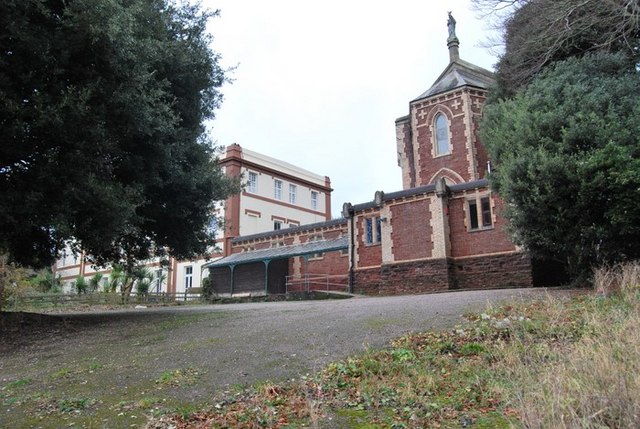
The photograph looks up a gravel drive towards the buildings, framed by large evergreen trees. On the right is the chapel’s eastern end: a tall block of red walling with pale stone quoins and dressings, a pointed window high up, and on the very top a slender pedestal carrying the statue, a standing figure against the sky. The lower courses of the walls are of darker red stone. In front of the chapel runs a lower range with a pitched slate roof and a light veranda carried on thin posts.
Behind, to the left, rises a three-storey house painted cream, with red trim at the corners and along the eaves: the former monastery buildings. The Heritage Society describes the chapel inside as a single nave under a wagon-shaped vaulted roof. Local accounts note that the statue, once visible from most of Paignton, is now largely hidden by the trees that have grown up around it.
Practical information
- The chapel is owned by Paignton Monastery CIC, a community company that is restoring it for heritage, education, arts and community use.
- Volunteer days, consultations and events are announced by the CIC, which is the contact for access to the building.
- The former grounds of the monastery are public woodland.
Getting there
The monastery is on the hill west of Paignton town centre, reached from Berry Drive. Paignton railway and bus stations are in the town centre below; from there the climb up to Berry Drive is steep.
Nearby
- Winner Street, below the hill, with several listed buildings including the Globe Inn, listed Grade II.
- The Paignton Clink and its adjoining walls, listed Grade II.
- Southfield Methodist Church, listed Grade II.
- In Torquay, along the bay: the Pavilion Theatre and St John’s Church.
Sources
- Paignton Heritage Society, The Marist Order in Paignton (Sarah Hemingway, 2021): purchase of Quarry House in 1881, the Rossiter story, Fr Desrosier and F. W. Vanstone, opening on 14 June 1883, dimensions, statue, decline of the seminary, sale to Torbay Council in 1971 and later uses.
- Torbay Council, press release PR9557, 7 August 2026, Community-focussed future secured for Old Monastery in Paignton: Cabinet approval in December for transfer at £1, covenant and overage clause, handover of the keys to Paignton Monastery CIC.
- Torbay Communities, Paignton’s vacant monastery could serve the community once again: local red sandstone, empty since 2017, grounds now public woodland.
- Paignton Monastery CIC: aims of the restoration project.
- Geograph photographs by Paul Hutchinson and Richard Dorrell (via Wikimedia Commons): statue on the eastern end, obscured by trees; chapel used as a community centre from 1978.
- Historic England, National Heritage List for England (open data): no entry for the monastery or chapel; nearby entries include the Globe Inn, Paignton Clink and Southfield Methodist Church.
Find it on the map
See this place and what’s around it →📷 Become a Cultural Heritage Online photographer
Share your photos of places: they stay published under your name as the author. The more they're seen, the more you get noticed — and soon a contest will reward the most appreciated photos.
Log in or sign up free to add a photo