
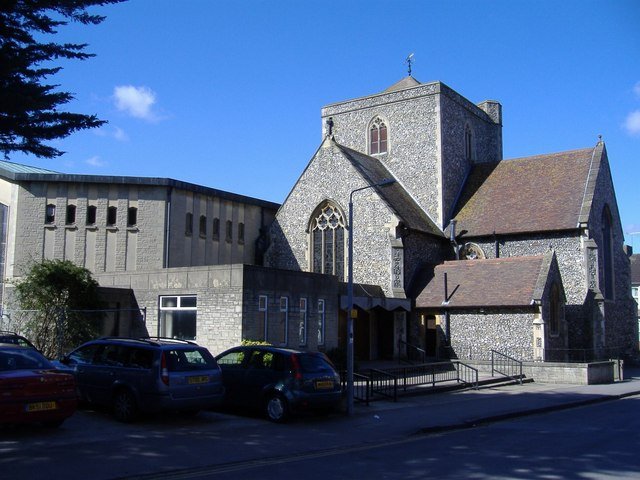
A Gothic Revival landmark that marked the return of Catholic worship to Swindon after three centuries of religious prohibition.
At a glance
Holy Rood Church stands at the intersection of Groundwell Road and Lincoln Street in central Swindon. Designed by Edward Doran Webb, this Roman Catholic parish church represents a pivotal moment in English religious history—the first Catholic place of worship constructed in and around the town since the Reformation.
History
The church began modestly as a chapel in 1851, when Swindon’s Catholic community had no permanent home for worship. By 1905, the growing congregation warranted rebuilding and expansion. The new structure replaced its predecessor on the same site, establishing a permanent Catholic presence in a town where such buildings had been absent for over 350 years.
What you see
Edward Doran Webb’s design embraces Gothic Revival principles, the dominant ecclesiastical style of Victorian England. The church’s architectural language—pointed arches, vertical emphasis, and traditional proportions—reflects nineteenth-century Anglican and Catholic aesthetics. Its position at a prominent town corner underscores its civic importance.
Cultural significance
Holy Rood Church embodies Catholic emancipation in Victorian Britain. After the Reformation, Catholic worship in England faced legal restrictions and social hostility. By 1905, legal barriers had been lifted, and Swindon’s new church proclaimed religious freedom through its public, permanent architecture. The building witnesses both architectural taste and religious tolerance.
Key facts
- Founded as a chapel: 1851
- Rebuilt as a church: 1905
- Architect: Edward Doran Webb
- Style: Gothic Revival
- Location: Swindon, Wiltshire, England
- Coordinates: 51.5585, −1.7782
Practical information & getting there
Holy Rood Church occupies a central location in Swindon, accessible from the town’s main thoroughfares. For current visiting hours and Mass times, contact the parish directly or check the Catholic Diocese of Clifton website.
Sources & resources
Find it on the map
See this place and what’s around it →📷 Become a Cultural Heritage Online photographer
Share your photos of places: they stay published under your name as the author. The more they're seen, the more you get noticed — and soon a contest will reward the most appreciated photos.
Log in or sign up free to add a photoIs this page about you?
This page is read by travellers and heritage enthusiasts who find it on Google. Tell us how you are connected to this place and we will take it from there.