
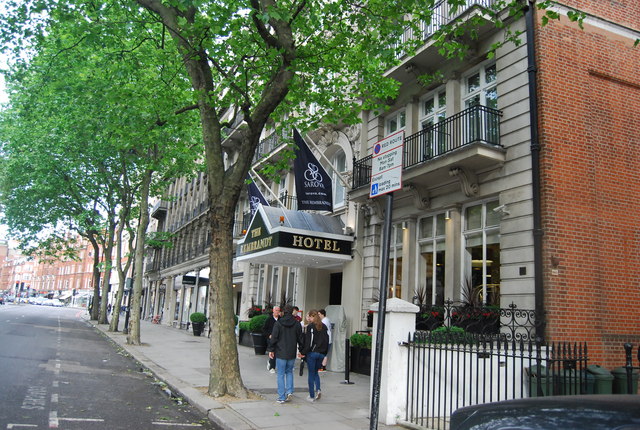

The first building of a speculative rebuilding of Thurloe Place, put up in 1910–11 a short walk from the Victoria and Albert Museum. It is not a listed building; it is recorded by the Survey of London and by the borough as a significant building of its conservation area.
At a glance
The Rembrandt stands on the south side of Thurloe Place in South Kensington, a few doors west of its junction with the Brompton Road. It was designed by the architect Delissa Joseph and built in 1910–11 by Ford and Walters of Kilburn, as the first new building of a redevelopment by Metropolis Estates Limited. In 1922 it was extended eastwards and along North Terrace behind. The building is sometimes described as Grade II listed. It is not: the National Heritage List for England has no entry for No. 11 Thurloe Place. We document it because the Survey of London describes its design and history in detail, and because the Royal Borough of Kensington and Chelsea names it among the “other significant buildings” of the Thurloe Estate and Smith’s Charity Conservation Area.
Key facts
- Where: 11 Thurloe Place, South Kensington, London SW7, Royal Borough of Kensington and Chelsea
- Built: 1910–11; extended 1922
- Architect: Delissa Joseph; builders Ford and Walters of Kilburn. Extension of 1922 by R. H. Kerr and Sons
- Developer: Metropolis Estates Limited, chaired by (Sir) Robert W. Perks
- Protection: not listed. Within the Thurloe Estate and Smith’s Charity Conservation Area (appraisal adopted 25 October 2016)
- Current use: hotel, The Rembrandt
- Coordinates: 51.495897, -0.170114 · open in Google Maps
History
The site was first built up in the late 1820s, when ten small houses called York Cottages went up here on the Alexander estate; the first lease was granted in January 1827, and the cottages were later renumbered Nos. 2–11 Thurloe Place. The Survey of London calls this corner the first part of the estate to be developed, and its houses the smallest and least prepossessing on it. Early in the twentieth century that made it the obvious place to rebuild, with the chance to widen the road at the same time.
By 1906 the estate had come to an arrangement with Metropolis Estates Limited, a company formed in 1902 under the chairmanship of Robert W. Perks, industrialist, railway lawyer and Liberal MP. A first scheme by the company’s architect, Howard Chatfeild Clarke, was rejected by the London County Council. New proposals by his successor, Delissa Joseph, were approved in 1909, and in the same year all the old houses on the site were pulled down except the Bell and Horns inn. The Rembrandt Hotel was the first new building to rise, in 1910–11. The Survey notes its close likeness to the Brompton Road front of the Basil Street Hotel, which Joseph designed at the same moment.
In 1922 the hotel was extended across part of the still-empty site to the east, adding fourteen feet to the Thurloe Place front and some sixty feet to the rear front in North Terrace, to designs by R. H. Kerr and Sons. The extension spoiled the symmetry of Joseph’s front. It was restored, in effect, by Dalmeny House next door, built in 1926–7 to designs by Horace Gilbert, whose eastern wing repeats the design of the Rembrandt’s extension; Gilbert’s plans even intended Dalmeny House’s fifth and sixth floors as extra bedrooms for the hotel. Metropolis Estates was wound up in 1928.
What you see
The photograph looks along the Thurloe Place front from the pavement. The wall is faced in pale stone, and the upper floors carry balconies with black iron railings on carved brackets. Over the entrance projects a glass canopy with the hotel’s name, flanked by flags, and plants in large pots line the pavement. Street trees stand in front of the building and hide most of its height; at the right edge, beside a stone bay with its own balcony, a red-brick building adjoins.
The Survey of London describes the whole front as balconied, with the centre projecting slightly above a tall entrance and rising at roof level to a high attic and a small dome. The borough’s appraisal counts five storeys, balconies on three floors and a central entrance with “a wealth of Classical motifs”, now partly obscured by the canopy and flags. On North Terrace behind, the long rear front is divided into seven bays, three windows wide, alternately faced in stone and red brick, with balconies in the stone bays.
Practical information
- The building is a hotel, The Rembrandt; the front can be seen from Thurloe Place at any time.
- The rear front, with its alternating stone and brick bays, is visible from North Terrace.
- Opposite the hotel stands a Victorian cabmen’s shelter of 1897, moved to this spot in the 1970s and listed Grade II.
Getting there
South Kensington Underground station (Piccadilly, District and Circle lines) is a short walk to the south-west. Buses run along the Brompton Road and Cromwell Road close by.
Nearby
- Empire House, the Continental Tyre Company’s office block of 1910–16 by Paul Hoffmann at the corner with Brompton Road, listed Grade II.
- The Victoria and Albert Museum, a few minutes’ walk to the north-west.
- Holy Trinity Brompton, a few minutes’ walk north.
- Natural History Museum on Cromwell Road and the Science Museum on Exhibition Road.
- Michelin House, on Fulham Road, a few minutes’ walk south.
Sources
- Survey of London, vol. 41, Brompton (1983), The Alexander Estate: York Cottages (1827) and their demolition in 1909; Metropolis Estates, Chatfeild Clarke and Delissa Joseph; the Rembrandt Hotel 1910–11, Ford and Walters, the 1922 extension by R. H. Kerr and Sons; Dalmeny House; the cabmen’s shelter.
- Royal Borough of Kensington and Chelsea, Thurloe Estate and Smith’s Charity Conservation Area Appraisal (adopted 25 October 2016), “Other Significant Buildings”, para. 3.258, and the historical summary.
- Historic England, National Heritage List for England (open data): no entry for 11 Thurloe Place; nearby entries 1405810 (Empire House, Grade II), 1226948 (12–16 Thurloe Place, Grade II), 1265389 (cabmen’s shelter, Grade II, listed 1988).
- OpenStreetMap / Nominatim: position, returned as The Rembrandt, 11, Thurloe Place, Brompton, SW7 2RZ.
Find it on the map
See this place and what’s around it →📷 Become a Cultural Heritage Online photographer
Share your photos of places: they stay published under your name as the author. The more they're seen, the more you get noticed — and soon a contest will reward the most appreciated photos.
Log in or sign up free to add a photoIs this page about you?
This page is read by travellers and heritage enthusiasts who find it on Google. Tell us how you are connected to this place and we will take it from there.