
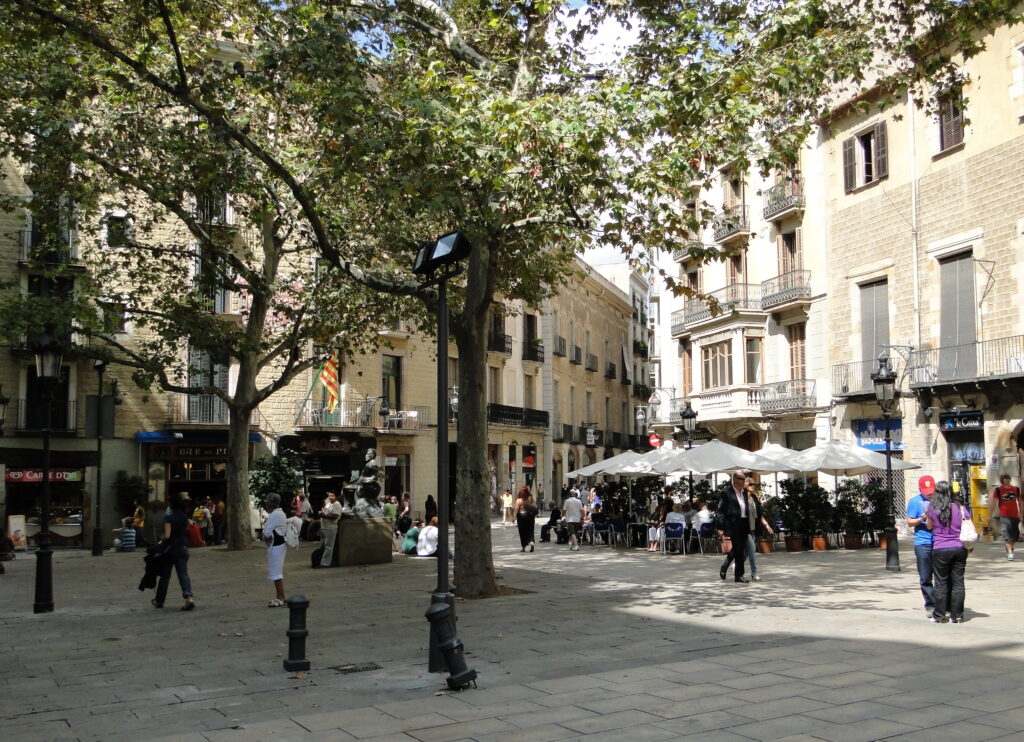

Two small squares open beside the Gothic church of Santa Maria del Pi, both laid out over its old graveyards. One house stands at the hinge between them, with a front on each. The City of Barcelona protects it, and its ground floor holds the Bar del Pi, opened in 1927.
At a glance
The house stands at Plaça de Sant Josep Oriol 1, with a second front at Plaça del Pi 6, in the Barri Gòtic of Ciutat Vella. The City of Barcelona catalogues it under the name Hotel del Jardí as a bé amb elements d’interès (level C), a residential building of ground floor and four upper floors. The municipal record describes it as closing off both squares visually and acting as the joint between the two spaces.
Its ground floor keeps the Bar del Pi, which the city lists separately as an establishment of interest for its early twentieth-century shopfront and interior. The house is also one of the protected buildings named in the city’s record for the ensemble around the church of the Pi.
Key facts
- Where: Plaça de Sant Josep Oriol 1 / Plaça del Pi 6, Ciutat Vella, Barcelona
- Date: 1872 according to the municipal catalogue; the Generalitat’s inventory entry for the bar calls the building late eighteenth century (see History)
- Original use: residential (municipal catalogue)
- Protection: bé amb elements d’interès, level C of the Barcelona heritage catalogue, record 1182; part of the protected ensemble of the church of the Pi, record 1290
- On the ground floor: Bar del Pi, founded 1927, catalogued as an establishment of interest (E2), record 4370; Inventari del Patrimoni Arquitectònic de Catalunya no. 42860
- Current use: Hotel el Jardí, with shops and the bar at street level
- Coordinates: 41.382517, 2.173986 · open in Google Maps
History
The squares around Santa Maria del Pi were once the church’s graveyards. The City of Barcelona’s record for the ensemble explains that Plaça del Pi, Plaça de Sant Josep Oriol and the small Placeta del Pi are all the result of recovering the ground of those fossars. Plaça de Sant Josep Oriol became a square in 1820 and takes its name from the beatification, in 1807, of Josep Oriol, who had held a benefice at the neighbouring church.
The same municipal catalogue gives 1872 for the house at number 1 and places it in the period 1851–1900. The Generalitat’s architectural inventory, in its entry for the Bar del Pi, describes the building as late eighteenth century. The two official sources do not agree, and we have not found a document that settles the question; the municipal record also cites building plans kept in the city archive.
According to the Generalitat’s inventory, the Bar del Pi was founded in 1927 by the Martí Pujol family, in premises that had earlier been a post house. The same entry records that the Partit Socialista Unificat de Catalunya (PSUC) was founded there on 23 July 1936; we report this as the inventory states it. The bar appears in Lluís Permanyer and Consol Bancells’ survey of Barcelona’s modernista bars and restaurants (2010), cited by the inventory.
The municipal catalogue names the whole building after the hotel that occupies its upper floors, today Hotel el Jardí.
What you see
In the photograph the house stands on the left, half hidden by the two large plane trees that shade the square. The walls are rendered in pale stucco scored into blocks, the finish the municipal catalogue describes as imitating stone. The windows are arranged in vertical lines, each opening onto a balcony with an iron railing. The catalogue adds that the openings have flat lintels, and that the balcony slabs are of metal sections, except on the first two floors of the Sant Josep Oriol front, where they are of concrete and project less as they rise.
At street level the blue awning and dark wooden front of the Bar del Pi sit in the middle of the house, next to a shop sign reading Molsa. The municipal record for the bar describes a single doorway in a modernista wooden frame, with the name on engraved glass above it and carved panels on either side framing a modern painting of a pine. Inside it lists a dark wooden bottle rack with mirrors behind the bar, a wooden mezzanine reached by a stair with turned balusters, and a black-and-white chequered floor.
In front of the bar, on a stone pedestal, is the seated statue of Àngel Guimerà. The city’s record for the ensemble notes that the monument was placed between the two plane trees when the square was reorganised.
Practical information
- The upper floors are a working hotel; both fronts can be seen from the squares at any time.
- The Bar del Pi on the ground floor is open to the public as a bar.
- The best view of the corner, where the two fronts meet, is from the middle of Plaça de Sant Josep Oriol, looking towards Plaça del Pi.
Getting there
The house is about 250 m from Liceu metro station (line L3) on La Rambla: Carrer del Cardenal Casañas leads from La Rambla straight into Plaça del Pi.
Nearby
- The Gothic church of Santa Maria del Pi, protected as a cultural asset of national interest: its main front faces Plaça del Pi and its side wall dominates Plaça de Sant Josep Oriol.
- Palau Fivaller, at Plaça de Sant Josep Oriol 4, protected as a cultural asset of local interest, on the same square.
- La Boqueria — Mercat de Sant Josep, about 200 m west.
- Liceu, the opera house on La Rambla, about 250 m south.
- Barcelona Cathedral, about 250 m north-east.
Sources
- Ajuntament de Barcelona, Catàleg de Patrimoni, record 1182 — Hotel del Jardí: level C, the date 1872, the residential use and the description of the facades.
- Ajuntament de Barcelona, Catàleg de Patrimoni, record 4370 — Bar del Pi: establishment of interest (E2) and the description of the shopfront and interior.
- Ajuntament de Barcelona, Catàleg de Patrimoni, record 1290 — Conjunt de l’església del Pi: the former graveyards, the 1820 square, its name, the Guimerà monument and the list of protected houses.
- Generalitat de Catalunya, Inventari del Patrimoni Arquitectònic de Catalunya, no. 42860 — Bar del Pi: the 1927 foundation, the post house, the PSUC in 1936 and the late eighteenth-century date for the building.
- Viquipèdia, Bar del Pi, and Wikidata Q47170760.
- OpenStreetMap / Nominatim — position and address, returned as el Jardi, 1, Plaça de Sant Josep Oriol, Santa Maria del Pi, el Gòtic, Ciutat Vella, Barcelona.
- The founding of the PSUC in the bar rests on the Generalitat inventory and on the Viquipèdia article that repeats it.
Find it on the map
See this place and what’s around it →📷 Become a Cultural Heritage Online photographer
Share your photos of places: they stay published under your name as the author. The more they're seen, the more you get noticed — and soon a contest will reward the most appreciated photos.
Log in or sign up free to add a photoIs this page about you?
This page is read by travellers and heritage enthusiasts who find it on Google. Tell us how you are connected to this place and we will take it from there.