
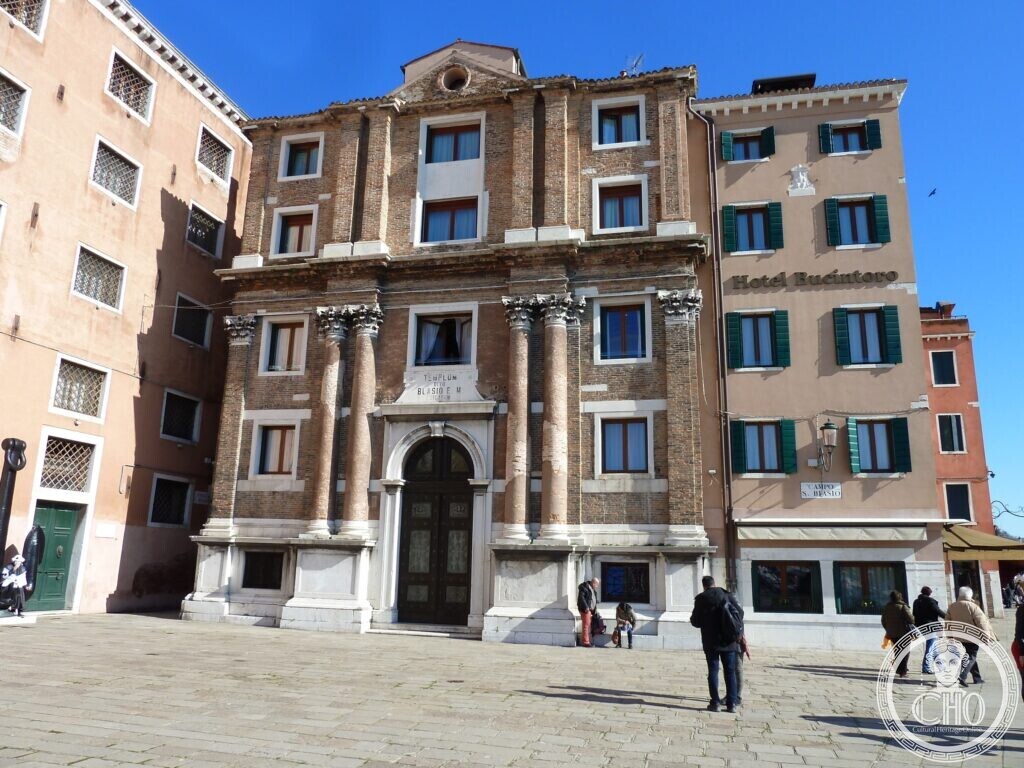
A church of red brick and white stone on the Riva di San Biagio, next door to the Naval History Museum. Greek sailors prayed here, the Austrian navy reopened it, and today it belongs to the museum.
At a glance
San Biagio, also called San Biagio dei Marinai, stands on the Riva di San Biagio in Castello, next to the Museo Storico Navale and a short walk from the Arsenale. Its present building dates from the middle of the eighteenth century. For most of its history it has been a church of seafarers: of the Greek sailors of the city before they had their own church, and then of the Austrian and Italian navies. Since 1991 it has been part of the Naval History Museum.
Key facts
- Rebuilt: in the mid-eighteenth century, completed by 1754, to a design attributed to Filippo Rossi, proto of the Arsenale; consecrated 1757
- Greek sailors: used by the Greek community for its rite before San Giorgio dei Greci
- Napoleonic era: suppressed and stripped of its furnishings
- Austrian navy: reopened as its church, with altars from the suppressed church of Sant’Anna
- Italian Navy: owner until 1958; restored and given to the Museo Storico Navale in 1991
- GPS: 45.43250, 12.35028 · Open in Google Maps
History
The sources do not agree on how old the church is. The Italian Wikipedia puts a first church here in the eleventh century; La voce del marinaio, a publication of the navy community, says it was erected in 1502 by the Boncigli family for those who landed in Venice from the sea. They agree on what followed. The Greek sailors and merchants of the city used San Biagio for their rite until they built San Giorgio dei Greci. In the middle of the eighteenth century the church was rebuilt, to a design given to Filippo Rossi, proto of the Arsenale (La voce del marinaio also names Francesco Bognolo), and it was consecrated in 1757.
Under Napoleon it was suppressed and emptied. The Austrian imperial navy reopened it as its own church, bringing in the altars and furnishings of the suppressed church of Sant’Anna. After 1866 it passed to the Italian Navy, which returned it to the State in 1958. Restored by the Magistrato alle Acque and the Superintendency, it was given in 1991 to the Museo Storico Navale. It keeps the funerary monument of Angelo Emo, whom La voce del marinaio calls the last admiral of Venice.
What you see
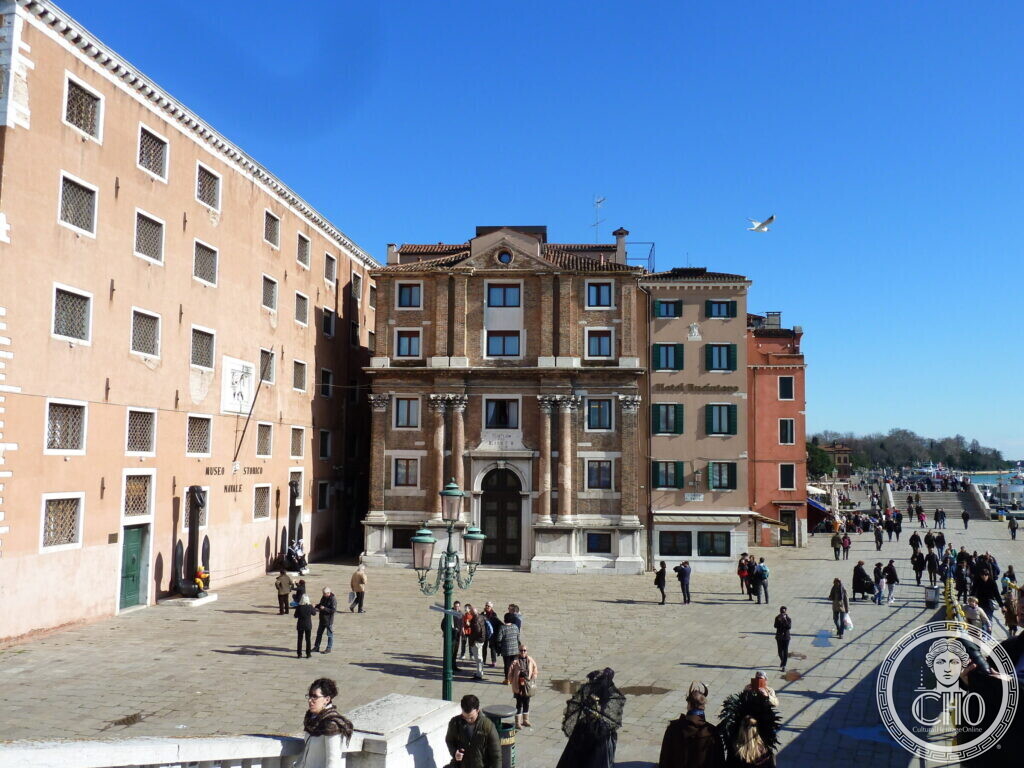
The front is in two orders, in exposed red brick framed in white Istrian stone, with paired columns on tall bases and a triangular pediment. Over the door is carved TEMPLUM BLASIO. The church stands flush with the houses of the Riva: on one side the long front of the museum, on the other the Hotel Bucintoro.
Nearby
- Venice Naval Historical Museum — next door, and the owner of the church since 1991
- Ponte San Biasio delle Catene — the 1936 bridge at the mouth of the Arsenale canal
- Venice Arsenal — whose proto rebuilt the church
Gallery
Sources
- Chiesa di San Biagio (Venezia), Italian Wikipedia: the eleventh-century origin, the rebuilding of 1749–1754 by Filippo Rossi, the consecration of 1757, the Greek community, the Austrian and Italian navies, the 1991 transfer, the Emo monument
- La voce del marinaio, La chiesa di San Biagio a Venezia: the 1502 foundation by the Boncigli, the Greek sailors, the rebuilding attributed to Bognolo or Rossi, the consecration of 1757, the suppression, the Austrian navy, the return to the State in 1958 and the 1991 transfer
Find it on the map
See this place and what’s around it →📷 Become a Cultural Heritage Online photographer
Share your photos of places: they stay published under your name as the author. The more they're seen, the more you get noticed — and soon a contest will reward the most appreciated photos.
Log in or sign up free to add a photoIs this page about you?
This page is read by travellers and heritage enthusiasts who find it on Google. Tell us how you are connected to this place and we will take it from there.