
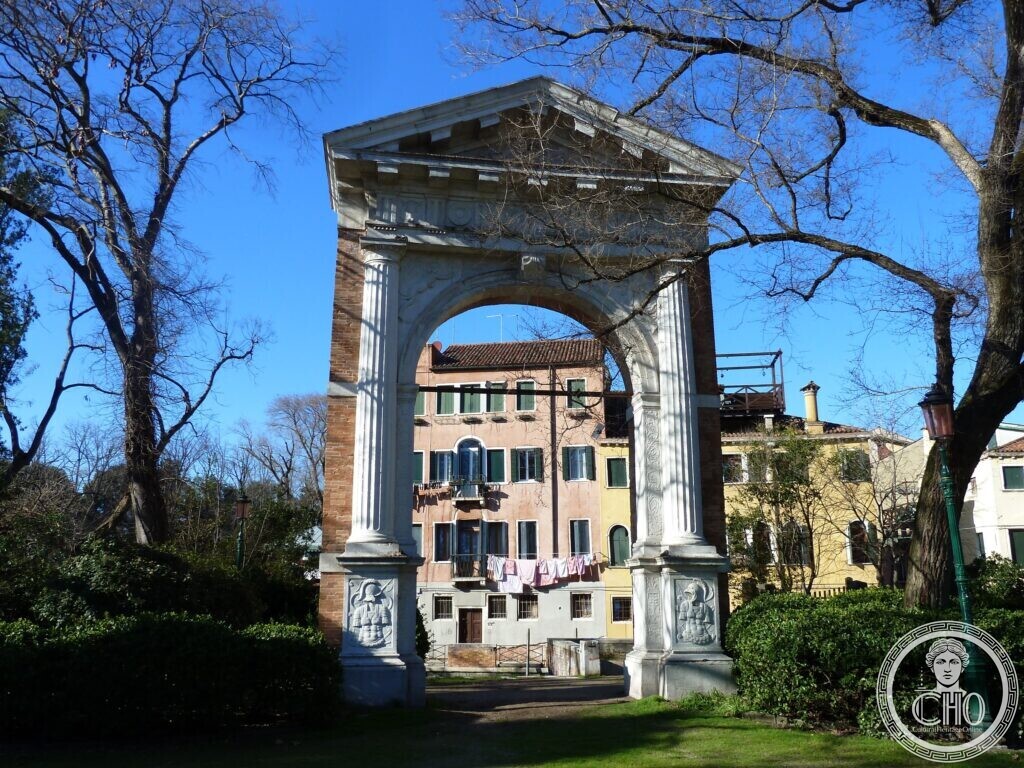
In the public gardens at the end of Castello, an arch stands on its own among the trees. It was the door of a chapel in a church that was pulled down to make the gardens.
At a glance
The church of Sant’Antonio di Castello stood at the south-eastern end of Castello until the beginning of the nineteenth century, when it was demolished, with the convent and a whole neighbourhood, to make room for the public gardens ordered by Napoleon. One piece of it survives on the spot: the arch that was the entrance to the Lando chapel, reassembled in the gardens in 1822.
Key facts
- Church: Sant’Antonio Abate, founded with its monastery in 1346
- Demolished: for the Napoleonic gardens, begun in 1807; the church came down in 1810
- The arch: the entrance to the Lando chapel, attributed to Michele Sanmicheli
- Reassembled: in 1822, after lying in pieces for fifteen years
- Buried in the church: the doge Antonio Grimani and the admiral Vettor Pisani, among others
- GPS: 45.43027, 12.35602 · Open in Google Maps
History
Sant’Antonio Abate was founded with its monastery in 1346 by fra Giotto degli Abati, prior of the canons of Saint Anthony of Vienne, and passed in 1471 to the Lateran canons of San Salvador. It held twelve altars and the tombs of the doge Antonio Grimani, the admiral Nicolò Cappello and the captain general Vettor Pisani. Its interior is known from Vittore Carpaccio’s painting of the Apparition of the Crucified of Mount Ararat in the Church of Sant’Antonio di Castello, and its front from Jacopo de’ Barbari’s view of Venice.
When the gardens were laid out, from 1807, the church, the convent and the surrounding houses were demolished. Conoscere Venezia records that the arch at the entrance of the Lando chapel, believed to be the work of Sanmicheli, lay in pieces on the ground for fifteen years before it was rebuilt in 1822.
What you see
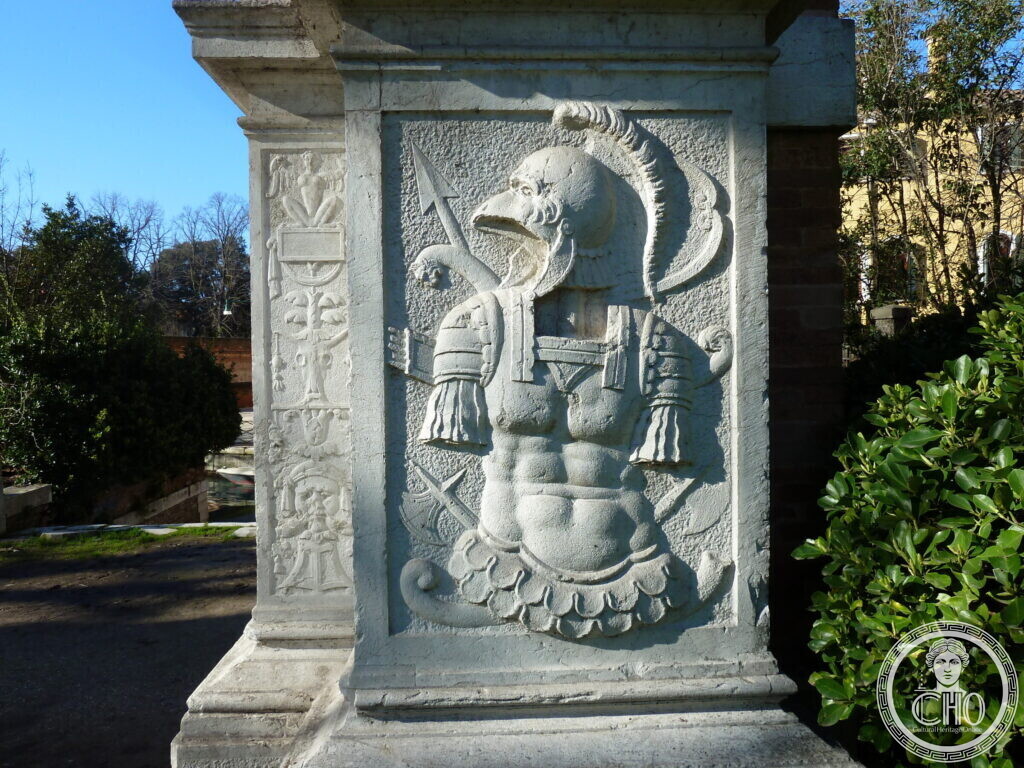
An arch framed by fluted columns under a triangular pediment, standing by itself on the lawn, so that you look through it at the houses of Castello. The pedestals of the columns are carved in relief with trophies of armour, among them a helmeted grotesque head.
Nearby
- Palazzina Canonica — the sculptor’s museum on the Riva dei Sette Martiri, a short walk west
- Sant’Elena — the Gothic church at the far end of the gardens
Gallery
Sources
- Conoscere Venezia, Rio dei Giardini: the arch of the Lando chapel, the attribution to Sanmicheli, fifteen years in pieces and the reconstruction of 1822
- Chiesa di Sant’Antonio di Castello, Italian Wikipedia: the foundation of 1346, the demolition of 1810, the tombs, Carpaccio and de’ Barbari
Find it on the map
See this place and what’s around it →📷 Become a Cultural Heritage Online photographer
Share your photos of places: they stay published under your name as the author. The more they're seen, the more you get noticed — and soon a contest will reward the most appreciated photos.
Log in or sign up free to add a photoIs this page about you?
This page is read by travellers and heritage enthusiasts who find it on Google. Tell us how you are connected to this place and we will take it from there.