
.jpg)
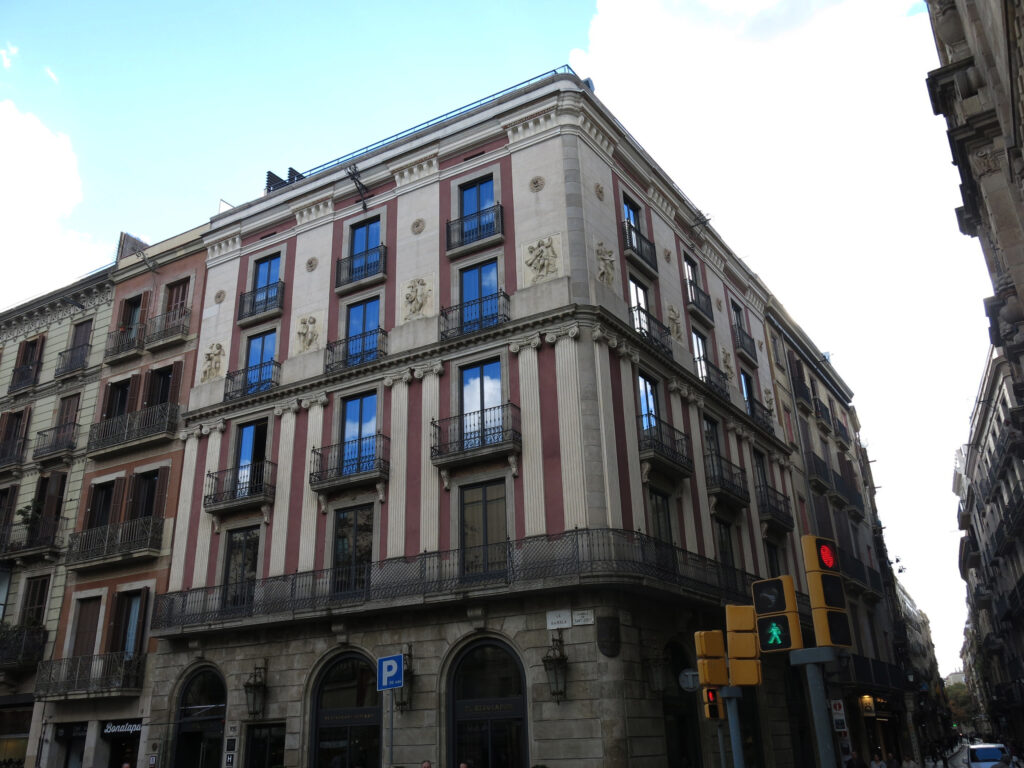
At the corner of La Rambla and Carrer del Carme, next to the church of Betlem, stands a house designed in 1850 by Josep Fontserè. Its facade of pink stucco, paired pilasters and playing children in terracotta is, in the city’s words, a notable example of Romantic-era architecture on the promenade.
At a glance
Casa Francesc Piña stands at La Rambla 105, on the corner with Carrer del Carme, beside the Baroque church of Betlem and a short walk from the Boqueria market. The City of Barcelona catalogues it as a cultural asset of local interest and describes it as a notable example of the architecture called Romantic. For most of the twentieth century its ground floor was a jeweller’s and watchmaker’s shop, and the building took its popular name from it. It is now the Hotel Bagués.
Key facts
- Where: La Rambla 105, corner of Carrer del Carme 1, Ciutat Vella, Barcelona
- Architect: Josep Fontserè i Domènech
- Date: designed in 1850 as a house of rented flats (municipal catalogue)
- Client: Francesc Piña i Aguiló, who bought the plot in 1850 (Viquipèdia, from the municipal archive)
- Protection: Bé cultural d’interès local (BCIL), level B of the Barcelona heritage catalogue, record 972
- Current use: Hotel Bagués
- Coordinates: 41.382804, 2.17158 · open in Google Maps
History
The municipal catalogue records the building as a house of flats projected in 1850 by Josep Fontserè i Domènech. According to the Catalan Wikipedia, drawing on the city archive, Francesc Piña i Aguiló bought the property in 1850 and commissioned the project, and his heirs sold it in 1887.
The ground floor gave the house its identity. The catalogue notes that it was occupied by a very old watchmaker’s and jeweller’s shop, known popularly as El Regulador, and that none of its successive shopfronts has survived, including a modernista one by Josep Bori that won a city prize in 1911. The Hotel Bagués explains the name El Regulador by a public scale at the shop’s entrance, used by passers-by and by customers of the nearby Boqueria. According to the Catalan Wikipedia the shop was bought in 1948 by the Bagués jewellers; the hotel, which takes their name, now shows Art Nouveau jewellery from the Bagués-Masriera collection in its rooms.
The building was restored in 1990–91, and the catalogue asks that any work follow the parameters of that intervention. It was later converted into a hotel; the conversion rebuilt the interior and added a recessed attic above the cornice.
What you see
The photograph shows the corner from the Rambla. The ground floor is a stone base opened by tall round arches, which the catalogue believes once contained a mezzanine. Above it a continuous iron balcony wraps round the corner on the principal floor.
The next two storeys are framed by pairs of white fluted pilasters set against pink stucco, carrying a strong entablature. Above that line, in the axis of each pair of pilasters, small terracotta reliefs of children at play stand out in white against the pink: the catalogue calls them the most attractive element of the front. Round medallions punctuate the top storey under a cornice on brackets, and the later attic is just visible behind the roofline.
Practical information
- The building is a working hotel; the facade is on La Rambla and can be seen at any time.
- Step back towards the church of Betlem, on the same side, for a view of the whole corner.
- La Rambla is crowded for most of the day; early morning is the calmest time to look at the facade.
Getting there
Liceu metro station (line L3) is about two minutes’ walk down La Rambla. From Plaça de Catalunya (L1, L3 and regional trains) the walk down the promenade takes about eight minutes.
Nearby
- La Boqueria, Mercat de Sant Josep, about 100 m down La Rambla.
- Farmàcia Nadal, a 1918 pharmacy front further up La Rambla.
- The church of Betlem, the Baroque Jesuit church immediately next door.
- The Palau de la Virreina, the eighteenth-century palace across Carrer del Carme.
Sources
- Ajuntament de Barcelona, Catàleg de Patrimoni, record 972 — Casa Francesc Piña: architect, 1850 project, level B, the description of the facade, the jeweller’s shop and the lost 1911 shopfront.
- Hotel Bagués — the hotel’s account of the building, the name El Regulador and the Bagués-Masriera jewellery.
- Viquipèdia, Casa Francesc Piña: Francesc Piña’s purchase in 1850 and later owners, from the Arxiu Municipal.
- Wikidata, Casa Francesc Piña (Q21568888): Inventari del Patrimoni Arquitectònic de Catalunya record 40488.
- OpenStreetMap / Nominatim — position and address, returned as 105, La Rambla, el Raval, Ciutat Vella, Barcelona.
Find it on the map
See this place and what’s around it →📷 Become a Cultural Heritage Online photographer
Share your photos of places: they stay published under your name as the author. The more they're seen, the more you get noticed — and soon a contest will reward the most appreciated photos.
Log in or sign up free to add a photoIs this page about you?
This page is read by travellers and heritage enthusiasts who find it on Google. Tell us how you are connected to this place and we will take it from there.