
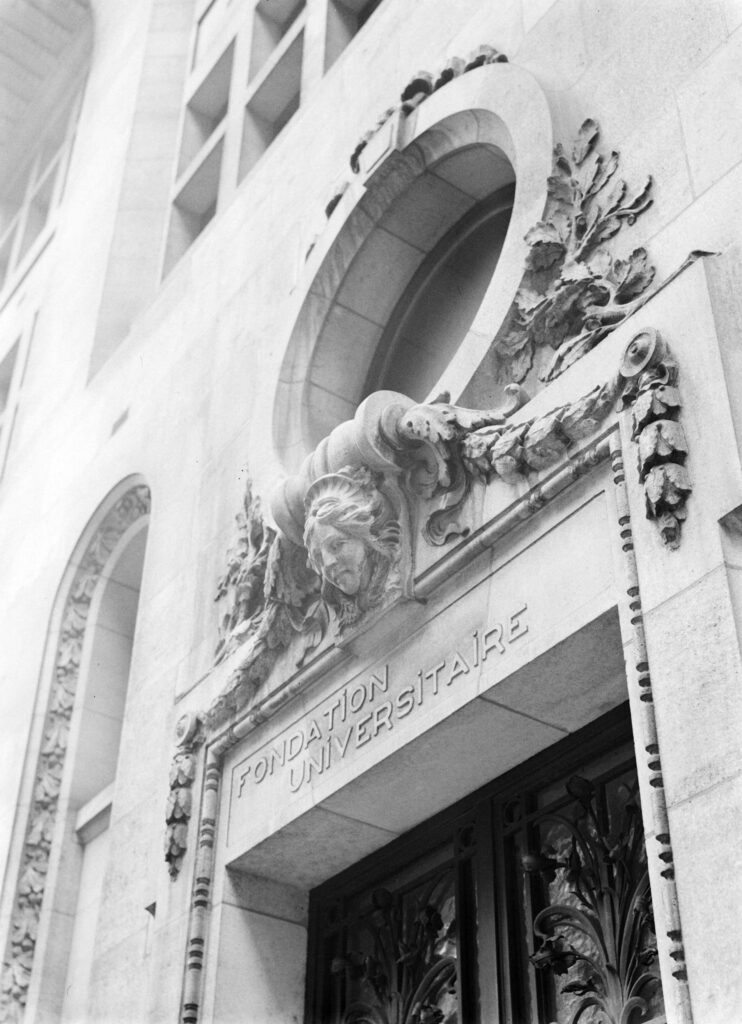

Two nineteenth-century town houses between the Rue d’Egmont and the Rue du Champ de Mars, rebuilt in the 1920s by Ernest Jaspar as the home of a foundation paid for with what was left of the First World War food-relief funds. Listed as a monument since 2015, it is still a club, a restaurant and a small hotel for academics.
At a glance
The Fondation Universitaire (Universitaire Stichting, University Foundation) was set up in 1920 to support higher education and scientific research in Belgium. Its seat runs through a block in the upper town of Brussels, with one front on the Rue d’Egmont (nos. 9–11) and the other on the Rue du Champ de Mars (nos. 30–32). The Brussels regional inventory records two phases: the original houses by Eugène Flanneau, of the 1870s, and their conversion by Ernest Jaspar in 1921–1923, with further work in 1926. The building has been legally protected (classé) since 16 July 2015.
Inside, the foundation still runs what it was built for: a members’ club with a reading room, meeting rooms, a restaurant and a hotel of twelve rooms for visiting academics.
Key facts
- Where: Rue d’Egmont 9–11 and Rue du Champ de Mars 30–32, 1000 Brussels, Belgium
- Original houses: Eugène Flanneau, architect, 1870–1880
- Conversion for the foundation: Ernest Jaspar, architect, 1921–1923 and 1926
- Styles recorded by the inventory: Eclecticism and Art Deco
- Protection: listed monument (classé) since 16 July 2015
- Inventory record: Inventaire du patrimoine architectural, Région de Bruxelles-Capitale, notice 40150
- Institution: Fondation Universitaire / Universitaire Stichting, founded 1920
- Coordinates: 50.838984, 4.365535 · open in Google Maps
History
The money behind this building came out of the First World War. During the German occupation, Belgium was fed through a relief operation organised by the American businessman Herbert Hoover and the Belgian banker Émile Francqui. When the war ended the operation had funds left over, and in 1919 Hoover proposed that they be used for the universities. Part of that capital founded the Fondation Universitaire in 1920, with Francqui as its first chairman.
The foundation needed a house that could serve as a meeting place for academics from every Belgian university and for their foreign colleagues. It found it in two town houses built in the 1870s by the architect Eugène Flanneau, standing back to back between two streets. Ernest Jaspar converted them between 1921 and 1923 and returned in 1926. The festival guide of Brussels Architecture Days (BANAD) describes the result as a building with the atmosphere of an English club. The conversion was published in the Belgian architecture review L’Émulation in 1924, and a photograph of that façade, credited to Jaspar, is held in the Ghent University Library.
In 1935 the Dutch photographer Willem van de Poll photographed the entrances and the reading room; his pictures are now in the Nationaal Archief in The Hague. One of them shows the brass plates at no. 11, Rue d’Egmont: the Fondation Universitaire, the National Fund for Scientific Research, and the Commission for Relief in Belgium. The Brussels-Capital Region listed the building as a protected monument on 16 July 2015.
What you see
The photograph shows one of the foundation’s entrances as it was in 1935. The doorway is framed in smooth ashlar, and the words Fondation Universitaire are cut into the lintel in plain capitals. Above the lintel the carving takes over: a female mask set in a scrolled cartouche, with oak-leaf garlands running up both sides of a large oval window. The door itself is filled with ironwork of heavy acanthus leaves. To the left, a tall round-arched window is framed by a carved moulding of the same kind.
According to the BANAD description, the salons, meeting rooms and study rooms have kept much of their woodwork and stucco ceilings despite later changes, and the Rue du Champ de Mars front is the one to look for: moulded details and arched windows surrounded by garlands, as in the photograph.
Practical information
- The Fondation Universitaire is a private members’ club. The club, the restaurant and the twelve-room hotel are for members, their guests and the academic community.
- The building has been part of the programme of BANAD, the Brussels architecture festival, which is the occasion to see the interiors; check the festival’s programme for current dates.
- Both street fronts can be seen from the pavement at any time.
Getting there
The Rue d’Egmont runs off the Rue du Champ de Mars in the upper town, a few minutes’ walk from the Porte de Namur, served by the metro station of the same name and by buses. The Rue de Namur, the Avenue de la Toison d’Or and the Avenue Louise are all within a short walk.
Nearby
- The former Minerva building, Rue de Namur 82, about 300 metres west, a car showroom and apartment block by Michel Polak, 1928.
- Royal Museums of Fine Arts of Belgium in the upper town.
- BELvue Museum, on the Place des Palais.
Sources
- Inventaire du patrimoine architectural, Région de Bruxelles-Capitale — Fondation Universitaire: addresses, Eugène Flanneau 1870–1880, Ernest Jaspar 1921–1923 and 1926, listed since 16 July 2015, styles; cites P. Le Clerc, “Nos Planches”, L’Émulation, 7, 1924, pp. 110–112, pl. 25–26.
- BANAD Festival — 19. Fondation Universitaire: the English-club atmosphere, the Champ de Mars front, the surviving woodwork and stucco, and the Hoover–Francqui origin of the funds.
- University Foundation — About and Hotel: founded 1920; club, restaurant and twelve-room hotel.
- Ghent University Library: photograph “Fondation Universitaire, rue d’Egmont à Bruxelles. Façade vers la rue du Champ de Mars. Ernest Jaspar, architecte”.
- Nationaal Archief, Fotocollectie Van de Poll, 1935 (entrance and reading room), via Wikimedia Commons, CC0.
- Wikipedia (fr), Fondation universitaire (Belgique): the 1919 Hoover proposal and Francqui as first chairman, used as a secondary source.
Find it on the map
See this place and what’s around it →📷 Become a Cultural Heritage Online photographer
Share your photos of places: they stay published under your name as the author. The more they're seen, the more you get noticed — and soon a contest will reward the most appreciated photos.
Log in or sign up free to add a photoIs this page about you?
This page is read by travellers and heritage enthusiasts who find it on Google. Tell us how you are connected to this place and we will take it from there.