
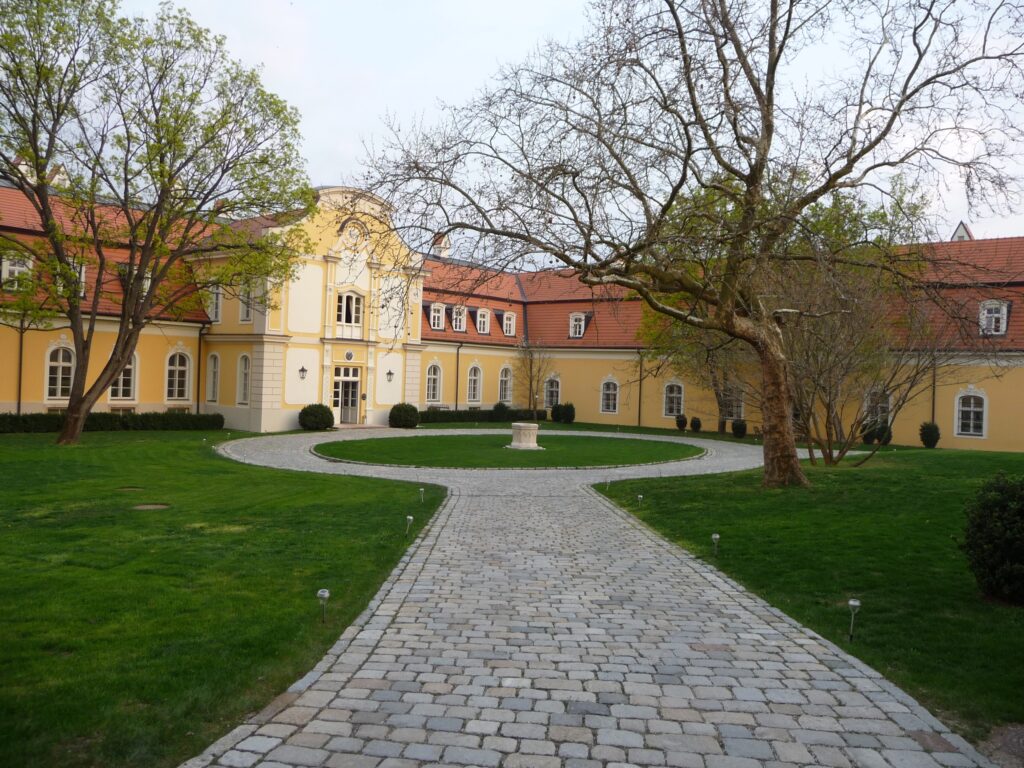

A yellow Baroque manor in a village of the Belianske hills, a few kilometres from the Danube and the dome of Esztergom. Owned in turn by the Tersztyánszky, Baldácsy and Ullmann families, used as a prison and a warehouse after 1945, it was bought back by an Ullmann descendant and reopened as a hotel.
At a glance
Belá is one of the oldest documented villages in Slovakia: its first written mention, in the charter of the Dömös provostry, dates from 1138. The manor house at its centre is protected as a national cultural monument, together with the neighbouring church of the Exaltation of the Holy Cross and the park, under the register name kaštieľ rodiny Baldácsy, the manor of the Baldácsy family. It was built or rebuilt in the Baroque style from the 1730s, passed through several noble families, and was taken by the state in 1945. After decades as a prison and a storehouse, it was bought in 2000 by Ilona von Krockow, granddaughter of its last pre-war owner, and restored.
Key facts
- Where: Belá no. 1, Nové Zámky district, Nitra region, Slovakia
- Built: 1732, by J. Tersztyánszky (Trstiansky), according to the Nitra tourist office; the manor and the adjoining church are dated 1732–1755
- Style: Baroque
- Owners: Tersztyánszky; Antal Baldácsy (Baldacci) from 1834; Adolf Ullmann from 1909–1910, then his son György
- Protection: national cultural monument, register no. 404-321/1 (manor), with the church (404-321/2) and park (404-321/3)
- Current use: hotel, reopened after restoration completed in 2007–2008
- Coordinates: 47.830642, 18.596555 · open in Google Maps
History
The village history published on the municipality’s Wikipedia page records that in 1732 the estate belonged to Jozef Tersztyánszky, who began rebuilding the manor in the French Baroque style, and that from 1770 it passed to András Török, a county governor, who built on a large scale in the village. The Nitra tourist office gives 1732 as the date of the manor and dates the manor and its church together to 1732–1755. The hotel’s own history places the completion of the chapel in 1780; the sources do not agree on every date, and we give them as each states them.
In 1834, according to the hotel, the estate was bought by Antal Baldácsy (Baldacci), of Corsican descent, who invested heavily in it; it is under his family’s name that the manor appears in the Slovak monument register today. In 1909 or 1910 it was bought by Adolf Ullmann, whom the hotel describes as a nobleman from Budapest; after his death it passed to his son György. György Ullmann left the country in 1945.
The house was then taken by the state. The Nitra tourist office lists its later uses as a prison, a vocational school, a furniture store and a paint warehouse; the hotel adds that the prison held political prisoners. In 2000 Ilona von Krockow, György Ullmann’s granddaughter, bought the manor from the state. Interiors and exteriors were restored with the help of period photographs and the memories of witnesses, and the house reopened as a hotel after the restoration, which the municipality dates to 2007.
What you see
The photograph shows the manor from its courtyard. The long two-storey wings are painted a warm yellow, with white stucco frames around the windows, each crowned by a small moulded cresting, and steep roofs of red clay tiles with a row of dormers. At the centre stands a projecting bay picked out in white and pale yellow, with pilaster strips, a French window above the entrance door and a tall curved gable with scrolls and a small oval window, the Baroque focal point of the front.
From the gate a cobbled drive runs straight towards the entrance and then divides into a ring round a circular lawn, at whose centre stands an old stone well-head. Big plane trees shade the grass on either side. The wing on the right continues as a lower range with its own dormers, closing the courtyard.
Practical information
- The manor is a hotel with a restaurant; the courtyard front can be seen from the entrance on the village street.
- The church of the Exaltation of the Holy Cross, part of the same protected group, stands beside the manor.
- The Danube and the Hungarian border at Štúrovo–Esztergom are a short drive away.
Getting there
Belá lies in the south of the Nové Zámky district, between Štúrovo and Mužla. The nearest railway station is Štúrovo, on the Bratislava–Budapest line, about fifteen minutes away by car. Bratislava is about an hour and a half by road; Budapest, across the Mária Valéria bridge and through Esztergom, a little over an hour.
Nearby
- The Baroque church of the Exaltation of the Holy Cross, next to the manor.
- Esztergom Basilica, across the Danube in Hungary, visible from the Štúrovo riverfront.
- The Mária Valéria bridge between Štúrovo and Esztergom.
Sources
- Pamiatkový úrad SR, register of national cultural monuments: Belá, kaštieľ rodiny Baldácsy (404-321/1), church (404-321/2) and park (404-321/3), as listed in Wikipedia (sk), Zoznam kultúrnych pamiatok v obci Belá.
- Nitra tourist information centre, Kaštieľ Belá: 1732, Tersztyánszky, 1732–1755, the Ullmann family, the post-1945 uses, the restoration.
- Obec Belá, official site: Baroque manor, reconstructed in 2007.
- Château Béla, history page: Baldacci 1834, Ullmann 1910, prison for political prisoners, purchase and restoration by Ilona von Krockow (the owner’s account).
- Wikipedia (sk), Belá (okres Nové Zámky): 1138 first mention, Tersztyánszky 1732, Török 1770, Ullmann 1909.
- OpenStreetMap / Nominatim: position returned as Hotel Château Bela, 1, Belá, okres Nové Zámky.
Find it on the map
See this place and what’s around it →📷 Become a Cultural Heritage Online photographer
Share your photos of places: they stay published under your name as the author. The more they're seen, the more you get noticed — and soon a contest will reward the most appreciated photos.
Log in or sign up free to add a photoIs this page about you?
This page is read by travellers and heritage enthusiasts who find it on Google. Tell us how you are connected to this place and we will take it from there.