
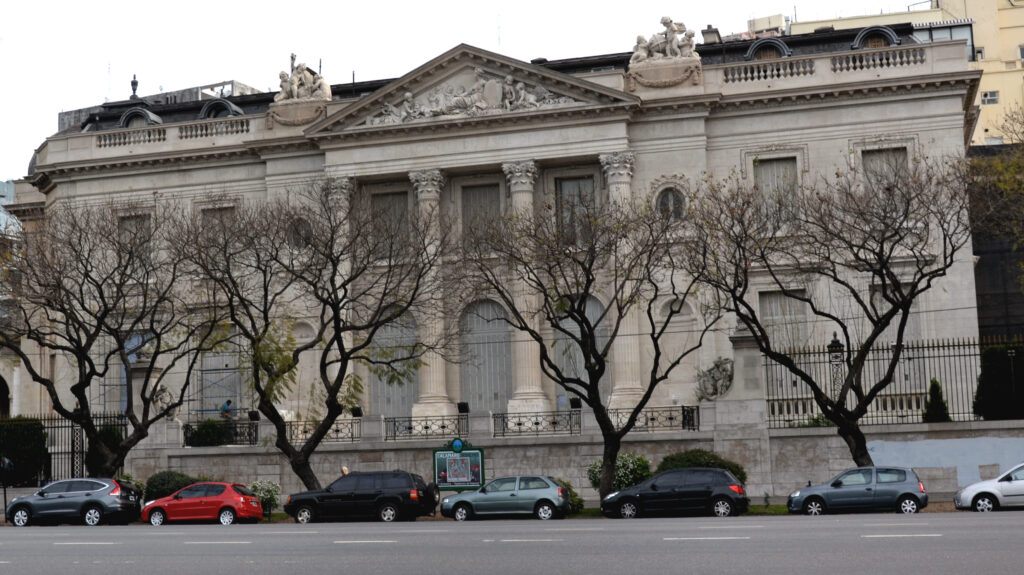

A Paris town house designed in Paris for a Chilean diplomat and his Argentine wife, built in Buenos Aires by an architect who never crossed the Atlantic to see it. Since 1937 it has been the National Museum of Decorative Art.
At a glance
The Palacio Errázuriz was the residence of Matías Errázuriz Ortúzar, Chile’s ambassador, and Josefina de Alvear. It was designed from 1911 by the French architect René Sergent in the manner of an eighteenth-century French grand hôtel particulier, and built under the direction of the Buenos Aires firm of Eduardo Lanús and Pablo Hary until 1917. In 1937 the Argentine state bought it with most of its furniture and decoration, and it opened as the Museo Nacional de Arte Decorativo. The building also houses the Argentine Academy of Letters and the National Academy of Fine Arts, and it was declared a National Historic and Artistic Monument in 1997.
Key facts
- Where: Avenida del Libertador 1902, at the corner of Pereyra Lucena, Palermo, Buenos Aires
- Architect: René Sergent (Paris); site direction by Eduardo Lanús and Pablo Hary
- Built: designed 1911, completed 1917
- Built for: Matías Errázuriz Ortúzar and Josefina de Alvear
- Size: about 4,300 m² on four floors
- Protection: Monumento Histórico Artístico Nacional, Decree 437/1997
- Current use: Museo Nacional de Arte Decorativo; seat of the Academia Argentina de Letras and the Academia Nacional de Bellas Artes
- Coordinates: -34.582611, -58.401076 · open in Google Maps
History
In 1911 three Alvear siblings went to Paris to find an architect for their houses. They chose René Sergent, a specialist in the classical French town house, and he produced three: the Palacio Bosch in Buenos Aires, now the residence of the United States ambassador; the Sans Souci palace in Victoria for Carlos María de Alvear; and this house for Josefina de Alvear and her husband Matías Errázuriz. Sergent directed the work from France and never visited Argentina. On site, the building was run by Lanús and Hary, a local firm whose partners had trained in Paris.
The couple imported craftsmen and materials from Europe for much of the work, and the First World War slowed deliveries: the house, begun in 1911, was finished in 1917. Its interiors were deliberately varied, a walk through French and English period styles, with one exception. A small salon on the first floor, for the couple’s son, was decorated in Art Deco by the Catalan painter Josep Maria Sert. La Nación notes that a Sert mural planned for the winter garden ceiling was never painted.
The family lived in the house for about twenty years. In 1937 the state acquired it, together with the best part of its furniture and art, and created the National Museum of Decorative Art. The two national academies moved into the building later. On 16 May 1997 Decree 437/97 declared the former Errázuriz Alvear palace a National Historic and Artistic Monument.
What you see
The photograph shows the side facing Avenida del Libertador, set back behind a stone base and an iron railing. It is all in pale stone-coloured facing. Four giant columns with Corinthian capitals rise through two storeys to carry a triangular pediment filled with reclining sculpted figures. On the roofline above, to either side, stand two groups of statuary with putti, and between them runs a stone balustrade. Behind it the dark slate roof shows round dormer windows in the French manner. The tall ground-floor openings between the columns are arched; the upper windows have plain moulded frames and, to the right, an oval oeil-de-boeuf in a carved surround.
The national heritage record describes the exterior as the elegance of late Louis XV architecture tempered by the neoclassicism of Ange-Jacques Gabriel. The main entrance, at the corner of Pereyra Lucena, is a wrought-iron and bronze gate opening onto a court of honour and a round entrance portico with Tuscan pilasters. Inside, the same record lists a Louis XVI vestibule, a Tudor-style hall, a Regency ballroom, a Louis XIV dining room in coloured marbles, Sert’s Art Deco salon and an Empire bedroom.
Practical information
- The building is a national museum open to the public; the Buenos Aires tourist board lists it as open Tuesday to Sunday in the afternoon, closed on public holidays. Check before going.
- The collection covers European and Asian furniture, sculpture, porcelain, painting and tapestry from the fourteenth to the twentieth century.
- The Libertador facade can be seen from the pavement at any time; the entrance court is through the gate on Pereyra Lucena.
Getting there
The palace is in the Palermo Chico district, on the Avenida del Libertador, one of the city’s main north–south arteries, with many bus routes. From Recoleta it is about fifteen minutes on foot along the avenue. Jorge Newbery airport (Aeroparque) is about four kilometres to the north-east.
Nearby
- The Museo Nacional de Bellas Artes, further along Avenida del Libertador towards Recoleta.
- MALBA, the Museo de Arte Latinoamericano de Buenos Aires, a few blocks north on Avenida Figueroa Alcorta.
- The Palacio Bosch, Sergent’s other Buenos Aires house for the Alvear family, further north on the avenue (exterior only).
Sources
- Argentina.gob.ar, Comisión Nacional de Monumentos: Antiguo Palacio Errázuriz Alvear: Decree 437/1997, address, description of the exterior and the interiors, the 1937 acquisition, the academies.
- Buenos Aires city tourist board: National Museum of Decorative Art: Sergent 1911, the couple, the collection, opening days.
- La Nación, “11 cosas que tal vez no sabías del Palacio Errázuriz Alvear” (27 July 2016): grand hôtel particulier, 4,300 m² on four floors, the unpainted Sert ceiling.
- Wikipedia (es), Palacio Errázuriz: the three Alvear commissions, Lanús and Hary, the war delays, Sergent never visiting Argentina.
- OpenStreetMap / Nominatim: position returned as Museo Nacional de Arte Decorativo, 1902, Avenida Del Libertador, Palermo.
Find it on the map
See this place and what’s around it →📷 Become a Cultural Heritage Online photographer
Share your photos of places: they stay published under your name as the author. The more they're seen, the more you get noticed — and soon a contest will reward the most appreciated photos.
Log in or sign up free to add a photoIs this page about you?
This page is read by travellers and heritage enthusiasts who find it on Google. Tell us how you are connected to this place and we will take it from there.